Pages

Thursday, February 08, 2007

Save public broadcasting

...from the good folks at Moveon.org. Please click on the link below and do your part to rescue public broadcasting in the United States.
-----------------------------------------------------------------------------
George W. Bush is trying—yet again—to slash funding for NPR and PBS. This week, Bush proposed a new budget with devastating cuts to public broadcasting. Sesame Street and other ad-free kids' shows are under the knife. So is the independent journalism our country needs.

Enough is enough. We've fought this fight before and won—but we can't afford the risk anymore. With the new Congress, we can make sure this never happens again. We need Congress to insulate NPR and PBS from the political winds.

We can make it happen if enough of us sign this petition: "Congress must save NPR and PBS once and for all. Congress should guarantee permanent funding and independence from partisan meddling." Clicking here will add your name to the petition:

http://civ.moveon.org/publicbroadcasting/o.pl?id=9851-6377474-L5dPf0j_gyEzG4IObMd1cQ&t=2

After you sign, please forward this email to your friends, family, and co-workers to keep this campaign going. We'll deliver the petition to members of Congress as they consider Bush's budget—offering a public counterpoint to this dangerous attack.

Congress can protect NPR and PBS from future cuts. The long-term solution to save public radio and TV is to:

  • fully restore this year's funding

  • guarantee a permanent funding stream free from political pressure

  • reform how the money is spent and keep partisan appointees from pushing a political bias

  • Bush's budget would cut federal funds for public broadcasting by nearly 25%. According to PBS, the cuts "could mean the end of our ability to support some of the most treasured educational children's series" like Sesame Street, Reading Rainbow, and Arthur."

    As telecommunications chair Rep. Ed Markey said, "In a 24-7 television world with content often inappropriate for young children, the public broadcasting system represents an oasis of quality, child-oriented educational programming. We owe America's children and their parents this free, over-the-air resource."

    The cuts could also decimate one of the last remaining sources of watchdog reporting on TV—continuing the partisan war on journalism led by the ex-chair of public broadcasting, Ken Tomlinson. More people trust public broadcasting than any corporate news media. President Bush would rather undermine our free press than face reporters who are asking tough questions.

    Let's put an end to the constant threats to NPR and PBS. Let's ask Congress to guarantee funding and stop partisan meddling. Clicking here will add your name to the petition:

    http://civ.moveon.org/publicbroadcasting/o.pl?id=9851-6377474-L5dPf0j_gyEzG4IObMd1cQ&t=3

    Thank you for all you do.

    –Noah, Marika, Eli, Adam G. and the MoveOn.org Civic Action Team
    Thursday, February 8th, 2007

    P.S. Our friends at Free Press have more on how to save NPR and PBS once and for all:

    http://www.freepress.net/publicbroadcasting/=policy

    Tuesday, February 06, 2007

    It's in the jeans

    Busy, busy, busy! That seems to be the word around here these days and indeed the reason for my relative quiet on Differences & Repetitions. The semester began more than a month ago with a fantastic, graduate student-initiated symposium involving folks from IU, the Universities of Illinois, Iowa, Minnesota, and Pittsburgh, UNC-Chapel Hill, and Northwestern, all of whom gathered here to discuss the relationship of rhetoric and democracy. Next came the job searches, which we've nearly wrapped up, and this week we have on tap the 11th annual IU cultural studies conference, where I'll be presenting a paper on cultural studies and academic journal publishing. Life's been something of a blur, needless to say.

    I'm writing now to discuss an article I ran across recently in The Washington Times about the Levi-Strauss Company--you know, the apparel manufacturer best known for its jeans. Well, as it turns out, the company has fallen on something of hard times of late, owing to the declining popularity of its jeans and other clothing lines. What's intriguing to me is the strategy the company has adopted to get its act back together. Rather than seriously rethinking its brand associations or updating its designs, it's taken to suing competitors who've stitched arches on the back pockets of their jeans. Levi's evidently has trademarked that detail and, publicly, at least, says that it's convinced its economic downturn is related to the piggybacking of other companies on its design.

    Really? I see this as a desperate measure on the part of a company that refuses to get creative. At bottom, I think, is the widespread presumption that Levi-Strauss--a company that's more than 130 years old--is frumpy...and I say that, admittedly, as someone who has a pair or two of Levi's hanging in my closet. Rather than spending millions of dollars to litigate arches stitched in gold thread, wouldn't it make more sense to try to create a hipper image or product line for Levi's jeans? I ask this not because I'm particularly concerned for the wellbeing of the Levi-Strauss Company, but rather because I'm discomforted by the company's leveraging its trademarks to forestall what in a reasonable world (as opposed to what Jane Gaines calls the "legal real") would amount to appropriate competition.

    Thursday, January 25, 2007

    Just say no to The Matrix

    I'm writing to declare a moratorium on scholarly books and essays on The Matrix.

    Why? First, it seems as if every other journal and book catalog I receive these days contains some new screed on one or more installments of the film trilogy. After I pointed out this phenomenon, a friend of mine in rhetoric aptly commented, "It's as if The Matrix were becoming to the humanities what Abraham Lincoln's 'Gettysburg Address' has long been to studies of public address in the United States"--which is to say, groundbreaking at one time, but at this point, overdone. Indeed, the shear volume of Matrix scholarship seems to be transforming the film into something of a trite object, so much so that the phrase, "the Matrix has you," is becoming our scholarly reality.

    Beyond that, though, a good deal--though certainly not all--of this scholarship tends to be rather boring anyway. Part of this has to do with the fact that The Matrix wears much of its potential scholarly insight on its sleeve. "Oh my! Is that Baudrillard's Simulacra and Simulations? The film must be saying something about postmodernism!" "Is that Cornel West I see? There must be something philosophical going on here!" "Hmmm....how real is our so-called waking life? Maybe the films are about epistemology!" "Cause and effect, is it? Aha! Etiology at work!" "So I've already made all my choices in life, and now all that's left to do is to find their meaning. Perhaps the films are about ontology after all!" And so on. This isn't to say The Matrix trilogy isn't valuable for, say, teaching purposes, and this isn't to say that there aren't good questions to be asked of and through the films even today. But at this point, scholars interested in writing still another book, essay, or what have you on The Matrix would do well to proceed cautiously...very cautiously.

    Lest you think I'm just a tired old crank, I will say that my favorite piece on The Matrix is Jennifer Daryl Slack's "Everyday Matrix," which is included in her edited collection, Animations [of Deleuze and Guattari]. It's a wonderful look at the mobilization of affect in, through, and beyond the first film, and in this respect it differs from many of the more textual "readings" or straightforward "philosophical" ruminations that tend to dominate the burgeoning field of Matrix scholarship.

    And yes, indeed, it's fast becoming a field--or maybe even an industry. Heck--if you need a quick publication, something on The Matrix would be a safe bet.

    Wednesday, January 17, 2007

    McClassroom

    ...courtesy of Kembrew McLeod and The Chronicle of Higher Education, a sobering "report" on the state of a liberal arts education in an increasingly corporatized university. Enjoy...?

    -----------------------------------------------------------------------------
    Chronicle Careers
    Monday, January 15, 2007
    An Educational Prank

    By Kembrew McLeod

    In a groundbreaking marketing move, six corporations sponsored my undergraduate course during the fall of 2006. To be more accurate, I should say, with a wink and a nod, that they "sponsored" the course.

    There was no contractual exchange of money or services in this faux patronage experiment and, to be honest, some of the businesses didn't want to be involved in my scheme. (One company representative, sensing the political motivations behind my endeavor, told me via an e-mail message: "You will not use the Disney logos or any connection to the Disney Co. in your class.")

    I began referring to my syllabus as a McSyllabus, and for the duration of the semester my corporately sponsored name was Professor McKembrew McLeod.

    I even planned to plaster a tweed sports coat with the logos of my pseudo-sponsors -- McDonald's, MTV, AT&T, Disney, Pfizer, and Sony Music. Kind of like a NASCAR outfit, but with elbow patches. Alas, I never went through with that part of my plan, as there were too many papers to grade and not enough time.

    My experiment was a provocation, a quiet protest that escalated near the end of the semester after a contentious move made by the University of Iowa's Board of Regents. That body had increasingly adopted a top-down management style and embraced a corporate model for the university, and demonstrated that last November by scuttling a 10-month presidential search because it didn't like the finalists.

    The board's actions inspired me to push my prank even further, and so I personally contacted each regent, telling them about my plan. It came as no surprise when one regent -- unaware of my satirical motives -- happily endorsed the idea of a corporately sponsored classroom. But more on that later.

    I should point out that I write this column from a protected position. As a newly tenured professor, I have strong free-speech rights in the workplace -- a right that is weakening across the country as colleges reduce the number of tenure-track professorships. Cutting the workforce and extracting more labor for less compensation may increase the bottom line of corporations, but it's no way to run a university, for a number of reasons.

    Close attention from faculty members was a privilege I enjoyed while attending a midsized state university in Virginia during the early 1990s. That one-on-one interaction broadened my intellectual horizons, and it transformed my life.

    But few students I have met at Iowa have had the same experience. My own department, for example, is bursting with more than 1,300 majors, but we have only 12 full-time tenured and tenure-track faculty members. Of course, some of our students do receive the special attention they deserve, but it comes from the goodwill of a faculty whose workweek easily exceeds 40 hours (not to mention our hardworking graduate students, visiting instructors, and office staff members).

    The arts and humanities have obviously been hit hard, but even "big money" units have been affected. For instance, the blossoming university-industrial complex has experienced serious consequences in certain areas of basic scientific research, where the sharing of information is becoming less and less free. As universities and their corporate partners place a greater emphasis on developing valuable patented technologies, the norm of openness among scientists has eroded.

    That has been widely documented, including in a survey of nearly 2,000 university-based geneticists the results of which were reported in the January 2002 issue of the Journal of the American Medical Association. According to the survey, a third of the scientists agreed that it was becoming more common in their field to withhold data for financial reasons.

    About three years ago I interviewed David J. Skorton, then the president of Iowa, about some of those issues. During our talk Skorton told me that he understood and took seriously the expectation that we should do "the best we can to commercialize technologies developed in the universities for the state's good."

    "But," the president quickly added, "my own point of view has been, and will remain, that I am more concerned with freedom of expression than with the commercial imperative."

    I'm sure his philosophy did not sit well with the university's regents, with whom the president had skirmished over other issues. When he left last year to become president of Cornell University, few people on our campus saw his departure as a coincidence.

    Iowa's presidential searches have always been campus-led affairs, but after Skorton announced his resignation, for the first time in the university's history, the board appointed a regent as head of the search panel and exercised unprecedented control over the committee's operations. The regents also appointed the former dean of the business college as Iowa's interim president, who is quoted in a Q&A on the university's Web site as saying that "in educational programs and in research and clinical programs, we should seek partnerships, relationships where we're not bearing all of the costs and we're sharing the rewards."

    All of which got me thinking, "What would a liberal-arts education look like if McDonald's underwrote it?"

    My project gained a new sense of urgency when the regents terminated the search for Skorton's replacement. In a cryptic press release, the regents explained that the board "needed candidates who had more experience as leaders who oversaw complex health-sciences operations as well as the myriad of other academic and nonacademic operations of a large university." The Des Moines Register reported that the final applicant pool did not include an earlier candidate who had been favored by the board president, a candidate with significant ties to the insurance industry.

    This disturbing sequence of events prompted me to send the aforementioned e-mail message to each member of Iowa's board explaining my prank in a straight-faced manner:

    "In a class exercise I thought you'd appreciate, we are imagining what it would be like if several corporations sponsored this class. In one assignment, the students will be making an advertisement for one of these 'clients,'" I wrote, adding, "Because it is so important to organize the university more like a business, I thought you would appreciate and agree with the philosophy that underpins this project."

    I concluded by mock complaining, "I believe that too many professors at the university are out of touch with real-world business practices."

    Because I contacted the regents in the middle of the presidential-search firestorm -- and given my prankish history, which is just one Google click away -- I worried about two things. Either the regents would (a) see through my sardonic rhetoric and try to have me fired for being a smart aleck, or (b) affirm the e-mail's core sentiments.

    One way or the other, it was a lose-lose proposition.

    A few days later, I received an e-mail message from one regent, who cheerfully wrote: "Conceptually, it sounds great. Happy Thanksgiving." Although this was not a smoking-gun admission -- "yes, product placement in the classroom is part of our nefarious plan for the future!" -- my suspicions were nevertheless confirmed.

    The troubles faced by the University of Iowa (and our nation's universities, more generally) run deeper than a mere bureaucratic squabble. This episode highlights the systemic problems that emerge when we try to turn the university into "an economic engine for the state," a term our administrators are fond of using.

    Perhaps I should start stitching together that logo-slathered tweed jacket after all.

    Kembrew McLeod is an associate professor of communication studies at the University of Iowa. His latest book, Freedom of Expression: Resistance and Repression in the Age of Intellectual Property, will be published this spring by the University of Minnesota Press.

    Thursday, January 11, 2007

    A promising new journal...

    ...I'm especially intrigued by the "worth a second look" book review section, and by the fact that they're publishing under Creative Commons licenses. Check it out!

    -----------------------------------------------------------------------------
    The International Journal of Communication (IJoC) is now officially launched. Volume 1, 2007, including scholarly articles, book reviews and features, is available to any interested reader, free of charge –- just go to the website, http://ijoc.org, and register.

    Our inaugural contents include articles by scholars from Australia, Canada, China, Israel, Scotland, Great Britain and the U.S. Book reviewers assess works published in the U.S. as well as Italy, the Netherlands, Scandinavia and Spain. Lawrence Grossberg inaugurates a series we hope to expand, briefly discussing books that deserve a second, or even a first look. Our feature section opens with a series of essays written in honor of our late colleague and friend, Roger Silverstone, and goes on to include an interview with theorist Fritjof Capra, a preview of global Hollywood in 2010 by Toby Miller, and an illuminating excursion into the thickets of Fair Use.

    The International Journal of Communication is an interdisciplinary journal that, while centered in communication, is open and welcoming to contributions from the many disciplines and approaches that meet at the crossroads that is communication study.

    We are interested in scholarship that crosses disciplinary lines and speaks to readers from a range of theoretical and methodological perspectives. In other words, The International Journal of Communication is a forum for scholars when they address the wider audiences of our many sub-fields and specialties, rather than the location for the narrower conversations more appropriately conducted within more specialized journals.

    Visit the journal website, register and engage with our authors and contributors –- IJoC offers readers the opportunity to comment on articles and join in dialogue and debate with authors and other readers –- and submit your own work to us, via the online submission system.

    We hope you are as excited and pleased as we are at the start of this new venture in scholarly publishing!

    Manuel Castells and Larry Gross
    Editors

    Wednesday, January 10, 2007

    Camp Gilles Deleuze

    Sorry it's been so long--nearly a month, actually! Grading finals and visiting friends and family took up most of my December, and January's brought with it a mad dash to prepare for my spring graduate seminar, "Everyday Life and Cultural Studies." In any case, I promise to write more next week, once things have died down. For now, here's an announcement for an upcoming "Deleuze Camp." No, you can't make this stuff up, and yes, it looks to be very interesting. Were I a graduate student, I certainly would save my pennies and go.

    ------------------------------------------------------------------------
    "Deleuze Camp"
    A Summer School for postgraduate students interested in the work of Gilles Deleuze.

  • Who? Ian Buchanan, Claire Colebrook, Gregg Lambert, Paul Patton and Daniel W. Smith.

  • What? A hectic combination of lectures, seminars, and workshops on the work of Gilles Deleuze lead by some of the most important Deleuze scholars writing today. The full schedule will be uploaded soon.

  • Where? The Centre for Critical and Cultural Theory, Cardiff University (Cardiff, Wales UK).

  • When? August 20 to August 24 2007. (Cut-off date for enrolment is June 29, 2007)

  • How much? £100 all inclusive for all lectures, seminars and workshops. Does not include meals or accommodation.

  • Contact? Professor Ian Buchanan buchanani@cardiff.ac.uk or 44 (0)29 2087 5619

    Check http://www.cardiff.ac.uk/encap/ for details.
  • Tuesday, December 12, 2006

    How can one be Deleuzian?

    Though it's always been more than this, Differences & Repetitions began in many respects as a Deleuze blog. At the time I was teaching a graduate seminar, "The Problem of the Media in Deleuze and Guattari," and so, perhaps unsurprisingly, Deleuzo-Guattarian philosophy was very much on my mind in the fall of 2005. In a way it often continues to be, though sometimes other issues and intellectual concerns need to take priority both in life and here on this blog. As this semester winds down, though, I find myself with just a little more time to think and write than when we're in full-swing. And here, in anticipation of composing an essay on the concept of critique, I've found myself more fully engaged once again with Deleuzo-Guattarian (mostly Deleuzian) philosophy.

    The odd thing is, inasmuch as I'm gripped by the individual and collaborative writings of D&G, and while many in my department poke fun at my "Deleuzianism" (I bring this on myself, as I have a poster of Deleuze on my office wall), my work rarely comes across as Deleuzo-Guattarian in any clear or direct way--and readers who know my writing are welcome to correct me if you think I'm wrong. Granted, I at times refer directly to the work of D&G, and I occasionally--and I really mean occasionally--pilfer ideas and vocabulary from them. Still, I don't believe that my research reads as particularly Deleuze/Guattari-inspired, at least in the same way as that of many scholars who claim an interest in D&G. I interact intensively with Deleuze and Guattari, in other words, especially in preparation for writing, but in the end I have a tendency to leave them behind.

    My question is, why? And it's this question that leads me back to Charles Stivale's brilliant question from his Two-Fold Thought of Deleuze and Guattari: how can one be Deleuzian? I suppose, for me, "being" Deleuzian (or, really, Deleuzo-Guattarian, for as someone with an alphabetically late-occurring last name, I can appreciate the travails of second authorship) means thinking with or alongside Deleuze and Guattari but doing so in the background, more than, say, employing a whole host of their concepts explicitly. So, for example, my book manuscript explores an emergent set of consumer practices that might well be describe in Deleuzo-Guattarian terms as "becoming actual." And yet, I don't use that language until the final chapter, and only then do I use it in passing. In a more general sense, my commitment to cultural studies, and thus to the idea of articulation, in many respects disposes me to think and analyze "rhizomatically." Nevertheless, I cannot really recall a time when I used that specific language in a published essay.

    I'm not trying to set out here a normative prescription by which one ought to "be" (or become) Deleuzo-Guattarian. Indeed, I think of some of the most intriguing work coming out of Deleuzo-Guattarian cultural studies, much of which refers more explicitly (and successfully, I think) to Deleuzo-Guattarian language than does my published research. Here I'm thinking of the work of Greg Seigworth, Jennifer Daryl Slack, Steve Wiley, Greg Wise, and others. Still, I wonder if, in the end, the question "How can one be Deleuzo-Guattarian?" is best answered by trying to start from their work, with the intention then of trying to move away from it. That's what's seemed to work best for me, at any rate.


    P.S. This might well be my last post of 2006, and if so, let me wish all of my readers the happiest of winter holidays and good cheer for 2007. Peace.

    Monday, December 04, 2006

    Good will

    Yes, indeed, it's been awhile. The last couple of weeks have gotten away from me, owing largely to the US Thanksgiving holiday (a much-needed break) and to the National Communication Association (NCA) conference, which took up most of the preceding week. Now we're in the last week of classes here at Indiana University, with final exams looming just around the corner. I'm still amazed at how quickly the semester's blown by.

    I'm writing largely to report on the NCA convention, and more specifically on the interesting roundtable on academic publishing and intellectual property (IP) that I mentioned in an earlier post. The session, which was organized by Mark Hayward, a really bright and interesting graduate student from my alma mater, UNC-Chapel Hill, brought together IP scholars, academic book and journal publishers, and an audience of interested parties. The panelists included, on the "academic" side of things, Mark, Kembrew McLeod, Siva Vaidhyanathan, and me, and from the world of publishing, Taylor & Francis' Tracy Roberts and NYU Press' Eric Zinner. Together, we tried to hash out the past, present, and future of scholarly publishing within the framework of intellectual property concerns.

    Some highlights--and I'll stress that this is what I heard, not necessarily what each of the participants actually said: Mark expertly introduced the panel, noting how graduate students often find themselves in quite a predicament, given that many feel as though they lack the leverage to insist on reasonable copyright provisions when they're just beginning to get their feet in the door of academic publishing. Kembrew suggested that NCA and other professional associations should formulate "best practices" statements to guide what can and cannot be incorporated into scholarly publications and how (and here, song lyrics were of particular concern). Siva, for his part, offered an impassioned and insightful history of fair use in the US and how it pertains to academic publishing, and made a plea for the use of Creative Commons licensing of academic books and journal articles.

    Tracy and Eric's contributions were equally enlightening. Tracy enumerated T&F's "retained rights" provisions, which helped to demystify the company's attitude toward journal publishing, IP, and authors (though I still wish T&F would scale back its 18-month embargo period, which restricts when authors can place PDFs of their published articles on personal websites). Eric, meanwhile, said something that delighted me. He said that much of the hullabaloo (my word) about academic publishing and IP was just that--hullabaloo, especially since the profit margins in academic book publishing in particular tend to be quite slim. He wasn't arguing that academic books should cease being copyrighted, though he did note that suing an academic author or press for copyright infringement probably wouldn't yield much in terms of financial compensation--and with that, he seemed to be suggesting that academic publishers should take a more open stance on the issue of authors' appropriating copyrighted materials in published work.

    I've shared much of what I said at the convention on D&R over the past couple of months: that academic publishing may well be headed in some nasty directions, given the looming threat (and even implementation) of unnecessarily restrictive digital rights management schemes and related changes; and that academic authors and publishers, collectively, need to recover our common ground, and perhaps more important, to respect one another's good will a great deal more. And, yes, I really mean that for both sides of the publishing world.


    P.S. I should add that our panel was programed opposite another quite intriguing panel in which the participants read and discussed rejection letters they'd received from academic journals. I'd have loved to have sat in on that session, since I gather most of the people involved have gone on to produce some of the most ground-breaking work in the field of communication studies.

    Sunday, November 26, 2006

    Reconstruction on blogging

    Reconstruction: Studies in Contemporary Culture
    Blogging Issue Publication Announcement & Call for Papers

    Reconstruction is proud to announce the publication of its Vol. 6, No. 4 (2006) themed issue, "Theories/Practices of Blogging," which can be found at http://reconstruction.eserver.org. Featured in the issue:

    * Craig Saper, "Blogademia"
    * Tama Leaver, "Blogging Everyday Life"
    * Erica Johnson, "Democracy Defended: Polibloggers and the Political Press in America"
    * Carmel L. Vaisman, "Design and Play: Weblog Genres of Adolescent Girls in Israel"
    * David Sasaki, "Identity and Credibility in the Global Blogosphere"
    * Anna Notaro, "The Lo(n)g Revolution: The Blogosphere as an Alternative Public Sphere?"
    * Emerald Tina, "My Life in the Panopticon: Blogging From Iran"
    * Various Authors, "Webfestschrift for Wealth Bondage/The Happy Tutor"
    * Lilia Efimova, "Two papers, me in between"
    * Lauren Elkin, "Blogging and (Expatriate) Identity"
    * Various Bloggers, "Why I Blog"

    Reconstruction is now accepting submissions for the following upcoming theme issues:

    * Class, Culture and Public Intellectuals (deadline: December 1, 2006)
    * Visualization and Narrative (deadline: December 15, 2007)
    * Fieldwork and Interdisciplinary Research (no deadline set)

    For individual CFP requirements and guest editor contact information, please check our "Upcoming Issues" page at
    http://reconstruction.eserver.org/upcoming.shtml.

    Reconstruction is also accepting submissions for upcoming Open Issues. The next Open Issue is scheduled for publication in Fall 2007.

    Reconstruction: Studies in Contemporary Culture (ISSN: 1547-4348) is an innovative cultural studies journal dedicated to fostering an intellectual community composed of scholars and their audience, granting them all the ability to share thoughts and opinions on the most important and influential work in contemporary interdisciplinary studies. Reconstruction publishes one open issue and three themed issues quarterly--more or less in the third week of January, April, July, October.

    Submissions may be created from a variety of perspectives, including, but not limited to: geography, cultural studies, folklore, architecture, history, sociology, psychology, communications, music, political science, semiotics, theology, art history, queer theory, literature, criminology, urban planning, gender studies, graphic design, etc. Both theoretical and empirical approaches are welcomed.

    As a peer reviewed journal, submissions to Reconstruction are read in traditional double-blind fashion, critiqued, and subsequently either returned to the author for revision or accepted for publication. In the case of disputed articles, the readers unable to come to a consensus, the article will be read by an additional reader and then, again, decided upon for future publication.

    Articles accepted for publication are done so under the following conditions: 1) If the article has not appeared in English previously, the article will not appear in publication before its publication in Reconstruction. 2) The author of said article is responsible for any and all legal complaints made against the work, and is thus financially responsible for any legal actions. 3) Any subsequent publication of the article, in any form, must acknowledge its earlier publication in Reconstruction. The author is responsible for gaining permission to use any copyrighted images or other materials.

    In matters of citation, it is assumed that the proper MLA format will be followed. Other citation formats are acceptable in respect to the disciplinary concerns of the author. For further information, please consult our Submission Guidelines found at
    http://reconstruction.eserver.org/guidelines.shtml.

    Reconstruction is indexed in the MLA International Bibliography. All submissions and submission queries should be written care of submissions@reconstruction.ws.

    Thursday, November 09, 2006

    An excuse for everything

    I love living in Indiana. I say this because living in Indiana means that I have an excuse for everything: daylight savings time. Let me explain.

    Until this past spring, Indiana was one of I believe just two states in the US that did not adhere to daylight savings time. Technically we lived all year on Eastern Standard Time, though the fact that most of the rest of the country set its clocks ahead by one hour in the spring meant that we effectively lived in two time zones. From early April to the end of October our clocks were the same as those who adhered to Central Daylight Time (most of our proximate westerly neighbors), and from early November to the end of March our clocks were the same as those who adhered to Eastern Standard Time (most of our easterly neighbors). What resulted was utter chaos and confusion, less for those of us living in Indiana than for friends and loved ones who lived elsewhere. I wish I had a dollar for the number of times someone left a message on my answering machine to the effect of, "Hi, it's me. It's 2:00 here in New York, which means it's, uh, what time is it in Indiana...?"

    Well, as it turns out, our current Governor, Mitch Daniels, wanted to settle the Indiana time zone issue once and for all. After much wrangling, this past spring Indiana finally decided to abide by daylight savings time. I gather that a few border counties opted out, but for the most part Indiana is now eastern time zone. What's resulted is still more chaos and confusion, but this time those of us living in Indiana are the ones most directly affected.

    The crux of the matter is, some folks here resent, make an excuse of, or simply don't understand the concept of daylight savings time. Not long after our first "spring ahead" time change, Indiana was inundated with destructive thunderstorms and tornadoes. A student of mine told me that a radio DJ blamed the storms on the fact that we now had an extra hour of daylight, which must be heating the earth more than usual. No kidding. Later, as summer approached, my town, Bloomington, experienced something of a minor crime wave. The culprit? Daylight savings time, giving criminals more sun by which to perpetrate their dastardly deeds. (What self respecting criminal works by daylight?) And finally, as I was watching ABC's election returns coverage on Tuesday night, the anchor blamed the loss of three Republican congressional seats here to--you guessed it--Republican Mitch Daniels' drive to get Indiana to adhere to daylight savings time.

    So, if you ever find yourself in Indiana and in trouble, you know the drill. Blame it on daylight savings time. Don't laugh. It probably will work.

    Monday, November 06, 2006

    Dee, me, & the PMRC

    First of all, if you're living in the United States, vote tomorrow. That's what's really important.

    Now on to matters at hand. I was watching one of those "totally 80s" countdown shows on VH1 the other day, when I heard the Twisted Sister anthem, "We're Not Gonna Take It," start blaring. It was such a blast from the past, especially seeing lead singer Dee Snider all decked out in the band's drag-show-gone-wrong regalia. I never was much of a Twisted Sister fan myself, though several of my friends had a penchant for drawing the band's "TS" logo all over their notebooks when we were in junior high. Even so, there's something so wonderfully anti-establishment about "We're Not Gonna Take It" that it always manages to put a smile on my face.

    Or so I thought. The "We're Not Gonna Take It" clip also included a "where are they now?" segment, which focused mostly on the comings and goings of Dee Snider since the heyday of Twisted Sister. Evidently--and perhaps this is news only to me, since I live in Indiana--he's a staunch Republican who's campaigned for Arnold "the Govinator" Schwarzenegger and other Republican candidates. I was shocked to hear this, not only because of the song's message (and here I'm reminded of the adage, "the politics of media texts aren't inscribed in media texts..."), but also because of Snider's resistance to the Parent's Music Resource Center or PMRC. For those of you who don't remember, the PMRC was founded in the mid-1980s by spouses of prominent US senators (then-Senator Al Gore's partner, Tipper, chief among them) who campaigned to censor "explicit" music. One of the more intriguing moments that I can recall from my adolescence is seeing images of Dee Snider emerging from the US Capitol after testifying on behalf of musicians opposed to the PMRC. Talk about dissonance.

    I suppose it was naive of me to assume that Snider's resistance to media censorship would carry over into a more general, left-leaning politics. Beyond that, I'm also reminded of the fact that the PMRC was composed of both Republicans and Democrats, so I guess there should have been no reason for me to assume that Snider would have been a Democrat, anyway. I guess that all just goes to show how formal governmental politics and the politics of culture aren't always commensurable and how, conversely, they sometimes make strange bedfellows.

    Monday, October 30, 2006

    Free culture badge

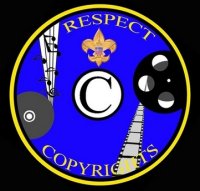
    Courtesy of Sivacracy, here's the Free Culture movement's response to the "Respect Copyright" merit badges now being issued to upstanding Boy Scouts living in and around the Los Angeles area. (Take a look at my post below for more information about the BSA's intellectual property-related initiative.) I gather that "copyleft" is the gist of the patch, which only exists in mock-up.

    Now, let's just hope some cheeky clothing designer doesn't decide to adopt "copyleft" as the name of her or his label....

    Thursday, October 26, 2006

    This has to be a joke

    I was on my way to the gym this morning, when I heard a story on NPR (this is sounding so bourgeois already) about the latest merit badge that Boy Scouts living in the Los Angeles area now reportedly can earn. It's an "anti-piracy" badge, an image of which appears at left. Evidently the movie industry is behind the whole thing, and to earn the badge Scouts need to learn some basic information about copyright law and "piracy." You can hear the full story from NPR by clicking here.

    My first reaction to this story was, "this must be a Kembrew McLeod media hoax." My second reaction was, "didn't the recording industry sue the Girl Scouts of America not that long ago for singing copyrighted campfire songs?" And my last response was, "where do I get one of those badges?"

    Any confirmation of the story's validty would be appreciated, as would a Boy Scout anti-piracy badge. You can send it to me at my office.

    Monday, October 23, 2006

    The costs of doing business

    Jonathan Sterne's Superbon! has been a wellspring of inspiration lately. His latest post, a provocative meditation on the academic compulsion to perform upper-middle classness, certainly is worth checking out. For my part, I left a comment relating some of my own difficulties in negotiating the transition from graduate student to aspiring-to-be-middle-class professor. The first few months post-Ph.D. were especially trying.

    I also made an offhanded comment on Superbon! about the astonishing amount of money it takes to finish graduate school, which is something few people ever seem to talk about. That got me thinking about what I had to pay simply to receive my Ph.D., above and beyond years of paying tuition, fees, and related expenses:

  • $74 dissertation binding and microfilming fee

  • $45 copyright registration fee

  • $350 (approx.) for dissertation copying on 24#, 100% cotton paper

  • This list, of course, doesn't include "incidentals" such as regalia. At my alma mater, UNC-Chapel Hill, graduating Ph.D.s can rent regalia for $46 or purchase a "keepsake" cap and gown for $66. (Whatever you do, make sure to keep these acetate wonders away from open flames!) Custom regalia, which many faculty are expected to wear to formal academic ceremonies, will set you back anywhere from $500 to a grand. Some institutions even charge "graduation fees," though thankfully UNC did not.

    Grand total: anywhere from about $500 to $1500 just to get out the door.

    These pricey, though perhaps innocuous-sounding, fees don't tell you much about the strange ways in which they force graduating Ph.D. students to shoulder costs that really ought to be picked up by the university, since they benefit the latter much more than they do the former. Take the $74 "dissertation binding and microfilming fee," for instance. Essentially the graduate is paying the institution to keep copies of her/his dissertation in its library. What if I'd rather save the $74 by opting out? No can do. Part of that $74 goes to UMI, moreover, a company that microfilms and electronically indexes dissertations. The company's doing so might benefit me indirectly, because it essentially makes my dissertation accessible to a broad, international audience. Still, there's irony at work here: why do I have to pay money out of pocket so that UMI can profit from my labor? That's hard to get my head around. Then, of course, there's the 24#, 100% cotton paper, which is astonishingly expensive compared to regular weight, wood pulp-based paper. As with the other fees, the graduate student once again has to endure a cost that really has little to do with him or her. In this case, it results from the university's compulsion to store whatever it can on archival quality paper.

    This list, of course, doesn't account for dissertation copies that finishing graduate students might want to keep for themselves or share with friends, family, loved ones, colleagues, or committee members--and don't even get me started about the costs of custom binding those copies. I'm sure there are many, many more expenses that I'm missing here. The point is, it takes a remarkable amount of money to become a middle-class academic. And I suspect the lack of public conversation on the topic has a lot to do with the strong sense of resignation many people feel as they near completion of a Ph.D. By the time you slog through years of course work, exams, dissertation writing, and defenses, you're so tired that you'll do just about anything to be done with graduate school. At least, that's how I felt--and that's certainly why I didn't make a stink about the price tag until now.

    Monday, October 16, 2006

    Echolalias

    I have a special category to which only some, particularly special, books in my library belong. It's called, "books whose significance I intuit but cannot yet comprehend." Daniel Heller-Roazen's remarkable Echolalias: On the Forgetting of Language (Zone Books, 2005), which I just finished reading, is my latest addition to the category.

    Echolalias is challenging to describe--a bit of a paradox, really. It's among the most erudite books I've encountered, but at the same time, it's also surprisingly readable. Its accessibility stems, I think, from Heller-Roazen's gift at telling poignant stories about language, all of which revolve around the central theme of forgetting. His range is astonishing. Most of the stories he recounts and subsequently develops were rendered originally in Hebrew, Arabic, Aramaic, Latin, French, German, and other non-English languages. (The book itself is in English, a few untranslated passages notwithstanding.) The result is what can only be described as among the most subtle and culturally plural intellectual-historical meditations on the philosophy of language that I can recall.

    I'm taken above all by both the idea and phenomenon of an echolalia, which refers to a kind of "babble," stuttering, or blurting out that's prior to language. (The term has particular uptake in relation to individuals with Tourette's Syndrome, many of whom have great difficulty controlling language.) It's precisely this kind of activity, argues Heller-Roazen, that we must forget for language to form, and yet echolalias persist despite language. Think, for example, of all the "uhs," "ums," and other nonsense words that permeate speech that aren't categorically language.

    Having read Echolalias, I'm beginning to think of language/speech through the image of walking, which I gather from kinesiologists is basically a controlled fall. Perhaps language is, after all, something of a controlled echolalia, or a strategic reining in of our capacity to produce resonant sound. And like walking, its purpose is to move us forward.

    The closest work to which I can compare Echolalias is John Durham Peters' Speaking Into the Air, which similarly investigates the nature of communication by exploring its absolute limits. And whether you liked, loathed, or haven't read Peters' book (it's a masterpiece in my estimation), make sure to pick up Echolalias. You won't be disappointed--though perhaps, like me, you'll take some time to figure out just what's so significant about this elegant book.

    Monday, October 02, 2006

    B-I-G news!

    PLEASE CIRCULATE AND POST WIDELY

    Ted Striphas and Kembrew McLeod announce the release of the complete contents of Cultural Studies 20(2/3) (March/May 2006), a special issue on "The Politics of Intellectual Properties." By special agreement with the publisher, Taylor & Francis, the issue can be downloaded free of charge from http://www.indiana.edu/~bookworm and http://kembrew.com/academics/research.html.

    About the issue: This special issue of Cultural Studies aims to create a genuinely interdisciplinary scholarly discussion of the politics of intellectual properties. While many areas of study pay lip service to the idea of interdisciplinary work, one remarkable thing about recent intellectual property research is the way it has produced an actual cross-pollination of scholarship. Drawing together prominent scholars from multiple disciplines, this issue of Cultural Studies speaks to many significant topical intersections--from library science, computer science, and the biological sciences to popular music, film studies, and media studies, to name a few. In addition to presenting compelling, cutting-edge research, this issue explores what cultural studies can contribute to public conversations about the politics of intellectual properties.

    Issue Table of Contents:
    (1) Ted Striphas & Kembrew McLeod, “Introduction—Strategic Improprieties: Cultural Studies, the Everyday, and the Politics of Intellectual Properties”
    (2) Adrian Johns, “Intellectual Property and the Nature of Science”
    (3) McKenzie Wark, “Information Wants to be Free (But is Everywhere in Chains)”
    (4) Andrew Herman, Rosemary J. Coombe, & Lewis Kaye, “Your Second Life? Goodwill and the Performativity of Intellectual Properties in On-Line Games”
    (5) Steve Jones, “Reality© and Virtual Reality©: When Virtual and Real Worlds Collide”
    (6) Jane Gaines, “Early Cinema, Heyday of Copying: The Too Many Copies of L’arroseur arose”
    (7) Gilbert B. Rodman & Cheyanne Vanderdonckt, “Music for Nothing or, I Want My MP3: The Regulation and Recirculation of Affect”
    (8) David Sanjek, “Ridiculing the 'White Bread Original': The Politics of Parody and Preservation of Greatness in Luther Campbell a.k.a. Luke Skyywalker et al. v. Acuff-Rose Music, Inc.”
    (9) Eva Hemmungs Wirtén, “Out of Sight and Out of Mind: On the Cultural Hegemony of Intellectual Property (Critique)”
    (10) Siva Vaidhyanathan, “Afterword—Critical Information Studies: A Bibliographic Manifesto”
    (11) Patricia R. Zimmermann, “Just Say No: Negativland's No Business”

    Academic publishing and DRM

    Courtesy of Jonathan Sterne's Superbon! a very compelling (and depressing) meditation on academic book publishing and the increasing presence/disturbance of digital rights management (DRM) schemes. Here's an excerpt:
    I opened up my email this morning to discover a letter from Sage, to which I link at the end of this post. The gist of it is that my author’s offprints now come as an executable file. I can print forever, off this computer. I can email the file to 25 people and they can print forever off the one computer on which they receive it. I clicked the link, and the good people at Sage even had the wisdom to create a Macintosh version of the program. Now, presumably, I also need to download the PC version in case someone to whom I’m mailing the program has a PC. Also, it is unclear what will happen if someday I decide to use another computer as my main computer. Will I have the same permissions? Different ones?

    This is a disappointing development because, like Jonathan, I've published a good deal of work with Sage, a great commercial scholarly publisher who's now intent on implementing restrictive DRM schemes--apparently, without seeking much in the way of author input. Sigh. Hopefully we'll begin to get at some of these issues at the upcoming National Communication Association annual convention, in which I'm sitting on a panel with several academic book publishers to discuss just these kinds of developments. I'll keep you posted....

    Wednesday, September 27, 2006

    Check out this CFP

    CULTURE MACHINE 9 (2007)
    http://www.culturemachine.net

    CALL FOR PAPERS: RECORDINGS
    Editors for this issue: Paul Hegarty and Gary Genosko

    What is the current state of aural art media in ‘an era of digital reproduction’? Which trails were followed in order to reach the present of online and/or digital (sub)versions? Due consideration needs to be given to the residues of technologies, the anachronisms, the failures, the less-than-excellent, the dated, the outmoded, and even the yet-to-work. Once we take into account the material (or dematerialised) art object, what about collecting cultures, recycling, destroyed and broken media (the TV thrown from the window….), new broadcast media, turntablism, noise, radio and its avatars, podcasting, any casting, the range of material ‘supports’ (vinyl, the 8 track, betamax, different audio files). Still, has the digital and informational swamped the world in a mass encoded simulation? What and where are the resistances? Are they within or outside of the digital? In the junk heap of analogue machines? In Ebay dreams? What are the material forms/formats that offer critical models, avant-gardism, metacommentary and so on? What is the status of the art commodity, non-commodity or hypercommodity? Contributions on any of the above are welcomed, from any theoretical or historical perspective. Whilst sound is very important, due to its apparent disappearance in ubiquity, submissions are invited to consider other media (notably video art, DVD, streaming), provided it addresses some of the above ideas.

    Recommended length: 4000 – 7000 words

    Submission deadline date: 1 Feb 2007.
    All contributions to Culture Machine are refereed anonymously. Authors should follow the Culture Machine Style Manual in preparing their articles: http://culturemachine.tees.ac.uk/papers.htm#submissions.

    Contact:
    Editors for this issue: Paul Hegarty, University College Cork, Ireland
    Email: phegarty@french.ucc
    Gary Genosko, Lakehead University, Canada
    Email: genosko@tbaytel.net

    Contributing to Culture Machine
    Culture Machine publishes new work from both established figures and up-and-coming writers. It is interactive, fully refereed, and has an International Advisory Board which includes Robert Bernasconi, Lawrence Grossberg, Peggy Kamuf, Alphonso Lingis, Meaghan Morris, Paul Patton, Avital Ronell and Nicholas Royle. Among the distinguished contributors to the first eight editions of Culture Machine are Mark Amerika, Alain Badiou, Geoffrey Bennington, Bifo, Oran Catts, Simon Critchley, Jacques Derrida, Diane Elam, Johan Fornäs, Henry A. Giroux, Lawrence Grossberg, Stevan Harnad, N. Katherine Hayles, Peggy Kamuf, David Kolb, Ernesto Laclau, J. Hillis Miller, Anna Munster, Michael Naas, Mark Poster, Melinda Rackham, Tadeusz Slawek, Bernard Stiegler, Ted Striphas, Kenneth Surin, Gregory L. Ulmer, Hal Varian, Cathryn Vasseleu and Samuel Weber.

    Culture Machine welcomes material from Britain, Australia and the United States, and is particularly interested in acquiring contributions from those working outside the usual Anglo/Australian/American nexus that currently seems to dominate so much of Cultural Studies/Cultural Theory. Appropriate unsolicited articles of any length from academics, post-graduates and non-academics will all be accepted for publication, as will contributions which respond to or seek to engage with work previously published in Culture Machine. So-called ‘inter-active’ texts are welcomed, as are any forms of contribution that take advantage of and explore the uses and limitations of digital technology.

    --------
    Dr Gary Hall
    Senior Lecturer in Media and Cultural Studies, Middlesex University
    Co-editor of Culture Machine http://www.culturemachine.net
    Director of the Cultural Studies Open Access Archive: http://www.culturemachine.net/csearch
    My website http://www.garyhall.info

    Monday, September 25, 2006

    Tone down the meta

    I always look forward to the fall.

    I excitedly anticipate the start of each new school year, often to the point of insomnia, and I love experiencing the change of seasons as the harsh summer gives way to the more mellow autumn. The fall also means the start of another new season--the television season. This week and the preceding one have seen a deluge of new and returning shows.

    I'm most intrigued by the new Aaron Sorkin production, Studio 60 on the Sunset Strip. Sorkin, you may recall, wrote and created The West Wing (before his ouster) and is widely regarded as a doyen of "quality television." I caught a rerun of the Studio 60 premiere last night on Bravo, and I'm looking forward to seeing episode #2 tonight on NBC. The show revolves around a television writer-director team played by Matthew Perry and Bradley Whitford, who return to a Saturday Nigh Live-esque show after having been fired several years before by an uptight network executive.

    The premiere featured an extended rant by Judd Hirsch, who plays (or played) the longtime producer of the fictitious show-within -the-show, Studio 60 on the Sunset Strip. After having received word from network standards and practices that one of the night's skits wouldn't fly, Hirsch breaks into the broadcast and kvetches about how television programming has gone down the toilet, to the point of "lobotomizing" the television audience--an audience that doesn't seem to care, for example, that a global war's been going on for years. All the TV audience seems to care about anymore, he inveighs, are programs about marrying one's sister.

    I was both thrilled and saddened by what I'll henceforth call "the rant." I was thrilled because, though I don't necessarily agree with the arguments about the decline of "quality" television, it's rare that television writers get to indict or critique the medium within which they're working to the extent Sorkin appears to have. The show's "meta" dimension works quite well, as it were, in terms of talking about the possibilities and limitations of our existing televisual system on TV. By the same token, I get the sense that Studio 60 may, in the end, be too "meta." The rant was followed later by fictitious news coverage, which likened the monologue over and over to the famous "I'm mad as hell, and I'm not going to take it anymore!!!" speech from the 1976 film, Network. That coupled with the fact that Perry and Whitford's characters seem to embody key elements of Sorkin himself seem to me to make the show, at least at this early stage, just another TV program that aspires to little more than announcing itself as "postmodern" or self-aware of itself as TV. And that's just not all that interesting to me.

    I'm going to give Studio 60 a shot, though. It's remarkably high production values, clever writing, and potential make it worth watching. Let's just hope that Sorkin can tone down the meta.

    P.S. While I'm on the subject of TV, a quick follow-up to my summertime post about Rockstar: Supernova. Despite the fact that Dilana clearly was the better front-person, the band took the easy way out and picked--surprise, surprise--a guy to lead them, Lukas Rossi. The band claimed in the finale that their decision was based on the call-in and online voting. It's depressing to me how people can't seem to get their heads around the fact that women can rock. I might well have purchased Supernova's album had Dilana recorded with them, but now there's not a chance.

    Wednesday, September 13, 2006

    Happy birthday, D&R!

    Maybe it's cliched to say this, but how quickly a year goes by! On September 14th, 2005, I launched Differences and Repetitions. To tell you the truth, I didn't have any idea at the time what I was doing or if I'd even sustain my interest in blogging. One year later and I'm happy to report a solid, engaged readership, and as of this writing 62 posts. Not too shabby, if I do say so myself.

    As I said, it took me some time to figure out what D&R would be about--almost a month, really. In October 2005 I wrote what amounts to the D&R manifesto (people don't write enough manifestos anymore), which, if you're new to the site (or you simply don't remember what I think I'm up to), you can access by clicking here. No doubt, in the next year, D&R will continue to evolve in unexpected ways, and perhaps I'll have to write a new manifesto. If nothing else, the last year has brought a mix of political, intellectual, and more light-hearted posts. I imagined this blog to be pretty serious, and indeed it often is, but I'm glad my readership has helped me to loosen up a bit.

    Speaking of readers, THANK YOU! Without your reading and commentary, there wouldn't be much point to my doing what I'm doing here. I'm especially grateful to those of you who've pushed me on some of my opinions and insights, which, admittedly, are perhaps somewhat raw when I put them out here. I really imagine D&R as a public forum in which to think out loud--something I find fewer and fewer people in the academy seem to do these days, at the risk of seeming intellectually unpolished. Thank you, all of you, for indulging me.

    Please continue to spread the word about D&R, and please keep reading, responding, and cajoling. It's been a great year, and I look forward to many more with all of you.

    Thursday, September 07, 2006

    Becoming intense, becoming Haraway

    Tonight I had the good fortune of seeing Donna Haraway deliver a lecture here at Indiana University. Her talk, "We Have Never Been Human: When Species Meet," was the keynote address at IU's first-ever Kindred Spirits conference, which is taking place here today, tomorrow, and throughout the weekend. It promises to be a remarkable event interrogating the relationship between human and non-human animals. The lineup even includes (among other notables) Carole Adams, whose The Sexual Politics of Meat is a remarkable, thought-provoking book about vegetarianism.

    I'm writing, though, to talk about Haraway's relationship to the work of Deleuze and Guattari. Judging by the title of the talk, perhaps it comes as no surprise to hear that one of her objects of interest was Deleuze and Guattari's chapter from A Thousand Plateaus, "Becoming-Intense, Becoming-Animal, Becoming-Imperceptible" (chapter 10). She began by noting that many had suggested to her over the years that her work was Deleuzo-Guattarian in spirit, and so after some time she decided, finally, to read them. She also noted many of Deleuze's individual writings (most notably one of my favorites, Difference and Repetition), and generally seemed laudatory toward his larger body of work. (I'm not sure how she feels about Guattari, who was the self-avowed environmentalist of the duo.) ATP chapter 10 was another story, however. She described it as something to the effect of, "the 50 pages that deserved to be burned at the inquisition." Ouch. If I gather correctly, she most objected to their celebrating the wolf pack and denigrating the image of the lone, older woman walking her dog.

    From a feminist standpoint, I can certainly understand the objection. I also agree that D&G are wrong to dismiss the significance of the woman-dog scene, which, as Haraway pointed out, is a deeply complex moment of interspecies encounter. As a dog parent (see the photo above-left of my canine companion), I intuitively "get" what she was getting at. What's intriguing to me, though, is how, in a way, Haraway seems to shoot out the other side in trying to achieve an ethics of interspecies interaction. To me what's so significant and interesting about D&G's discussion of the wolf pack is precisely the absence of people in that moment, or their implicit suggestion that philosophy/critical theory need not always return in some moment to the human in order to address broad ontological questions. Haraway, in the end, seems to want to understand the human through the non-human and vice-versa, which I take to be a different kind of project--a new humanism, I think, rather than a Deleuzo-Guattarian ahumanism. And for my part, the latter continues to be a more compelling project, precisely because it doesn't demand that human beings always dwell within the philosophical proscenium.

    I don't plan on lighting any fires at the inquisition anytime soon, in other words. I should say, though, to be fair, that Haraway's talk was provocative, engaging, and nothing short of amazing--precisely the kind of work people have come to expect from her. I was lucky to have had a chance to see her in person.

    Wednesday, September 06, 2006

    V for, "Does it really matter?"

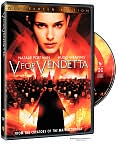
    Last weekend I rented V for Vendetta, the Natalie Portman/Hugo Weaving vehicle that's based on comic book impresario Alan Moore's graphic novel. For those of you who haven't seen the movie, it's set in the not-too-distant future and is about the people's struggle against a totalitarian state--Britain, to be exact. V, the main character, is a modern-day Guy Fawkes who inspires the oppressed masses to rise up and to confront the homophobia, religious intolerance, fear-mongering, and lack of civil liberties that have beset jolly-old England.

    What's abundantly clear is that the film is a warning about the slippery slope countries like Britain and the United States find themselves on these days. The future Britain it portrays--where copies of the Koran are banned, sexual minorities must live underground, art is suspect, and eavesdropping on the populace is the order of the day--is, in some respects, embodied in our present, though perhaps not in quite those extremes.

    You might say that the film offers a scathing critique of the current policies of the British and U.S. governments, especially many of the initiatives that have begun under the auspices of the "war on terror." My question is this: Does it really matter?

    Perhaps I've been out of the loop, but I don't get the impression that V for Vendetta has sparked much of a serious public dialogue about democracy's slide toward totalitarianism in either country. Perhaps that's asking too much from one film. But for me it raises a larger question: to what extent are the media genuinely effective in producing concrete shifts in governmental policy? Another way of putting this would be to say: to what extent is cultural politics able to change formal governmental politics or policy anymore?

    V, for me, is an intriguing test-case. To the extent that it hasn't seemed to produce much public outcry (or effective public outcry), my inclination would be to say that the power critics once attributed to cultural politics may be on the decline. Don't get me wrong. I still believe cultural politics matters. By the same token, a film like V suggests to me that cultural politics may not matter in the way that it once did.

    Monday, August 28, 2006

    Lame

    Okay...I'll admit it. My last post was a bit lame. It raises an important topic--the politics and intellectual worth of social constructionism--but it doesn't really address it. I wanted to post something to D&R since I hadn't in awhile, but in the end I didn't have the mental wherewithal to do more than raise a too-open-ended question.

    Where did I want to go with that question? I had intended to talk about Deleuze and Guattari's contributions to what, for lack of a better term, might be called the philosophy of knowledge (and I'm purposefully trying to avoid using the word "epistemology" here). They develop this line of work both individually and collaboratively, though their most pointed statement comes in their final venture together, What Is Philosophy? If I'm reading WIP? and other works (e.g., Deleuze's Proust and Signs) correctly, concepts (what epistemologists might call "knowledge") inhere in things, and it's up to philosophers and other cultural workers to extract and articulate them.

    I'll say that I'm seduced by this notion, though I'm uncomfortable with the kind of "reading" practice it seems to imply. Theoretically, from a Deleuzo-Guattarian standpoint, one is affected in such a way by a thing that she/he can be moved to extract whatever concept or concepts happen to inhere in it. Perhaps. But isn't that a hop, skip, and a jump away from the kind of literary reading--of feeling the meaning of a literary work "on your pulse"--that defined the work of people such as F. R. and Q. D. Leavis and others? How is Deleuzo-Guattarian knowledge production not, at some level, a sort of virtuoso protocol for reading culture?

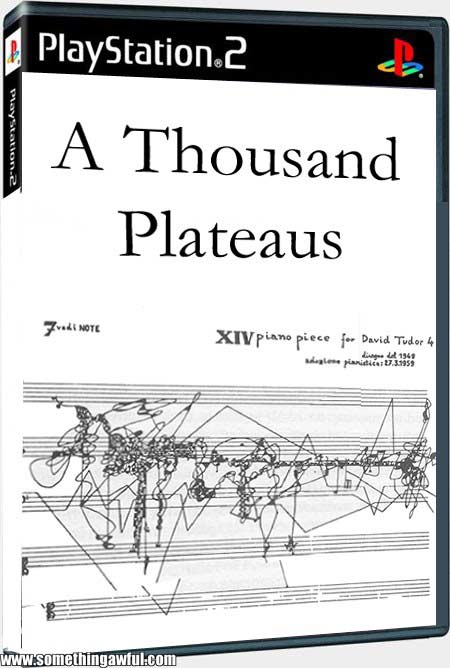
    That question seems to me less lame, and honestly it's one I'm going to need some time to work through. For now, because this has been a fairly heady entry (most of my summer posts admittedly have been on the lighter side), I figured I'd end with an image my colleague John Lucaites sent me from somethingawful.com. Sony, like many these days, apparently is becoming Deleuzo-Guattarian..... ;)

    Thursday, August 24, 2006

    The end is nigh

    My research leave is nearly at an end. I can tell that by the dramatic upsurge in responsibilities related to on-campus life that I've been feeling for the last few weeks: preparing and copying syllabi; orientation sessions; meetings with colleagues and students; prepping for classes; and more. I'm at once anxious for the school year to start and sad to bid farewell to what's been a remarkably peaceful and productive time for research and writing.

    That's not really why I'm writing, though. I'm writing to draw D&R readers' attention to a hilarious and brilliant skit called "Wikiality" that ran recently on Comedy Central's mock news program, The Colbert Report. You can access the piece on You Tube.

    For those of you who haven't seen it, Colbert pokes fun at the online Encyclopedia, Wikipedia. The site, I'm sure most of you know, allows people like you and me to author entries, thereby participating actively in the constitution of knowledge. Wikipedia's been both praised and condemned for this kind of openness: praised, because it facilitates collaborative, more or less democratic knowledge production; and condemned, because, as Colbert and others have noted, if enough contributors agree on something as true, then it becomes true on Wikipedia.

    What's remarkable to me about the Colbert piece, and about the debates over Wikipedia more generally, is how in part they reflect debates about the usefulness of "social constructionism"--that is, the doctrine that humans produce meanings, values, and institutions (realities) that we then come to inhabit as though they were necessary and given. The left's embraced social constructionism and put the idea to use in quite critical, politically efficacious ways. What the Colbert piece shows clearly, though, is how the politics of social constructionism are not inherent to social constructionism. He jokingly suggests, for example, that people should access Wikipedia and insist that Africa's elephant population is increasing. (Some, apparently, have followed through on the gag.)

    "Wikiality"--both the skit and the notion--underscore how the left needs to do better. It can't simply continue pointing out how knowledge (and what follows from it) is constituted socially, or how people come to inhabit specific regimes of truth. The question--and I'm hardly the first to pose it--is, If devolving into an untenable relativism is undesirable, then what's the alternative to social constructionism?

    Monday, August 14, 2006

    Space

    I work in a box.

    Actually, I work in a cinderblock building that was constructed originally to house GIs returning to college after the Second World War. It's since been converted into an office building, though it still maintains many of the trappings of a dormitory. I'm particularly amused by the built-in closets in my office, which have been converted into makeshift bookshelves.

    Right now the university is in the midst of tearing down all the buildings in my complex to make way for new high-rise student housing--that is, with the exception of my own. The university's promised to build my department what's called a "generic office building," since we're ostensibly in the way of the looming construction project.

    Our current building is configured in such a way that all rooms are pretty much discrete. Each of the faculty has a private, enclosed office with one to two windows that open toward the outside. The classrooms--what few we have--are all self contained. Judging by the name, I suspect that our proposed "generic office building" will reflect a similar architectural disposition.

    In some ways, I like my existing building. There's plenty of privacy, and I happen to have a corner office. By the same token, a conversation with a friend of mine in computer science reminded me of just how much difference office space can make when it comes to fostering a certain kind of work environment. He described a lab to me in which seminar spaces are open, as are most of the offices. Conference rooms all have windows facing both the interior and the exterior of the building, which further helps to engender a sense of openness. As a whole, the lab's designed to encourage spontaneous, collegial interactions and to foster the culture of collaboration that's typical in computer science.

    I wonder if a similar kind of floor plan would be appropriate to a humanities-based department like mine. Indeed, I've always been struck by the humanities' critique of individualism, a critique that doesn't really get reflected in our work, the vast majority of which consists of single-authored articles and books. Could changing our architecture help foster a more collaborative humanities, one that better practices what it preaches?

    Sunday, August 06, 2006

    Two great new blogs

    Apologies for the hiatus. I was away again, this time traipsing around the remarkable Yellowstone National Park. I also was busy finalizing some aspects of my book, which now has a new title: The Late Age of Print: Everyday Book Culture From Consumerism to Control.

    I'm writing, though, to promote two great new blogs. The first is Gil Rodman's Revolution on a Stick, which he launched about a month ago. You may know Gil from his wonderful book Elvis After Elvis: The Posthumous Career of a Living Legend and from his co-edited collection, Race in Cyberspace. Like D&R, Revolution on a Stick is about culture, politics, and stuff. Right now Gil's featuring his paper from the recent Crossroads in Cultural Studies conference in Istanbul, Turkey, and knowing his work, it's sure to be both insightful and funny.

    The other new blog is J. Macgregor Wise's Ain't Got Time to Blog, which has been up and running for a few weeks now. Greg's the author of Exploring Technology and Social Space and the co-author of both Culture and Technology: A Primer and the second edition of Media Making. He says that his is Ain't Got Time to Blog will be "an occasional sort of thing, random thoughts, some about work, writing, ideas, some about life." Despite his modesty, though, he's already posted some interesting pieces on media collecting and LP records.

    Definitely check them out!

    Saturday, July 22, 2006

    Television & New Media

    My essay "Disowning Commodities: Ebooks, Capitalism, and Intellectual Property Law" was just published in the August 2006 issue of Television and New Media. Here's a copy of the abstract and a link to the table of contents:

    This article explores the changing social function of commodities in the United States by exploring the conditions of possibility of electronic books, or "ebooks." By juxtaposing the history of printed books and consumer capitalism on the one hand and the history of ebooks on the other, this article maps an emergent configuration of capitalism, technology, and intellectual property law. Together, these histories evidence how the widespread private ownership of mass-produced consumer goods has grown increasingly problematic from the standpoint of capitalist production—an understanding embedded in many, if not most, commercially available ebook texts and devices. In addition to showing how the category of "private property" is destabilized in relationship to ebooks and other digital technologies, this article strategizes how best to articulate a vital, progressive politics in light of changing material and economic conditions.

    Tuesday, July 18, 2006

    My blank page

    It is done.

    Well, a solid draft of it, at any rate--a draft of my book. Having (nearly) completed what amounts to a Herculean amount of writing in just the last few months, I figured now would be an appropriate time to reflect a little on my writing process.

    I don't know about you, but whenever I write, I hear in my head the voices of dozens of friends, mentors, and teachers, all of whom have given me writing advice over the years. Let me say right off the bat that much--probably most--of it's been invaluable. I'm grateful to all of my formal and informal writing teachers who've made words such an integral part of my life.

    The other shoe has to drop, of course, so here it comes. Inasmuch as I value their advice, I find at times that all the rules I've learned through the years can stifle my writing. I get so caught up sometimes on what not to do, that I have a tremendous amount of difficulty producing any writing at all. Here are just a few examples of "the rules":

  • Never split a verb infinitive (e.g., don't say, "to better explore...")

  • Never leave a dangling participle (e.g., don't say, "the store I left my wallet in."

  • Never end a sentence on a linking verb (e.g., don't say, "She's better than he is.)

  • Avoid the construction, "is that..."

  • Avoid using passive voice constructions (e.g., don't say, "The gift was given to them...")

  • Avoid using the presumptive "we"

  • Don't use contractions

  • Don't start a sentence with the conjunction, "and"

  • Don't use the word "this" without following it directly with a noun

  • Don't address your audience using the direct or implied "you"

  • Minimize your use of the pronoun "I" and avoid it where possible

  • I'm sure there are dozens more, but these most immediately come to mind. The funny thing about these "rules" is that, the more I write, the more I find myself violating them. (See--I just broke the "is that" rule right there.)

    In Francis Bacon: The Logic of Sensation, Gilles Deleuze talks about the art of painting as an art of chasing away all the cliches that occupy any unpainted canvas. I feel the same way when I write: my blank page is full of prosaic statements that challenge me constantly to write something poetic, insightful, moving, or otherwise meaningful. Yet, I also feel as though my blank pages is filled with all the writing advice that's been given to me over the years, advice that sometimes makes it hard for me to say anything at all.

    The most excruciating--and perhaps best--writing advice that was ever given to me came from my 9th grade English teacher. I recall her making the class write highly structured paragraphs, including topic sentences, support, evidence, and clinchers. Any deviation from "the form" would result in lost points. As much as I may have resented the structure at the time, today I often find that when I have trouble writing, I return to this, my base. Interestingly, it's one of the few affirmative pieces of writing advice that I've received--a far cry from all the "don'ts," "avoids," and "nevers."

    Saturday, July 08, 2006

    For those about to rock...

    Well, the writing continues apace. The introduction of my book now is in hand, which leaves just the conclusion between me and a completed manuscript draft. The intensity of the writing has kept me from blogging of late, unfortunately, though I have managed to squeak in some TV time. One of my favorite returning shows is CBS's Rockstar, the latest installment of which features a search for the lead-singer of the band, Supernova.

    Supernova, if you haven't heard, consists of cast-offs from Motley Crue (drummer Tommy Lee, a.k.a. "Rocker Tommy Lee"), Metallica (bassist Jason Newsted), and Guns 'n Roses (guitarist Gilby Clark). They're looking for a lead-singer, and, like INXS last year, they decided to find one through the reality television program, Rockstar.

    First things first: I like the show a great deal. Last year's installment surprised me, in fact, because it ended up having quite a bit of heart. INXS unexpectedly lost its lead-singer, Michael Hutchence, several years ago and found a worthy replacement on Rockstar in J.D. Fortune. Their new album, aptly titled Switch, is quite catchy.

    INXS, though undoubtedly a "serious" band, always had a certain pop-ish dimension to it. At minimum they were more radio-friendly than were Motley Crue and, in their early days, Metallica. As such, it didn't seem so surprising to me that they'd turn to a reality TV show--ostensibly a singing contest--to find a new singer. I'm more surprised to find Supernova doing this. I remember the days when metal acts used to anchor their authenticity in a kind of cool, underground status, whether real or perceived. Supernova clearly doesn't have any such pretensions.

    I realize that Rockstar promotes the band and gives its members an opportunity to see which contestant the largest audience will embrace well in advance of their having to make a final selection. The show's an enormously clever marketing and market-research campaign, to say the least, but to tell you the truth, I kind of miss the days when a singing contest would have been uncool for a metal band.

    Thursday, June 29, 2006

    Thank you, President Gore

    I just had the good fortune of seeing An Inconvenient Truth, the documentary about global warming as presented by Al Gore. It's a must-see.

    Though I'm not a student of global climate change, I consider myself to be someone who's reasonably well-informed. After having seen An Inconvenient Truth, however, I've discovered that I'm not. The film is chock-full of information about the phenomenon, one that's disputed, apparently, only by those outside of the scientific community. There, there's a clear consensus: it's happening, and something needs to be done--yesterday. One of the most provocative moments of the film for me occurred near the middle, where Gore contrasted scientific and popular views on global climate change. Despite the fact that more than 900 scientific studies confirm the existence of global warming without a dissenting voice, more than half of all news stories appearing in the popular media dispute its existence.

    Gore attributes this disparity of views, and the government's refusal to take more positive steps toward a solution, to those who cast doubt on the phenomenon--those who work, for example, in P.R. firms in the employ of energy profiteers. And here I need to make what's admittedly a strange leap to talk about cultural studies. I find, as I finish my own book, that a great deal of what I do as a practitioner of cultural studies is precisely that--to cast doubt. Part of what I try to do, too, is to tell a different, better story about whatever it is I'm trying to talk about, whether it's books, intellectual property, cultural studies, or something else entirely. But I find in my own work, and in at least some work in cultural studies, that we don't move sufficiently beyond casting doubt. I can't help but think that at least sometimes, my own work supports a culture of unhealthy skepticism.

    An Inconvenient Truth shines, though, in that it puts forth a vision of a more environmentally sustainable word and explains how change could be made at the level of the everyday and beyond. The film offers a normative, forward-looking vision of the world, the kind of thing that I think cultural studies would do well to offer, too.

    Wednesday, June 21, 2006

    A second-rate discipline?

    This post has been brewing for some time, and I suppose now's the moment in which to put it out into the world. It's about the discipline of communication--my own discipline--and people's perceptions of it.

    I'll start with a few anecdotes:

    (1) I recall attending a panel at the National Communication Association annual convention a few years ago, in which the panelists reflected on the discipline's wellbeing. One of them, I remember, commented on how the association's newsletter, Spectra, always included a list of books and articles that communication scholars had published in venues outside the discipline. He attributed the list to the discipline's self-consciousness about itself and, more specifically, to a latent sense in which the "real" work was taking place in disciplines other than our own. (I may be mistaken, but I think Spectra has since discontinued the list.)

    (2) I've met with editors at various university and commercial-scholarly presses who've all commented on their ambivalence toward the communication discipline. Generally, they seem to feel as though there's a handful of scholars in the discipline whose work is exciting, but as for the rest of it.... Friends and colleagues who work outside of the communication discipline, or who are in it but don't identify with it, have expressed similar feelings to me.

    (3) I wish I had a dollar for the amount of times a student said to me, "I wanted to major in business, but I couldn't get into the business school. That's why I decided to major in communication." (FYI, that's happened less frequently here at IU, where the department calls itself Communication & Culture.)

    Enough with the anecdotes. By now you're hopefully getting the drift. There seems to be a pervasive sense in which communication is a second-rate discipline, one that's: discomforted with its being relatively young; perceived by many to be intellectually unstimulating; and imagined by some students to be their fallback to a more challenging--and presumably more rewarding--career in taking over the world.

    The odd thing is, many of the most rigorous, imaginative scholars I know work in communication departments--and that's not only because I mostly know communication scholars. Beyond that, though, it's surprising to me to see how much weight both the idea and practice of communication are given in contemporary society. It seems strange that the communication discipline hasn't become the discipline of our age, or at least one of them. Maybe that's because every discipline seems to "do" communication in one form or another. I'm always struck, for example, when literary scholars publish research about, say, the internet, "communicative production," or immaterial labor (which often includes at least some communicative aspect).

    In any case, it's clear that the communication discipline finds itself in an odd place. While its subject-matter unquestionably is important, the discipline doesn't seem to be perceived as equally important. The question remains, why?

    Wednesday, June 07, 2006

    Italian detours

    Well, finally, I'm out from under the yoke of Harry Potter. I've been trying to finish my chapter on Harry Potter impostors, look-alikes, and knockoffs for some time, and for some reason it just kept slipping away. It probably had something to do with the shear volume of Potter doubles out there, not to mention his rights holders' bizarre efforts to make them all disappear. Anyway, the chapter's wrapped up, which means all that's left of my book, Equipment for Living: Everyday Book Culture in the Late Age of Print, is the introduction and conclusion.

    This post isn't about Harry Potter, however. It's about my recent trip to Italy. I spent two weeks there last May (part of the reason for the delay in tying up loose ends in the HP chapter) and got a crash course in Italian history, culture, and politics. I'll spare you the photos of me at the Coliseum, the Vatican, and all the other usual tourist hot-spots, though I have to confess to being rather impressed across the board. Overall, the trip was just fantastic.

    I also went on something like a Marxist "detour" while I was there, too. The image at left is one I took in Rome; it's of a political poster for the Italian Communist Party. That in itself wasn't interesting to me. What was interesting, though, was what it seemed to be espousing--within the limits of my admittedly spotty Italian, free culture and broad intellectual property rights. Though I think the idea of free culture does have its problems (I'm particularly leery of its libertarian dimensions), it was so refreshing to see a political party campaigning, in part, on a policy of open access to ideas, words, and things.

    This next image is a photo of me at the gravesite of Antonio Gramsci, the brilliant thinker and activist who contributed so much to cultural studies' (and other field's) understanding of hegemony. His ashes are interred at what's called the cemetery for non-Catholics. (Sometimes it's referred to as the Protestant cemetery, though there are Jews and members of various Eastern Orthodox faiths buried there, too.) It's a lovely place--for a cemetery--and it also plays "home" to poets Keats and Shelley. What was intriguing about the cemetery, beyond the "celebrities" buried there, was the fact that Gramsci, apparently, was one of its main attractions.

    Next time I'm in Italy, I suppose I'll have to track down Toni Negri or something....

    Monday, May 29, 2006

    Open access

    CALL FOR CONTRIBUTIONS

    CULTURE MACHINE
    http://www.culturemachine.net

    Recent figures suggest that research published as "open access" is between two and four times more likely to be read and cited than if it is published in print-on-paper form only.

    With this in mind, Culture Machine is seeking contributions to an open access archive for cultural studies and related fields (communication and media studies, visual culture, literary, critical and cultural theory, post-colonial theory, women's studies, new media ...). The archive, called CSeARCH, which stands for Cultural Studies e-Archive, is
    completely free to both download from and upload into.

    You can find CSeARCH at: http://www.culturemachine.net/csearch

    This will let you browse the archive as well as read and download its contents for free. It already contains over 500 books, book chapters, journal issues, articles, interviews and lectures by everyone from Adorno, Agamben, Badiou, Baudrillard, Deleuze and Foucault, through Hebdige, Laclau, Latour, McRobbie and Mouffe, to Nancy, Negri, Poster, Stiegler, Virilio, Virno, Williams and Zizek, to mention just some of the most well known names.

    To upload work into the archive go to the "Submit" page. Fill in the brief details and you'll then be sent a login name and password via e-mail together with a direct link. Click on the link and you'll be there--no need to login at that point the first time. (The password just ensures no one but you can edit your entries.) It's really quick and easy.

    We realise it's going to take a little time to grow. But one of the ideas behind open access archives of this kind is that if everyone deposits a digital copy of their published material in the archive, then it means all the (in this case) cultural studies research is going to be available for students, teachers, lecturers and researchers to use anywhere in the world, for free, for ever (as opposed to being restricted solely to those individuals and institutions which can afford to pay for access to it in the form of journal subscriptions, book cover prices, interlibrary loans, photocopying charges etc.).

    Obviously anything that is already in digital form, be it Word, pdf and so on, can be uploaded easily. If anyone does have early texts in cultural studies and related fields, including out of print books, book chapters, journal editions or articles they can scan in or otherwise make available, that would be great, too.

    However, the idea of the archive is not just to preserve documents from the past but to make widely available recent and even current work: both that which is already published and that which is awaiting publication.

    More information about CSeARCH, including how to include books, book chapters and journal articles which have already been published elsewhere, or which are due to be so in the future, without infringing copyright, is available in: "The Cultural Studies e-Archive Project (Original Pirate Copy)," Culture Machine 5, 2003.

    If you have any questions or problems, just send me an email: gary.hall@connectfree.co.uk

    Thanks, Gary Hall

    Wednesday, May 24, 2006

    Sadness

    I'm saddened to report that James W. Carey, one of the most important contemporary figures in communication, media, and cultural studies, has died. He passed away on Monday, May 22nd in Rhode Island as a result of complications from emphysema. He was 71. You can read his complete obituary online at The Rhode Island News. Columbia University, where Carey was CBS Professor of International Journalism, also has set up a website and discussion forum for those wishing to share their thoughts about Professor Carey's life. You can access it by clicking here.

    Carey taught for many years at the University of Illinois before moving on to Columbia. Titles and appointments, though, don't capture the depth of Carey's intellect, creativity, and passionate commitment to democracy. His writings on space, time, and communication have had an inestimable impact on my own work in media studies and communication theory, as I'm sure they have on the work of countless other people in these and related fields. He balanced history and theory as gracefully as could be, and never once let dogmatic commitments or intellectual trends cloud his vision of how this strange, modern world of ours worked communicatively. Always, the empirical led his writing and research, even as he was one of the most vociferous opponents of an unreconstructed empiricism. Carey's scholarship and mindful disposition are models for us to follow.

    I had the good fortune of meeting Professor Carey twice--once when he gave a lecture at the University of North Carolina, and later on a panel I organized for the National Communication Association's annual convention a few years back. (There was a third time, when I stood behind him on a hotel registration line, though I didn't know him at the time and, to my regret, ended up not talking to him.) He was gracious, patient, and engaged, and if the testimonials of his many students are any indication, these and other qualities were precisely what made him such an extraordinary mentor.

    He will be sorely missed, even by those who barely knew him.


    Addendum: Here is a link to the Poynter Institute website, which has more to say about Carey's life, work, and passing.

    Wednesday, May 03, 2006

    Cracking the code

    A confession: I'm obsessed with Dan Brown's The Da Vinci Code. I haven't read it, to tell you the truth, or at least much of it (I bought the book for my sister and browsed the first few pages), but my work on book history and intellectual property has led me to develop what's fast becoming a compulsive interest in it. Mostly, I'm riveted by the recent court case in Britain, in which the authors of The Holy Blood and the Holy Grail accused Brown of stealing key ideas and the "architecture" of their book. I won't burden you with the details, but a few weeks ago Justice Peter Smith found in Brown's favor.

    Inasmuch as I'm excited by intellectual property law and jurisprudence, on their own they're usually not enough to get me this worked up. What's got me excited is the text of the judge's ruling, which evidently contains its own hidden code--"The Smithy Code." You can read about it by clicking this link to an article that ran recently in The New York Times.

    You'll have to read The Da Vinci Code and The Holy Blood and the Holy Grail to crack The Smithy Code, and since I'm already behind in that department, I'm going to leave it to others to do so. For now, kudos to Justice Smith not only for handing down an intriguing decision, but more importantly, for embodying some of the principles and affects at stake in the case in the text of his ruling. I would, to be honest, like to see more scholarship--and jurisprudence, for that matter--adopt that kind of creative disposition. I've been trying to do this recently in my own work, specifically in my chapter-in-progress on Harry Potter counterfeits and knockoffs, for I find that letting the form of one's writing reflect that of its content can provide for a more engaging kind of academic discourse.

    P.S. Read boldly.