 It's funny--I find myself returning to "The Battle for Christmas" (see my post on 9/18, "Tisn't quite the season, but..."), even though it's Halloween. Maybe I'm just unseasonable. But what strikes me about the book's significance to this day--all Hallows Eve--is the remarkable similarity that Halloween used to share with the Christmas holiday. In the 18th and 19th centuries, working class people customarily invaded the homes of elites on or about December 25th, sometimes in costume, demanding sweets and other confections. A failure to produce the goods often resulted in interminable drunken singing, mischief, and even acts of outright vandalism. Christmas was a temporary, carnivalesque reversal of the established social order, the class dynamics of which have been transposed onto the act of children knocking at our doors demanding candy. And in that respect, though I love Halloween, it's hard not to be a little cynical about it. The cutting, critical-edge of many of our most cherished holidays has been blunted by a loss of the historicity of our ways of celebrating (or repeating) them.
Monday, October 31, 2005
Happy Halloween!
It's funny--I find myself returning to "The Battle for Christmas" (see my post on 9/18, "Tisn't quite the season, but..."), even though it's Halloween. Maybe I'm just unseasonable. But what strikes me about the book's significance to this day--all Hallows Eve--is the remarkable similarity that Halloween used to share with the Christmas holiday. In the 18th and 19th centuries, working class people customarily invaded the homes of elites on or about December 25th, sometimes in costume, demanding sweets and other confections. A failure to produce the goods often resulted in interminable drunken singing, mischief, and even acts of outright vandalism. Christmas was a temporary, carnivalesque reversal of the established social order, the class dynamics of which have been transposed onto the act of children knocking at our doors demanding candy. And in that respect, though I love Halloween, it's hard not to be a little cynical about it. The cutting, critical-edge of many of our most cherished holidays has been blunted by a loss of the historicity of our ways of celebrating (or repeating) them.


Monday, October 24, 2005
Of interest
My good friend Greg Seigworth, who teaches at Millersville and is one of the leading scholars at work on developing a Deleuzoguattarian cultural studies, wrote to me today to let me know about two things. First, he's been reading Differences & Repetitions (thank you!), and second, he sent me a list of some other blogs that might be of interest to D & R readers. Here they are, courtesy of Greg:
Steve Shaviro's Pinochhio Theory
http://www.shaviro.com/Blog/
Glen Fuller's auto shop (though it has a different name now)
http://glenfuller.blogspot.com/
Jon Beasley-Murray's post-hegemony
http://posthegemony.blogspot.com/
Spurious (no idea who this is, but fantastic writing on 'everyday life')
http://spurious.typepad.com/spurious/
Jodi Dean's I Cite
http://jdeanicite.typepad.com/
and Michael Berube's:
http://michaelberube.com/
-->Enjoy!
Steve Shaviro's Pinochhio Theory
http://www.shaviro.com/Blog/
Glen Fuller's auto shop (though it has a different name now)
http://glenfuller.blogspot.com/
Jon Beasley-Murray's post-hegemony
http://posthegemony.blogspot.com/
Spurious (no idea who this is, but fantastic writing on 'everyday life')
http://spurious.typepad.com/spurious/
Jodi Dean's I Cite
http://jdeanicite.typepad.com/
and Michael Berube's:
http://michaelberube.com/
-->Enjoy!
Tuesday, October 18, 2005
Why do I write?
This question has been vexing me for some time now, in part because it requires me to define something of a purpose for "Differences and Repetitions." I remember struggling with this question when, while setting up this blog, I was prompted to make a short statement on what it was about. I substituted instead a quotation on everyday life from the French Marxist Henri Lefebvre. You can see it right now, near the top of the page.
I realize, however, that I have been grappling with the question, "why do I write?" all along, albeit indirectly. The title "Differences and Repetitions" (which I draw from the work of the French philosopher Gilles Deleuze) and the Lefebvre quotation together define the ambit of this blog. Broadly, I am concerned with the notion of everyday life as both a theoretical category and as a terrain where people live out their lives in complex, modern societies. I am further interested by the two ways in which everyday life can repeat. "Everyday" often refers to what is most prosaic, ordinary, humdrum, and cliched, and indeed these qualities speak to the first way in which everyday life repeats...unwaveringly, incessantly. And yet, as Lefebvre and Catherine Regulier once wrote (in a line I habitually repeat), "there is always something miraculously charming about the rising of the sun"--this despite, or perhaps because of, its occurring every single day. There is, in other words, a sense in which the very repetitiveness of the everyday holds open the possibility for difference, innovation, creativity, wonder, and change. "Differences and Repetitions" is dedicated to exploring this tension intrinsic to everyday life, and I invite others to join me in doing so.
Apropos, to those of you who may be reading, please chime in once and awhile! I've received a few emails and have spoken with some of you about my posts, but I'd prefer if that were all aired publicly rather than in private correspondence. With that said, I want to thank Josh, Todd, Bob, Jonathan, and Kembrew for being my interlocutors and for promoting "Differences and Repetitions." With any luck "D&R" will keep on repeating, differently.
I realize, however, that I have been grappling with the question, "why do I write?" all along, albeit indirectly. The title "Differences and Repetitions" (which I draw from the work of the French philosopher Gilles Deleuze) and the Lefebvre quotation together define the ambit of this blog. Broadly, I am concerned with the notion of everyday life as both a theoretical category and as a terrain where people live out their lives in complex, modern societies. I am further interested by the two ways in which everyday life can repeat. "Everyday" often refers to what is most prosaic, ordinary, humdrum, and cliched, and indeed these qualities speak to the first way in which everyday life repeats...unwaveringly, incessantly. And yet, as Lefebvre and Catherine Regulier once wrote (in a line I habitually repeat), "there is always something miraculously charming about the rising of the sun"--this despite, or perhaps because of, its occurring every single day. There is, in other words, a sense in which the very repetitiveness of the everyday holds open the possibility for difference, innovation, creativity, wonder, and change. "Differences and Repetitions" is dedicated to exploring this tension intrinsic to everyday life, and I invite others to join me in doing so.
Apropos, to those of you who may be reading, please chime in once and awhile! I've received a few emails and have spoken with some of you about my posts, but I'd prefer if that were all aired publicly rather than in private correspondence. With that said, I want to thank Josh, Todd, Bob, Jonathan, and Kembrew for being my interlocutors and for promoting "Differences and Repetitions." With any luck "D&R" will keep on repeating, differently.
Monday, October 10, 2005
Don't let the sun go down on me...
 I just returned from trip to Syracuse, NY, where I had the good fortune of hearing historian James Loewen speak about his new book, "Sundown Towns." In a word, it's fascinating. Loewen documents how the South effectively won the US Civil War (a.k.a., "The War Between the States"), given the propagation of racist ideologies and practices nationwide thereafter. He looks specifically at the flourishing of what he calls "sundown towns," that is, of towns that implemented both implicit and explicit policies to exclude people of color (and sometimes Jewish people, too) from living in their communities. And lest you think this practice was uncommon in the North, think again. Loewen spends a great deal of time documenting more than 400 such towns in Illinois alone (a blue state, no less), and he estimates that as many as 10,000 of them have existed in the US as a whole. Frighteningly, I happen to live about 1/2 hour from one, and to this day the folklore (which seems to be all too true) says that people of color shouldn't stop there after dark. How far, indeed, have we come?
Monday, September 26, 2005
Surrealism & the everyday
Lately I feel like I'm living in a surrealist painting.
The last time I felt like this I was in graduate school, after Hurricane Fran landed full-force on Chapel Hill, NC in autumn 1996. Almost everything stopped, and what little that moved moved very, very slowly. Many roads were flooded, obstructed by trees, or they were impassable for other reasons having to do with the storm. Power was out everywhere for days, as was the TV. Most of the grocery stores were closed, at least for awhile, and because of the power outages their inventory quickly turned rancid. The water was untrustworthy for a time. In short, everyday life downshifted abruptly. There were fits, starts, and jerks; everything--everything--seemed out of sorts.
I'm fortunate not to live on the US Gulf Coast right now, though the images I see and the reports I hear take me back to my time in Chapel Hill--only far worse. The main effects many of us living outside the region feel (other than a continued loss of faith in our government's ability to act and a profound sorrow for those who've lost everything) is the rising price of gas. Rumor has it that it may reach $4/gallon. That, of course, is a deeply everyday concern, given how much petroleum makes the economy--indeed, everyday life itself--go. Everyone living in the US has been touched to greater and lesser degrees by the recent maelstroms.
Lefebvre once said that a breakdown in everyday life's usual routines is precisely that which precipitates fundamental change. Are we indeed living through just such a time? If so, who will direct the change, and to what ends?
The last time I felt like this I was in graduate school, after Hurricane Fran landed full-force on Chapel Hill, NC in autumn 1996. Almost everything stopped, and what little that moved moved very, very slowly. Many roads were flooded, obstructed by trees, or they were impassable for other reasons having to do with the storm. Power was out everywhere for days, as was the TV. Most of the grocery stores were closed, at least for awhile, and because of the power outages their inventory quickly turned rancid. The water was untrustworthy for a time. In short, everyday life downshifted abruptly. There were fits, starts, and jerks; everything--everything--seemed out of sorts.
I'm fortunate not to live on the US Gulf Coast right now, though the images I see and the reports I hear take me back to my time in Chapel Hill--only far worse. The main effects many of us living outside the region feel (other than a continued loss of faith in our government's ability to act and a profound sorrow for those who've lost everything) is the rising price of gas. Rumor has it that it may reach $4/gallon. That, of course, is a deeply everyday concern, given how much petroleum makes the economy--indeed, everyday life itself--go. Everyone living in the US has been touched to greater and lesser degrees by the recent maelstroms.
Lefebvre once said that a breakdown in everyday life's usual routines is precisely that which precipitates fundamental change. Are we indeed living through just such a time? If so, who will direct the change, and to what ends?
Thursday, September 22, 2005
Of the cliche
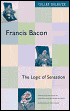 I finished reading Deleuze's "Francis Bacon: The Logic of Sensation" a few weeks ago. In it, he talks about artistic production as a process, in the case of painting, of ridding one's canvas of cliches. I'm both intrigued and vexed by this argument. On the one hand, it sounds perfectly sensible. Isn't the inventional process of art precisely that--invention--or the artist's more or less deliberate effort to dissociate her or himself from the familiar or cookie-cut? On the other hand, I'm persuaded by the work of Henri Lefebvre, who sees the mundane, the ordinary, the banal, the everyday--the cliched--as precisely the source of the extraordinary within the ordinary. Art or originality, for Lefebvre, consists of repeating the same thing all over again, differently. I wonder, then, if art isn't a process of painting (writing, sculpting, building, etc.) over cliches as much as it is a process of repeating the cliche in a new or novel way. Deleuze's book on Bacon very well may be a case in point. Deleuze sees Bacon as someone who has, in effect, unpainted the generic form of the portrait. But isn't Bacon still, at some level, a portraitist? Perhaps rather than unpainting the portrait, he's repainted the form in a fundamentally new way. The cliche is, I believe, more our friend than Deleuze would care to think it is.
Tuesday, September 20, 2005
"Socialism for the rich"
What follows is a brief excerpt from an address Robert F. Kennedy, Jr. gave on September 10th, 2005 at the National Sierra Club Summit in San Francisco, CA. It's a compelling and provocative look at contemporary life in the US and the "infrastructural" role the environment plays therein. The transcript is long but worth reading. I cannot recall the last time that I encountered such a savvy, informed, and well-reasoned account of why *everyone* should fight to preserve the environment.
"[T]his is an administration that represents itself as the White House of values, but every value that they claim to represent is just a hollow facade, that marks the one value that they really consider worth fighting for, which is corporate profit-taking. They say that they like free markets, but they despise free-market capitalism.
What they like, if you look at their feet rather than their clever, clever mouths, what they really like is corporate welfare and capitalism for the poor, but socialism for the rich. They say that they like private property, but they don't like private property except when it's the right of a polluter to use his private property to destroy his neighbor's property and to destroy the public property...."
You can read the complete text of the transcript at: http://www.sierraclub.org/pressroom/rfkspeech/
"[T]his is an administration that represents itself as the White House of values, but every value that they claim to represent is just a hollow facade, that marks the one value that they really consider worth fighting for, which is corporate profit-taking. They say that they like free markets, but they despise free-market capitalism.
What they like, if you look at their feet rather than their clever, clever mouths, what they really like is corporate welfare and capitalism for the poor, but socialism for the rich. They say that they like private property, but they don't like private property except when it's the right of a polluter to use his private property to destroy his neighbor's property and to destroy the public property...."
You can read the complete text of the transcript at: http://www.sierraclub.org/pressroom/rfkspeech/
Sunday, September 18, 2005
'Tisn't quite the season, but...
 I'm in the process of reading Stephen Nissenbaum's book "The Battle for Christmas." Actually, I've been reading it on and off since last Christmas, though my episodic reading shouldn't be taken as an indictment of its quality. It is, rather, the kind of book that's so richly detailed, textured, and layered that you can read it in one pass or in bits and pieces and benefit either way. More than anything, what's striking about "Battle" is the way in which Nissenbaum reads the 18th and 19th centuries through changes in the Christmas holiday. It's as much a history of those centuries, then, and of the dramatic political-economic and social transformations that took place, as it is a history of Christmas per se. His reading of Dickens' "A Christmas Carol" is exemplary in this regard, and perhaps the most astute interpretation of the story I've encountered. I may use Nissenbaum's book next time around in my graduate seminar on the theory and history of mass culture in the US. By all means, check it out. It's a lively read and fiercely smart--and did I mention that it was a Pulitzer Prize finalist?
Wednesday, September 14, 2005
Poisoning the dispossessed
The US Environmental Protection Agency has overhauled its guidelines on pesticide testing making them, in effect, more industry-friendly. Although the agency "regard[s] as unethical and would never conduct, support, require or approve any study involving intentional exposure of pregnant women, infants or children to a pesticide," the new guidelines stipulate several notable exceptions including:
(1) The testing of "abused or neglected" children without permission from parents or guardians.
(2) "Ethically deficient" human research if it is considered crucial to "protect public health."
(3) More than minimal health risk to a subject if there is a "direct benefit" to the child being tested, and the parents or guardians agree.
(4) EPA acceptance of overseas industry studies, which are often performed in countries that have minimal or no ethical standards for testing, as long as the tests are not done directly for the EPA.
Has the EPA forgotten the shame of Tuskegee?
(This post is adapted from an Andrew Schneider article in The National Sun and an email circulated by the Sierra Club.)
(1) The testing of "abused or neglected" children without permission from parents or guardians.
(2) "Ethically deficient" human research if it is considered crucial to "protect public health."
(3) More than minimal health risk to a subject if there is a "direct benefit" to the child being tested, and the parents or guardians agree.
(4) EPA acceptance of overseas industry studies, which are often performed in countries that have minimal or no ethical standards for testing, as long as the tests are not done directly for the EPA.
Has the EPA forgotten the shame of Tuskegee?
(This post is adapted from an Andrew Schneider article in The National Sun and an email circulated by the Sierra Club.)
Subscribe to:
Posts (Atom)