Pages

Thursday, June 29, 2006

Thank you, President Gore

I just had the good fortune of seeing An Inconvenient Truth, the documentary about global warming as presented by Al Gore. It's a must-see.

Though I'm not a student of global climate change, I consider myself to be someone who's reasonably well-informed. After having seen An Inconvenient Truth, however, I've discovered that I'm not. The film is chock-full of information about the phenomenon, one that's disputed, apparently, only by those outside of the scientific community. There, there's a clear consensus: it's happening, and something needs to be done--yesterday. One of the most provocative moments of the film for me occurred near the middle, where Gore contrasted scientific and popular views on global climate change. Despite the fact that more than 900 scientific studies confirm the existence of global warming without a dissenting voice, more than half of all news stories appearing in the popular media dispute its existence.

Gore attributes this disparity of views, and the government's refusal to take more positive steps toward a solution, to those who cast doubt on the phenomenon--those who work, for example, in P.R. firms in the employ of energy profiteers. And here I need to make what's admittedly a strange leap to talk about cultural studies. I find, as I finish my own book, that a great deal of what I do as a practitioner of cultural studies is precisely that--to cast doubt. Part of what I try to do, too, is to tell a different, better story about whatever it is I'm trying to talk about, whether it's books, intellectual property, cultural studies, or something else entirely. But I find in my own work, and in at least some work in cultural studies, that we don't move sufficiently beyond casting doubt. I can't help but think that at least sometimes, my own work supports a culture of unhealthy skepticism.

An Inconvenient Truth shines, though, in that it puts forth a vision of a more environmentally sustainable word and explains how change could be made at the level of the everyday and beyond. The film offers a normative, forward-looking vision of the world, the kind of thing that I think cultural studies would do well to offer, too.

Wednesday, June 21, 2006

A second-rate discipline?

This post has been brewing for some time, and I suppose now's the moment in which to put it out into the world. It's about the discipline of communication--my own discipline--and people's perceptions of it.

I'll start with a few anecdotes:

(1) I recall attending a panel at the National Communication Association annual convention a few years ago, in which the panelists reflected on the discipline's wellbeing. One of them, I remember, commented on how the association's newsletter, Spectra, always included a list of books and articles that communication scholars had published in venues outside the discipline. He attributed the list to the discipline's self-consciousness about itself and, more specifically, to a latent sense in which the "real" work was taking place in disciplines other than our own. (I may be mistaken, but I think Spectra has since discontinued the list.)

(2) I've met with editors at various university and commercial-scholarly presses who've all commented on their ambivalence toward the communication discipline. Generally, they seem to feel as though there's a handful of scholars in the discipline whose work is exciting, but as for the rest of it.... Friends and colleagues who work outside of the communication discipline, or who are in it but don't identify with it, have expressed similar feelings to me.

(3) I wish I had a dollar for the amount of times a student said to me, "I wanted to major in business, but I couldn't get into the business school. That's why I decided to major in communication." (FYI, that's happened less frequently here at IU, where the department calls itself Communication & Culture.)

Enough with the anecdotes. By now you're hopefully getting the drift. There seems to be a pervasive sense in which communication is a second-rate discipline, one that's: discomforted with its being relatively young; perceived by many to be intellectually unstimulating; and imagined by some students to be their fallback to a more challenging--and presumably more rewarding--career in taking over the world.

The odd thing is, many of the most rigorous, imaginative scholars I know work in communication departments--and that's not only because I mostly know communication scholars. Beyond that, though, it's surprising to me to see how much weight both the idea and practice of communication are given in contemporary society. It seems strange that the communication discipline hasn't become the discipline of our age, or at least one of them. Maybe that's because every discipline seems to "do" communication in one form or another. I'm always struck, for example, when literary scholars publish research about, say, the internet, "communicative production," or immaterial labor (which often includes at least some communicative aspect).

In any case, it's clear that the communication discipline finds itself in an odd place. While its subject-matter unquestionably is important, the discipline doesn't seem to be perceived as equally important. The question remains, why?

Wednesday, June 07, 2006

Italian detours

Well, finally, I'm out from under the yoke of Harry Potter. I've been trying to finish my chapter on Harry Potter impostors, look-alikes, and knockoffs for some time, and for some reason it just kept slipping away. It probably had something to do with the shear volume of Potter doubles out there, not to mention his rights holders' bizarre efforts to make them all disappear. Anyway, the chapter's wrapped up, which means all that's left of my book, Equipment for Living: Everyday Book Culture in the Late Age of Print, is the introduction and conclusion.

This post isn't about Harry Potter, however. It's about my recent trip to Italy. I spent two weeks there last May (part of the reason for the delay in tying up loose ends in the HP chapter) and got a crash course in Italian history, culture, and politics. I'll spare you the photos of me at the Coliseum, the Vatican, and all the other usual tourist hot-spots, though I have to confess to being rather impressed across the board. Overall, the trip was just fantastic.

I also went on something like a Marxist "detour" while I was there, too. The image at left is one I took in Rome; it's of a political poster for the Italian Communist Party. That in itself wasn't interesting to me. What was interesting, though, was what it seemed to be espousing--within the limits of my admittedly spotty Italian, free culture and broad intellectual property rights. Though I think the idea of free culture does have its problems (I'm particularly leery of its libertarian dimensions), it was so refreshing to see a political party campaigning, in part, on a policy of open access to ideas, words, and things.

This next image is a photo of me at the gravesite of Antonio Gramsci, the brilliant thinker and activist who contributed so much to cultural studies' (and other field's) understanding of hegemony. His ashes are interred at what's called the cemetery for non-Catholics. (Sometimes it's referred to as the Protestant cemetery, though there are Jews and members of various Eastern Orthodox faiths buried there, too.) It's a lovely place--for a cemetery--and it also plays "home" to poets Keats and Shelley. What was intriguing about the cemetery, beyond the "celebrities" buried there, was the fact that Gramsci, apparently, was one of its main attractions.

Next time I'm in Italy, I suppose I'll have to track down Toni Negri or something....

Monday, May 29, 2006

Open access

CALL FOR CONTRIBUTIONS

CULTURE MACHINE
http://www.culturemachine.net

Recent figures suggest that research published as "open access" is between two and four times more likely to be read and cited than if it is published in print-on-paper form only.

With this in mind, Culture Machine is seeking contributions to an open access archive for cultural studies and related fields (communication and media studies, visual culture, literary, critical and cultural theory, post-colonial theory, women's studies, new media ...). The archive, called CSeARCH, which stands for Cultural Studies e-Archive, is
completely free to both download from and upload into.

You can find CSeARCH at: http://www.culturemachine.net/csearch

This will let you browse the archive as well as read and download its contents for free. It already contains over 500 books, book chapters, journal issues, articles, interviews and lectures by everyone from Adorno, Agamben, Badiou, Baudrillard, Deleuze and Foucault, through Hebdige, Laclau, Latour, McRobbie and Mouffe, to Nancy, Negri, Poster, Stiegler, Virilio, Virno, Williams and Zizek, to mention just some of the most well known names.

To upload work into the archive go to the "Submit" page. Fill in the brief details and you'll then be sent a login name and password via e-mail together with a direct link. Click on the link and you'll be there--no need to login at that point the first time. (The password just ensures no one but you can edit your entries.) It's really quick and easy.

We realise it's going to take a little time to grow. But one of the ideas behind open access archives of this kind is that if everyone deposits a digital copy of their published material in the archive, then it means all the (in this case) cultural studies research is going to be available for students, teachers, lecturers and researchers to use anywhere in the world, for free, for ever (as opposed to being restricted solely to those individuals and institutions which can afford to pay for access to it in the form of journal subscriptions, book cover prices, interlibrary loans, photocopying charges etc.).

Obviously anything that is already in digital form, be it Word, pdf and so on, can be uploaded easily. If anyone does have early texts in cultural studies and related fields, including out of print books, book chapters, journal editions or articles they can scan in or otherwise make available, that would be great, too.

However, the idea of the archive is not just to preserve documents from the past but to make widely available recent and even current work: both that which is already published and that which is awaiting publication.

More information about CSeARCH, including how to include books, book chapters and journal articles which have already been published elsewhere, or which are due to be so in the future, without infringing copyright, is available in: "The Cultural Studies e-Archive Project (Original Pirate Copy)," Culture Machine 5, 2003.

If you have any questions or problems, just send me an email: gary.hall@connectfree.co.uk

Thanks, Gary Hall

Wednesday, May 24, 2006

Sadness

I'm saddened to report that James W. Carey, one of the most important contemporary figures in communication, media, and cultural studies, has died. He passed away on Monday, May 22nd in Rhode Island as a result of complications from emphysema. He was 71. You can read his complete obituary online at The Rhode Island News. Columbia University, where Carey was CBS Professor of International Journalism, also has set up a website and discussion forum for those wishing to share their thoughts about Professor Carey's life. You can access it by clicking here.

Carey taught for many years at the University of Illinois before moving on to Columbia. Titles and appointments, though, don't capture the depth of Carey's intellect, creativity, and passionate commitment to democracy. His writings on space, time, and communication have had an inestimable impact on my own work in media studies and communication theory, as I'm sure they have on the work of countless other people in these and related fields. He balanced history and theory as gracefully as could be, and never once let dogmatic commitments or intellectual trends cloud his vision of how this strange, modern world of ours worked communicatively. Always, the empirical led his writing and research, even as he was one of the most vociferous opponents of an unreconstructed empiricism. Carey's scholarship and mindful disposition are models for us to follow.

I had the good fortune of meeting Professor Carey twice--once when he gave a lecture at the University of North Carolina, and later on a panel I organized for the National Communication Association's annual convention a few years back. (There was a third time, when I stood behind him on a hotel registration line, though I didn't know him at the time and, to my regret, ended up not talking to him.) He was gracious, patient, and engaged, and if the testimonials of his many students are any indication, these and other qualities were precisely what made him such an extraordinary mentor.

He will be sorely missed, even by those who barely knew him.


Addendum: Here is a link to the Poynter Institute website, which has more to say about Carey's life, work, and passing.

Wednesday, May 03, 2006

Cracking the code

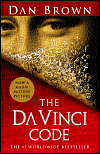
A confession: I'm obsessed with Dan Brown's The Da Vinci Code. I haven't read it, to tell you the truth, or at least much of it (I bought the book for my sister and browsed the first few pages), but my work on book history and intellectual property has led me to develop what's fast becoming a compulsive interest in it. Mostly, I'm riveted by the recent court case in Britain, in which the authors of The Holy Blood and the Holy Grail accused Brown of stealing key ideas and the "architecture" of their book. I won't burden you with the details, but a few weeks ago Justice Peter Smith found in Brown's favor.

Inasmuch as I'm excited by intellectual property law and jurisprudence, on their own they're usually not enough to get me this worked up. What's got me excited is the text of the judge's ruling, which evidently contains its own hidden code--"The Smithy Code." You can read about it by clicking this link to an article that ran recently in The New York Times.

You'll have to read The Da Vinci Code and The Holy Blood and the Holy Grail to crack The Smithy Code, and since I'm already behind in that department, I'm going to leave it to others to do so. For now, kudos to Justice Smith not only for handing down an intriguing decision, but more importantly, for embodying some of the principles and affects at stake in the case in the text of his ruling. I would, to be honest, like to see more scholarship--and jurisprudence, for that matter--adopt that kind of creative disposition. I've been trying to do this recently in my own work, specifically in my chapter-in-progress on Harry Potter counterfeits and knockoffs, for I find that letting the form of one's writing reflect that of its content can provide for a more engaging kind of academic discourse.

P.S. Read boldly.

Wednesday, April 26, 2006

Leggo my Lego

I grew up playing with Legos, and now I'm a professor of media and cultural studies. What better way to join my two interests than with Lego Theorists, the latest "release" from theory.org.uk? The sets feature such luminaries as Judith Butler, Anthony Giddens, Stuart Hall (at left), and Angela McRobbie, among others, and each comes equipped with a Lego scene appropriate to her or his work.

Before you get too excited (or put off) by the prospect of Lego Theorists, I gather that the sets don't really exist--though I suppose, if you're innovative enough with some off-the-shelf Legos, that you could build one yourself. Nevertheless, there is a growing body of academic/celebrity/activist paraphernalia out there, such as the Karl Marx and Michel Foucault finger puppets I have in my campus office. (I bought them at a local novelty store here in Bloomington, Indiana.) Part of me has always been bothered with my having purchased them, since, at some level, they represent making a commodity of individuals who had grave misgivings about a commodity-driven life. Yet, there is a certain, well, novelty about them, and if nothing else there's an odd kind of thrill in knowing that scholarly work can produce some kind of public recognition and impact. In part that's why I do what I do, although I'd be hard-pressed to imagine what I'd look like as a finger puppet, much less as a Lego character.

Saturday, April 22, 2006

Deleuze conference

Deleuze: Texts and Images

The 9th Annual University of South Carolina Comparative Literature Conference

5th - 8th April, 2007

Over the past two decades, readers of the works of Gilles Deleuze have had several opportunities to participate in international conferences held at Trent University and organized by Constantin V. Boundas. In that tradition, we announce the organization of a conference to take place on the campus of the University of South Carolina (Columbia, SC, USA), between April 5 and 8, 2007, sponsored by the Program in Comparative Literature, the English Department, and the College of Arts and Sciences.

The conference theme, "Gilles Deleuze: texts and images," is meant to be understood inclusively rather than exclusively. That is, while recognizing theconference's focus on the work of Gilles Deleuze, the organizers encourage broad and comparative interpretations and commentaries from Deleuzian perspectives on subjects such as literature, philosophy, painting and film, as well as exegeses of Deleuze's body of work that engage with ontological and epistemological concepts and problems. Presentations by the invited plenary speakers--Eric Alliez, Ronald Bogue, Constantin V. Boundas, and Elizabeth Grosz--will be supplemented by speakers in parallel sessions.

The conference will be held on the historic campus of the University of South Carolina (http://president.sc.edu/history.html). The weather in April will be mild, and the campus will be in bloom. Columbia is mid-sized city with a major airport and is easily accessible. It is the capital of South Carolina and has many fine restaurants. Conference participants will be lodged on campus at the new Inn at USC (http://www.innatusc.com/); rooms have been reserved at a special conference rate of $116.00 for those making their reservations by February 20, 2007. There are also other hotels nearby.

Those interested in speaking at the conference should send a title, a 750-word abstract, and a 250-word bibliographical biography to delcon2k7@yahoo.com as a Word or RTF attachment no later than October 1, 2006. Additional details will be available at http://www.cas.sc.edu/DLLC/CPLT/activities/9thannucon.html.

Organizing Committee:

Eugene W. Holland, Ohio State University
Paul Allen Miller, University of South Carolina
Daniel W. Smith, Purdue University
Charles J. Stivale, Wayne State University

Thursday, April 20, 2006

Reality television: the lonely crowd

I had the good fortune of visiting my teaching assistants' Introduction to Media classes this week and was fascinated by the discussions I was privy to on reality television. I'll confess that I'm hooked--especially on shows like Top Chef, Project Runway, Blow Out, and American Choppers, all of which give you a behind-the-scenes look at how people do things. I now wish I were a better cook, learned to sew, cut hair, and took metal shop, but that's another story.

Anyway, one of the instructors whose class I visited asked his students to reflect on the characteristics that might define reality television as a genre. One of them provocatively suggested, "isolation." Now, of course, not every show isolates its cast, but many of them--Survivor, Big Brother, Unan1mous, and to some extent programs like America's Next Top Model and The Real World--do. Indeed, in the case of Top Model, I recall seeing a behind-the-scenes show in which past cast members reflected on their not having had access to a telephone other than the one provided by the producers, been allowed to go out, read a paper, pick up a book, or, ironically, watch television. I don't mean to suggest that isolation is an absolutely necessary, generic condition of reality television, but I'd argue (following my teaching assistant's insightful student) that it certainly represents a dominant tendency within the genre. The question then becomes, what are the larger implications of this paradoxically public form of social isolation?

I'll need to ruminate on that question a bit, and perhaps I'll return to it at a later time. For now, I'd say there's an interesting connection to be made here between reality TV and the horror genre.

Wednesday, April 12, 2006

...and philosophy?

It had to happen one of these days....

"It" is my having purchased one of those ...and Philosophy books--Harry Potter and Philosophy: If Aristotle Ran Hogwarts, to be exact. I did so reluctantly. One of the chapters of my forthcoming book on book culture, Equipment for Living, concerns the global proliferation/circulation of Harry Potter volumes and, in part, attempts to think through the philosophy of reproducibility in light of them. Given the subject matter, I figured I ought to own what's probably the only publication currently out there to lay claim to "Harry Potter" and "philosophy."

It's clear that the book, and I assume the ...and Philosophy series as a whole, is intended for an introductory undergraduate audience. That's not a criticism. In fact, the idea behind the series seems to me consonant with cultural studies' commitment to "meeting people where they are." In this case, the "where" clearly is the terrain of the popular; the Potter book joins volumes on The Matrix, Buffy the Vampire Slayer, Woody Allen, The Simpsons, Star Wars, Seinfeld, and a whole host of other ...and Philosophy titles. The book is pretty boiled down, however, and to my mind tends to underestimate its audience more often than not. What's peculiar about the volume, moreover, is that some of the chapters read to me much more like run-of-the-mill cultural criticism (which is not to say cultural studies) than philosophy per se. Chapter 8, on discrimination, indifference, and social justice in Harry Potter, is a standout in that regard.

I don't know to what extent the Harry Potter volume is representative of the ...and Philosophy series, so I'm reluctant to make generalizations about the books and their intentions. I guess I'm inclined to say that I appreciate the spirit of the series, though I'm unsure of the depth of its content. I'd be curious to hear what D&R readers think about the series and/or specific volumes. I assume many of you, like me, have an interest in philosophy, cultural studies, and the popular and have been intrigued at some level by these books--books which seem to be taking up more and more of the scant shelf space in the philosophy section of my local bookstore.

Thursday, April 06, 2006

On "communication"

Years ago I had something to say about this topic at the National Communication Association convention, and I find myself returning to it again. "It" is communication and what Deleuze and Guattari have had to say on the subject.

Anyone who's read A Thousand Plateaus, What is Philosophy? or pretty much any of their other individual or collaborative writings knows that D+G have little complimentary to say about communication, at least as the idea's tended to be conceived within modern Western thought. They get impatient when interminable conversation becomes the sum-total of philosophy or politics, and while there may be grounds for disputing their reduction of communication to talk (or signification or...), they nonetheless have a point: "communication" tends to be both an overworked and a poorly-theorized concept.

I mentioned the work of Harold Innis in my previous post, and here I want to do so again. What's fascinating about Innis' understanding of communication is that he uses it to encompass not only modern communication apparatuses and infrastructure (e.g., phones, radio, TV, etc.), but also such things are roadways, sea ways, canals, rivers, and more. There is, in other words, a remarkable materiality in his vision of communication that's linked solidly with the earth and the environment.

Now, it would be ludicrous to suggest that Innis and D+G offer anything approaching a similar perspective as each understands (and criticizes) the idea of communication. They do share a common interest, however, in the material facticity of communicative events, as well as a grounding relationship in the geos--the Earth. Like Innis, in other words, D+G are among the very few who to take seriously the communicativity (if that's even a word) of the natural world. That focus seems to me vital if "communication" is to remain a serviceable concept in contemporary political and intellectual life, especially if we take seriously the charge of de-centering North Atlantic modernity.

Sunday, April 02, 2006

The Anti-Oedipus Papers

Yes, I know...it's been awhile. I've been plodding away on my book, feverishly trying to finish my chapter on Oprah's Book Club. I'm near to wrapping it up, thankfully, and so now seems like as good a time as any to write. Thanks for bearing with me. I know it seemed as though D&R had gone dark.

A few weeks ago, I was thrilled to receive Felix Guattari's The Anti-Oedipus Papers (Semiotext[e], 2006). Admittedly, I haven't yet found the time to give it a thorough read. My own book's just taken too much of my energy. I have managed to read some of it, however, and I've given all of it at least a thorough skim for now. The book's brilliant--but not for the reasons you might think.

What's striking to me about the book is the look it affords into both Deleuze and Guattari and Guattari's own process. What's also striking is the welcome, vulnerable portrait of Guattari that emerges in The Anti-Oedipus Papers. Anti-Oedipus, and indeed most of Guattari's individual and collaborative work is so forthright, declarative, and argumentative. I don't fault him for that; indeed, part of what makes that body of work so compelling is precisely its tone, not to mention the way in which tone helps convey the creativity of D+G's ideas. At the same time, though, I'm pleased to see here Guattari's more tentative, perhaps even insecure side, in addition to the experiments-in-action of such an experimental thinker. The book that I think most closely resembles this one is Harold Innis' Idea File, which likewise consists of half-baked ideas, thoughts, quotations, random stream-of-consciousness, and other such things that lend insight into how a voracious thinker works. You really have to be pretty bold to put your "process" out there like that.

I'm also pleased to see how both the introduction and Guattari himself draw attention to the work of Fanny Deleuze, Gilles Deleuze's partner. Too often, the significant contributions women have made to the production of landmark texts have gotten systematically erased. I'm glad to see at least a palimpsest beginning to form here.

I'd be curious to hear how others are responding to the book, as well as to Deleuze's latest release, Two Regimes of Madness.

Thursday, March 23, 2006

...and still more chatter

Since my previous post--heck, it was just a few hours ago--more people have chimed in on the piece Siva Vaidhyanathan's penned for Kembrew McLeod and my special issue of Cultural Studies. Here are some links to the discussion, courtesy of Kembrew:

  • Liberal Education Today

  • Virtualpolitik

  • Funferal

  • ACR Log

  • Simong
  • People are talking...

    I just caught wind of the fact that people already are talking about the special issue of the journal Cultural Studies Kembrew McLeod and I co-edited on the politics of intellectual properties. The buzz thus far mostly has concerned Siva Vaidhyanathan's Afterword to the issue, in which he talks about an emergent field he calls "Critical Information Studies." You can check out what's been said on Siva's Blog. It contains some links to Boing Boing and other sites where the conversation has been happening. I should mention that the rest of the issue is fantastic, too, and definitely worth checking out.

    The funny thing is, I don't think the issue's actually out. I haven't received my copy of the journal yet, nor have I gotten a hold of any offprints. (I haven't even received the preceding issue, for that matter, but that's another story....) Needless to say, I'm eagerly anticipating seeing the issue, especially now that it's starting to create something of a stir.

    Thursday, March 16, 2006

    Help

    Last November, I posted a short piece called "Will the future unfold?" It concerned Lawrence Grossberg's latest book, Caught in the Crossfire: Kids, Politics, and American's Future (Paradigm Publishers, 2005). If you haven't read it, please make sure to. It's a fantastic piece of scholarship.

    I'm writing now to ask for your help. I've been charged with composing a letter nominating Caught in the Crossfire for one of the National Communication Association's annual book awards. (NCA, for those of you who don't know, is the major professional organization for communication research and scholarship in the United States.) I'm thrilled to do this, obviously, because I'm convinced everyone ought to be reading the book. The trouble is, I'm not able to speak very well to its reception. It was published just this past May, and to the best of my knowledge it hasn't yet been reviewed or widely commented on. That's where you come in. If you've read and enjoyed Caught in the Crossfire, would you mind leaving a comment, below, along with your name and where you're writing from? If you do, please know that I might include your response, or an excerpt thereof, in my letter to NCA. I'd like it to reflect a wide, international readership, so comments from people both inside and outside the U.S. are welcome.

    Please post your comments by no later than March 21st. Thanks in advance for your help!

    Wednesday, March 15, 2006

    Culture Machine

    CULTURE MACHINE 8 (2006)
    http://www.culturemachine.net

    COMMUNITY
    Edited by Dorota Glowacka

    In recent years, the notion of community has emerged as an important but also contested field of enquiry. The ‘new’ discourse of community has challenged the understanding of community as related to the nation-state, and as an ‘imagined’ cultural and political artifact that provides a collectivity with the sense of unity, continuity, and closure. Jacques Derrida has insisted that such circumscribed articulations of community conceal but also perpetrate foundational violence that underlies the collective myth. Philosophical investigations of this myth by Jean-Luc Nancy, Maurice Blanchot and Giorgio Agamben have opened up the concept of community onto a broader politico-ethical and cultural context. Here, Nancy’s call for the disbanding of the immanent community has been especially influential. According to him, community as the dominant Western political formation, founded upon a totalizing, exclusionary myth of national, racial or religious unity, must be tirelessly ‘unworked’ in order to accommodate more inclusive and fluid forms of Being-in-common, of dwelling together
    in the world.

    The contributors to this issue of Culture Machine navigate multiple tangents of community as a socio-historical, politico-ethical, and cultural construct. The authors comment on the nascent virtual or networked communities as the forum for cultural avant-garde and politically progressive forces but also as, potentially, the mainstay of political conservatism. They ask about the function of community in rapidly shifting geo-political contexts, of which the European community
    is a fecund if also volatile contemporary example, as is the plethora of post-colonial, post-Western articulations.

    The ‘Community’ issue features:

    * Editorial, 'Community: Comme-un?'

    * Kuisma Korhonen, 'Textual Communities: Nancy, Blanchot, Derrida'

    * Ignass Devisch, 'The Sense of Being(-)with Jean-Luc Nancy'

    * Marie-Eve Morin, 'Putting Community under Erasure: Derrida and Nancy
    on the Plurality of Singularities'

    * Dorota Glowacka, 'Community and the Work of Death: Thanato-ontology in
    Hannah Arendt and Jean-Luc Nancy'

    * Timothy J. Deines, 'Bartleby the Scrivener, Immanence and the
    Resistance of Community'

    * Angela Mitropoulos and Brett Neilson, 'Cutting Democracy's Knot'

    * Paulina Tambakaki, 'Global Community, Global Citizenship?'

    * Daniel H. Ortega, '"En Cada Barrio": Timocracy, Panopticism and the
    Landscape of a Normalized Community'

    * John Paul Ricco, 'The Surreality of Community: Frederic Brenner's
    Diaspora: Homelands in Exile'

    * Jake Kennedy, 'Gins, Arakawa and the Undying Community'

    * Petra Kuppers, 'Community Arts Practices: Improvising Being-Together'

    * Natalie Cherot, 'Transnational Adoptees: Global Biopolitical Orphans
    or an Activist Community?'

    -------------------------

    CONTRIBUTING TO CULTURE MACHINE

    Culture Machine publishes new work from both established figures and up-and-coming writers. It is fully refereed, and has an International Advisory Board which includes Robert Bernasconi, Lawrence Grossberg, Peggy Kamuf, Alphonso Lingis, Meaghan Morris, Paul Patton, Avital Ronell and Nicholas Royle. Among the distinguished contributors to the first seven editions of Culture Machine are Mark Amerika, Alain Badiou, Geoffrey Bennington, Bifo, Simon Critchley, Jacques Derrida, Diane Elam, Johan Fornäs, Henry A. Giroux, Lawrence Grossberg, Stevan Harnad, N. Katherine Hayles, Peggy Kamuf, David Kolb, Ernesto Laclau, J. Hillis Miller, Anna Munster, Michael Naas, Mark Poster, Melinda Rackham, Tadeusz Slawek, Bernard Stiegler, Kenneth Surin, Gregory L. Ulmer, Hal Varian, Cathryn Vasseleu and Samuel Weber.

    Culture Machine welcomes original, unpublished submissions on any aspect of culture and theory. All contributions to Culture Machine are refereed anonymously. Anyone with material they wish to submit for publication is invited to contact:

    Culture Machine c/o Dave Boothroyd and Gary Hall
    e-mail: g.hall@mdx.ac.uk and d.boothroyd@kent.ac.uk

    All contributions will be peer-reviewed; all correspondence will be
    responded to.

    For more information, visit the Culture Machine site at:

    http://www.culturemachine.net

    Monday, March 06, 2006

    Pathetic

    Did you watch the Oscars? I'll say that, on the whole, I was pleased with the winners. I was most excited to see Ang Lee win a long-overdue best director award, and inasmuch as I was sad that Brokeback Mountain didn't take home the best picture honor, at least another socially-conscious movie, Crash, did. Still, I was bothered....

    I'll admit that the stage set was quite nice, decked out as it was in the look of a resplendent art-deco movie palace. The scrolling movie posters were a nice touch, as was the dynamic overhead marquee that displayed the winners' names. By mid-broadcast, though, it was clear that the set design was more than just elaborate window-dressing. It was part of a rather heavy-handed--and frankly pretty sad--effort on the part of the Academy of Motion Picture Arts & Sciences to convince viewers of the enduring virtues of theatrical movie-going.

    Jake Gyllenhaal led the charge during what can only be described as a painfully awkward monologue in which he impugned portable DVD players--doubtless at the Academy's request. It was clear from his body language and the way he stumbled through his lines--I think he nearly laughed once--that he didn't believe what he was saying. Gyllenhaal was followed by Academy President Sid Ganis, who dragged out the tired old saw about how nothing's better than seeing a movie on the big screen, with the sound coming at you from all sides, and how the DVD home theater experience simply doesn't compare.

    I have to admit to being baffled by these anti-DVD philippics. Sure, box-office receipts were down this year. But you'd think the movie industry would embrace the fact that DVD sales have become its cash cow, given how they've now more lucrative than theatrical movie-going. (See Charles Acland's brilliant Screen Traffic: Movies, Multiplexes, and Global Culture, if you haven't already.) So why dis the DVD? Why not simply own up to the fact that Hollywood needs to figure out how to make DVDs and theatrical movie-going lead an even more complementary and compatible existence? Is this just nostalgia for silver screens and celluloid, or is there something more at stake here?

    Wednesday, March 01, 2006

    The greediest guys in the room

    Last night, I had the good fortune of seeing the documentary Enron: The Smartest Guys in the Room. I'll say right off the bat that I would like to have heard more from the workers whose pensions and retirement plans got scuttled along with the company. Beyond that, though, the documentary provides a pithy look into the world of unmitigated corporate greed.

    First, I'm just fascinated by Enron's use of "mark-to-market" accounting, which essentially allowed it to claim earnings on investments that hadn't yet generated any revenue--and in many cases never generated any revenue at all. As it happens, a few days ago I happened to be reading over one of Amazon.com's annual shareholder reports. (No...I'm not a shareholder. I was referring to it for book-related research.) There I discovered--and the company doesn't try to hide this fact--that it's remained afloat in part through infusions of venture capital, but also, and more importantly, by maintaining positive cash flow. It's done so by keeping a "negative operating cycle," which, I gather, means that the company collects on payments from customers weeks before it ever has to make payments on its loans. Essentially, Amazon gets a free, short-term cash "loan" every time someone makes a purchase.

    So where's all this going? I'm beginning to believe that those of us interested in cultural studies need to become more mindful of these kinds of accounting tactics. They seem to me part and parcel of the new capitalism, and any political-economic analysis that doesn't "get" modern accounting is likely to come up short in the end. It's not, for example, all about bio-power and affective labor, as important as those "public" activities might be. I'm not saying that we need to become accountants, but we do need to understand the extent to which accounting constitutes knowledge work integral to capitalism's continued wellbeing. We need, in effect, a better understanding of what goes on in capitalism's back office.

    The other thing that struck me about the documentary was what it had to say about "free market" economics. Evidently, there's no such thing. Enron and others pushed hard for California to de-regulate its energy market, claiming that government only stultified possibilities for keeping prices down and letting profits soar. Yet, the documentary clearly showed how Enron intervened in the California energy market to manipulate electricity supply and demand, with the intention then of inflating prices. Those who champion the "free" market, it seems, really want to pull the market's strings themselves.

    Friday, February 24, 2006

    Copyright Criminals remix contest

    Kembrew McLeod asked me to post this announcement to D&R. He and the copyright activism organization, Creative Commons, are holding a contest in conjunction with a documentary Kembrew's co-directing and producing. Here's the information.
    -------------------------------------------------------------------------------
    COPYRIGHT CRIMINALS CONTEST EXTENDED UNTIL MARCH 14
    New Samples from Chuck D and George Clinton Available for Use

    Creative Commons, along with filmmakers Kembrew McLeod and Ben Franzen, today announced that due to overwhelmingly positive response, the Copyright Criminals Remix Contest has been extended by two weeks, ending on March 14. Additionally, new vocal samples from influential rapper Chuck D (of Public Enemy) and pioneering funk musician George Clinton (of Parliament-Funkadelic) have been made available for use in the competition.

    Winners will be chosen according to the same criteria as originally announced; no other contest details are changed.

    The Copyright Criminals Remix Contest encourages producers, DJs, and remixers from around the world to use audio snippets from the upcoming documentary film Copyright Criminals in new, original songs. One winner will have his/her music featured prominently in the final edit of Copyright Criminals. The winning track, along with 11 runners-up, will be included on the film's companion CD. The contest is going on now at http://ccmixter.org/.

    Drawing from more than fifty interviews with prominent musicians, artists, scholars, lawyers, and music industry representatives, Copyright Criminals looks at the development of sound collage (also known as sampling). The film explores the complicated impact that copyright law has had on the creative practice of sampling and studies the conflicting opinions artists and others have about appropriation.

    Samples of dialogue by artists like De La Soul, DJ Qbert, Matmos, Coldcut, and members of Negativland – all taken from interviews conducted for Copyright Criminals – are available online at the popular remix community ccMixter.org for use as source material to be included in entrants' songs. Entries will be judged by McLeod, Franzen, and author/producer Jeff Chang. Contest rules and details are available at http://ccmixter.org.

    About the judges

    Kembrew McLeod is a professor at the University of Iowa and an award-winning independent documentary filmmaker. McLeod has written music criticism for Rolling Stone, the Village Voice, and MOJO; and has authored two books, most recently Freedom of Expression®: Overzealous Copyright Bozos and Other Enemies of Creativity (Doubleday).

    Ben Franzen is an Atlanta-based artist who owns an independent production company called Changing Images LLC, which specializes in video, photography, and multimedia. Franzen edits the animated TV program Squidbillies, which appears as part of the Cartoon Network’s Adult Swim line-up.

    Jeff Chang is the author of the American Book Award-winning Can't Stop Won't Stop: A History of the Hip-Hop Generation. In 1993, he co-founded and ran the influential indie hip-hop label, SoleSides (now called Quannum Projects), helping launch the careers of DJ Shadow, Blackalicious, Lyrics Born, and Lateef the Truth Speaker. He has helped produce over a dozen records.

    About Creative Commons

    Creative Commons is a nonprofit organization that promotes the creative re-use of intellectual and artistic works by empowering authors and audiences. It is sustained by the generous support of the Center for the Public Domain, the John D. and Catherine T. MacArthur Foundation, the Omidyar Network, and the Hewlett Foundation. For more information, visit CC's Web site.

    Contact:

    Eric Steuer
    Creative Director, Creative Commons
    eric@creativecommons.org

    Kembrew McLeod
    Co-director, Copyright Criminals
    kembrew@kembrew.com

    Monday, February 20, 2006

    Deleuze: The new Lacan?

    Last week, the review section of The Chronicle of Higher Education contained an intriguing piece by Krin Gabbard entitled, "Cinema and Media Studies: Snapshot of an 'Emerging' Discipline." He just came off a stint as program chair of the Society for Cinema and Media Studies (SCMS), which is the major professional organization representing scholars in those fields. The piece makes a pitch for the Council of Learned Societies' formally recognizing media studies as a discipline. Even more intriguing to me, however, was his discussion of trends he saw in programming for the upcoming SCMS convention. He had this to say:
    The work of [Laura] Mulvey and those who extended her theories on the gender politics of representation is hardly forgotten, but it is no longer front and center. Indeed, Mulvey's name is nowhere to be seen in the stack of proposals for the 2006 conference. And I found only one mention of Jacques Lacan, the French psychoanalyst who was a major influence on Mulvey. . . . Lacan is no longer a central figure. Even Slavoj Zizek, the flamboyant theorist who revived Lacan in the 1990s, is absent from the proposals. The one theorist who pops up repeatedly in the proposals is Gilles Deleuze, another Frenchman, but one with little patience for the old therapeutically based models of psychoanalysis and cultural politics.

    I was at once thrilled and saddened to read these words. When I taught my graduate seminar, "The Problem of the Media in Deleuze and Guattari," last term, I felt like my class and I really were on the cutting-edge of work in media studies. I still think we were. On the other hand, I'm somewhat bothered by the prospect of such cutting-edge work going mainstream. What put me off more than anything in Gabbard's Chronicle piece was his subsequent explanation of Deleuze's work, which (a) reduced it merely to the concept of the rhizome, and (b) forgot that Guattari was an integral party involved in advancing that concept.
    I worry that, like Lacan before him, Deleuze might be spawning something of an industry. And here I'm reminded of Ken Wark's prophetic words in his Hacker Manifesto:
    D+G [Deleuze and Guattari] describe in somewhat formal, general terms the space of possibility of hacker thought. But their version of escape from history can easily take on an aristocratic form, a celebration of singular works of high modernist art and artifice. These in turn are all too easily captured by the academic and cultural marketplace, as the designer goods of the over-educated. D+G all too easily become the intellectual's Dolce and Gabbana. (n. 91)

    Is a Deleuze industry something to be welcomed or something from which to recoil in horror?