Pages

Wednesday, September 27, 2006

Check out this CFP

CULTURE MACHINE 9 (2007)
http://www.culturemachine.net

CALL FOR PAPERS: RECORDINGS
Editors for this issue: Paul Hegarty and Gary Genosko

What is the current state of aural art media in ‘an era of digital reproduction’? Which trails were followed in order to reach the present of online and/or digital (sub)versions? Due consideration needs to be given to the residues of technologies, the anachronisms, the failures, the less-than-excellent, the dated, the outmoded, and even the yet-to-work. Once we take into account the material (or dematerialised) art object, what about collecting cultures, recycling, destroyed and broken media (the TV thrown from the window….), new broadcast media, turntablism, noise, radio and its avatars, podcasting, any casting, the range of material ‘supports’ (vinyl, the 8 track, betamax, different audio files). Still, has the digital and informational swamped the world in a mass encoded simulation? What and where are the resistances? Are they within or outside of the digital? In the junk heap of analogue machines? In Ebay dreams? What are the material forms/formats that offer critical models, avant-gardism, metacommentary and so on? What is the status of the art commodity, non-commodity or hypercommodity? Contributions on any of the above are welcomed, from any theoretical or historical perspective. Whilst sound is very important, due to its apparent disappearance in ubiquity, submissions are invited to consider other media (notably video art, DVD, streaming), provided it addresses some of the above ideas.

Recommended length: 4000 – 7000 words

Submission deadline date: 1 Feb 2007.
All contributions to Culture Machine are refereed anonymously. Authors should follow the Culture Machine Style Manual in preparing their articles: http://culturemachine.tees.ac.uk/papers.htm#submissions.

Contact:
Editors for this issue: Paul Hegarty, University College Cork, Ireland
Email: phegarty@french.ucc
Gary Genosko, Lakehead University, Canada
Email: genosko@tbaytel.net

Contributing to Culture Machine
Culture Machine publishes new work from both established figures and up-and-coming writers. It is interactive, fully refereed, and has an International Advisory Board which includes Robert Bernasconi, Lawrence Grossberg, Peggy Kamuf, Alphonso Lingis, Meaghan Morris, Paul Patton, Avital Ronell and Nicholas Royle. Among the distinguished contributors to the first eight editions of Culture Machine are Mark Amerika, Alain Badiou, Geoffrey Bennington, Bifo, Oran Catts, Simon Critchley, Jacques Derrida, Diane Elam, Johan Fornäs, Henry A. Giroux, Lawrence Grossberg, Stevan Harnad, N. Katherine Hayles, Peggy Kamuf, David Kolb, Ernesto Laclau, J. Hillis Miller, Anna Munster, Michael Naas, Mark Poster, Melinda Rackham, Tadeusz Slawek, Bernard Stiegler, Ted Striphas, Kenneth Surin, Gregory L. Ulmer, Hal Varian, Cathryn Vasseleu and Samuel Weber.

Culture Machine welcomes material from Britain, Australia and the United States, and is particularly interested in acquiring contributions from those working outside the usual Anglo/Australian/American nexus that currently seems to dominate so much of Cultural Studies/Cultural Theory. Appropriate unsolicited articles of any length from academics, post-graduates and non-academics will all be accepted for publication, as will contributions which respond to or seek to engage with work previously published in Culture Machine. So-called ‘inter-active’ texts are welcomed, as are any forms of contribution that take advantage of and explore the uses and limitations of digital technology.

--------
Dr Gary Hall
Senior Lecturer in Media and Cultural Studies, Middlesex University
Co-editor of Culture Machine http://www.culturemachine.net
Director of the Cultural Studies Open Access Archive: http://www.culturemachine.net/csearch
My website http://www.garyhall.info

Monday, September 25, 2006

Tone down the meta

I always look forward to the fall.

I excitedly anticipate the start of each new school year, often to the point of insomnia, and I love experiencing the change of seasons as the harsh summer gives way to the more mellow autumn. The fall also means the start of another new season--the television season. This week and the preceding one have seen a deluge of new and returning shows.

I'm most intrigued by the new Aaron Sorkin production, Studio 60 on the Sunset Strip. Sorkin, you may recall, wrote and created The West Wing (before his ouster) and is widely regarded as a doyen of "quality television." I caught a rerun of the Studio 60 premiere last night on Bravo, and I'm looking forward to seeing episode #2 tonight on NBC. The show revolves around a television writer-director team played by Matthew Perry and Bradley Whitford, who return to a Saturday Nigh Live-esque show after having been fired several years before by an uptight network executive.

The premiere featured an extended rant by Judd Hirsch, who plays (or played) the longtime producer of the fictitious show-within -the-show, Studio 60 on the Sunset Strip. After having received word from network standards and practices that one of the night's skits wouldn't fly, Hirsch breaks into the broadcast and kvetches about how television programming has gone down the toilet, to the point of "lobotomizing" the television audience--an audience that doesn't seem to care, for example, that a global war's been going on for years. All the TV audience seems to care about anymore, he inveighs, are programs about marrying one's sister.

I was both thrilled and saddened by what I'll henceforth call "the rant." I was thrilled because, though I don't necessarily agree with the arguments about the decline of "quality" television, it's rare that television writers get to indict or critique the medium within which they're working to the extent Sorkin appears to have. The show's "meta" dimension works quite well, as it were, in terms of talking about the possibilities and limitations of our existing televisual system on TV. By the same token, I get the sense that Studio 60 may, in the end, be too "meta." The rant was followed later by fictitious news coverage, which likened the monologue over and over to the famous "I'm mad as hell, and I'm not going to take it anymore!!!" speech from the 1976 film, Network. That coupled with the fact that Perry and Whitford's characters seem to embody key elements of Sorkin himself seem to me to make the show, at least at this early stage, just another TV program that aspires to little more than announcing itself as "postmodern" or self-aware of itself as TV. And that's just not all that interesting to me.

I'm going to give Studio 60 a shot, though. It's remarkably high production values, clever writing, and potential make it worth watching. Let's just hope that Sorkin can tone down the meta.

P.S. While I'm on the subject of TV, a quick follow-up to my summertime post about Rockstar: Supernova. Despite the fact that Dilana clearly was the better front-person, the band took the easy way out and picked--surprise, surprise--a guy to lead them, Lukas Rossi. The band claimed in the finale that their decision was based on the call-in and online voting. It's depressing to me how people can't seem to get their heads around the fact that women can rock. I might well have purchased Supernova's album had Dilana recorded with them, but now there's not a chance.

Wednesday, September 13, 2006

Happy birthday, D&R!

Maybe it's cliched to say this, but how quickly a year goes by! On September 14th, 2005, I launched Differences and Repetitions. To tell you the truth, I didn't have any idea at the time what I was doing or if I'd even sustain my interest in blogging. One year later and I'm happy to report a solid, engaged readership, and as of this writing 62 posts. Not too shabby, if I do say so myself.

As I said, it took me some time to figure out what D&R would be about--almost a month, really. In October 2005 I wrote what amounts to the D&R manifesto (people don't write enough manifestos anymore), which, if you're new to the site (or you simply don't remember what I think I'm up to), you can access by clicking here. No doubt, in the next year, D&R will continue to evolve in unexpected ways, and perhaps I'll have to write a new manifesto. If nothing else, the last year has brought a mix of political, intellectual, and more light-hearted posts. I imagined this blog to be pretty serious, and indeed it often is, but I'm glad my readership has helped me to loosen up a bit.

Speaking of readers, THANK YOU! Without your reading and commentary, there wouldn't be much point to my doing what I'm doing here. I'm especially grateful to those of you who've pushed me on some of my opinions and insights, which, admittedly, are perhaps somewhat raw when I put them out here. I really imagine D&R as a public forum in which to think out loud--something I find fewer and fewer people in the academy seem to do these days, at the risk of seeming intellectually unpolished. Thank you, all of you, for indulging me.

Please continue to spread the word about D&R, and please keep reading, responding, and cajoling. It's been a great year, and I look forward to many more with all of you.

Thursday, September 07, 2006

Becoming intense, becoming Haraway

Tonight I had the good fortune of seeing Donna Haraway deliver a lecture here at Indiana University. Her talk, "We Have Never Been Human: When Species Meet," was the keynote address at IU's first-ever Kindred Spirits conference, which is taking place here today, tomorrow, and throughout the weekend. It promises to be a remarkable event interrogating the relationship between human and non-human animals. The lineup even includes (among other notables) Carole Adams, whose The Sexual Politics of Meat is a remarkable, thought-provoking book about vegetarianism.

I'm writing, though, to talk about Haraway's relationship to the work of Deleuze and Guattari. Judging by the title of the talk, perhaps it comes as no surprise to hear that one of her objects of interest was Deleuze and Guattari's chapter from A Thousand Plateaus, "Becoming-Intense, Becoming-Animal, Becoming-Imperceptible" (chapter 10). She began by noting that many had suggested to her over the years that her work was Deleuzo-Guattarian in spirit, and so after some time she decided, finally, to read them. She also noted many of Deleuze's individual writings (most notably one of my favorites, Difference and Repetition), and generally seemed laudatory toward his larger body of work. (I'm not sure how she feels about Guattari, who was the self-avowed environmentalist of the duo.) ATP chapter 10 was another story, however. She described it as something to the effect of, "the 50 pages that deserved to be burned at the inquisition." Ouch. If I gather correctly, she most objected to their celebrating the wolf pack and denigrating the image of the lone, older woman walking her dog.

From a feminist standpoint, I can certainly understand the objection. I also agree that D&G are wrong to dismiss the significance of the woman-dog scene, which, as Haraway pointed out, is a deeply complex moment of interspecies encounter. As a dog parent (see the photo above-left of my canine companion), I intuitively "get" what she was getting at. What's intriguing to me, though, is how, in a way, Haraway seems to shoot out the other side in trying to achieve an ethics of interspecies interaction. To me what's so significant and interesting about D&G's discussion of the wolf pack is precisely the absence of people in that moment, or their implicit suggestion that philosophy/critical theory need not always return in some moment to the human in order to address broad ontological questions. Haraway, in the end, seems to want to understand the human through the non-human and vice-versa, which I take to be a different kind of project--a new humanism, I think, rather than a Deleuzo-Guattarian ahumanism. And for my part, the latter continues to be a more compelling project, precisely because it doesn't demand that human beings always dwell within the philosophical proscenium.

I don't plan on lighting any fires at the inquisition anytime soon, in other words. I should say, though, to be fair, that Haraway's talk was provocative, engaging, and nothing short of amazing--precisely the kind of work people have come to expect from her. I was lucky to have had a chance to see her in person.

Wednesday, September 06, 2006

V for, "Does it really matter?"

Last weekend I rented V for Vendetta, the Natalie Portman/Hugo Weaving vehicle that's based on comic book impresario Alan Moore's graphic novel. For those of you who haven't seen the movie, it's set in the not-too-distant future and is about the people's struggle against a totalitarian state--Britain, to be exact. V, the main character, is a modern-day Guy Fawkes who inspires the oppressed masses to rise up and to confront the homophobia, religious intolerance, fear-mongering, and lack of civil liberties that have beset jolly-old England.

What's abundantly clear is that the film is a warning about the slippery slope countries like Britain and the United States find themselves on these days. The future Britain it portrays--where copies of the Koran are banned, sexual minorities must live underground, art is suspect, and eavesdropping on the populace is the order of the day--is, in some respects, embodied in our present, though perhaps not in quite those extremes.

You might say that the film offers a scathing critique of the current policies of the British and U.S. governments, especially many of the initiatives that have begun under the auspices of the "war on terror." My question is this: Does it really matter?

Perhaps I've been out of the loop, but I don't get the impression that V for Vendetta has sparked much of a serious public dialogue about democracy's slide toward totalitarianism in either country. Perhaps that's asking too much from one film. But for me it raises a larger question: to what extent are the media genuinely effective in producing concrete shifts in governmental policy? Another way of putting this would be to say: to what extent is cultural politics able to change formal governmental politics or policy anymore?

V, for me, is an intriguing test-case. To the extent that it hasn't seemed to produce much public outcry (or effective public outcry), my inclination would be to say that the power critics once attributed to cultural politics may be on the decline. Don't get me wrong. I still believe cultural politics matters. By the same token, a film like V suggests to me that cultural politics may not matter in the way that it once did.

Monday, August 28, 2006

Lame

Okay...I'll admit it. My last post was a bit lame. It raises an important topic--the politics and intellectual worth of social constructionism--but it doesn't really address it. I wanted to post something to D&R since I hadn't in awhile, but in the end I didn't have the mental wherewithal to do more than raise a too-open-ended question.

Where did I want to go with that question? I had intended to talk about Deleuze and Guattari's contributions to what, for lack of a better term, might be called the philosophy of knowledge (and I'm purposefully trying to avoid using the word "epistemology" here). They develop this line of work both individually and collaboratively, though their most pointed statement comes in their final venture together, What Is Philosophy? If I'm reading WIP? and other works (e.g., Deleuze's Proust and Signs) correctly, concepts (what epistemologists might call "knowledge") inhere in things, and it's up to philosophers and other cultural workers to extract and articulate them.

I'll say that I'm seduced by this notion, though I'm uncomfortable with the kind of "reading" practice it seems to imply. Theoretically, from a Deleuzo-Guattarian standpoint, one is affected in such a way by a thing that she/he can be moved to extract whatever concept or concepts happen to inhere in it. Perhaps. But isn't that a hop, skip, and a jump away from the kind of literary reading--of feeling the meaning of a literary work "on your pulse"--that defined the work of people such as F. R. and Q. D. Leavis and others? How is Deleuzo-Guattarian knowledge production not, at some level, a sort of virtuoso protocol for reading culture?

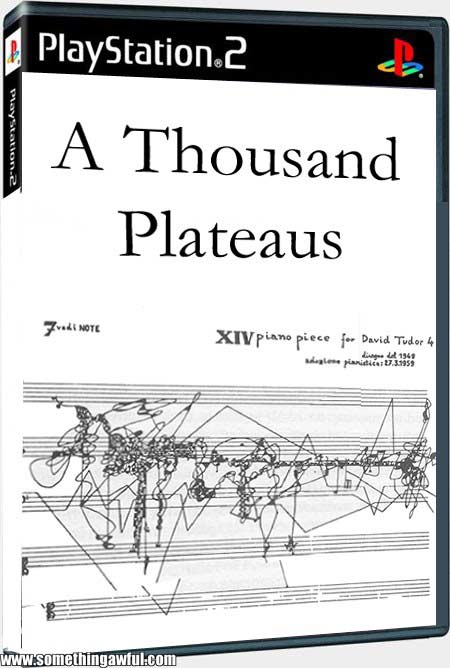
That question seems to me less lame, and honestly it's one I'm going to need some time to work through. For now, because this has been a fairly heady entry (most of my summer posts admittedly have been on the lighter side), I figured I'd end with an image my colleague John Lucaites sent me from somethingawful.com. Sony, like many these days, apparently is becoming Deleuzo-Guattarian..... ;)

Thursday, August 24, 2006

The end is nigh

My research leave is nearly at an end. I can tell that by the dramatic upsurge in responsibilities related to on-campus life that I've been feeling for the last few weeks: preparing and copying syllabi; orientation sessions; meetings with colleagues and students; prepping for classes; and more. I'm at once anxious for the school year to start and sad to bid farewell to what's been a remarkably peaceful and productive time for research and writing.

That's not really why I'm writing, though. I'm writing to draw D&R readers' attention to a hilarious and brilliant skit called "Wikiality" that ran recently on Comedy Central's mock news program, The Colbert Report. You can access the piece on You Tube.

For those of you who haven't seen it, Colbert pokes fun at the online Encyclopedia, Wikipedia. The site, I'm sure most of you know, allows people like you and me to author entries, thereby participating actively in the constitution of knowledge. Wikipedia's been both praised and condemned for this kind of openness: praised, because it facilitates collaborative, more or less democratic knowledge production; and condemned, because, as Colbert and others have noted, if enough contributors agree on something as true, then it becomes true on Wikipedia.

What's remarkable to me about the Colbert piece, and about the debates over Wikipedia more generally, is how in part they reflect debates about the usefulness of "social constructionism"--that is, the doctrine that humans produce meanings, values, and institutions (realities) that we then come to inhabit as though they were necessary and given. The left's embraced social constructionism and put the idea to use in quite critical, politically efficacious ways. What the Colbert piece shows clearly, though, is how the politics of social constructionism are not inherent to social constructionism. He jokingly suggests, for example, that people should access Wikipedia and insist that Africa's elephant population is increasing. (Some, apparently, have followed through on the gag.)

"Wikiality"--both the skit and the notion--underscore how the left needs to do better. It can't simply continue pointing out how knowledge (and what follows from it) is constituted socially, or how people come to inhabit specific regimes of truth. The question--and I'm hardly the first to pose it--is, If devolving into an untenable relativism is undesirable, then what's the alternative to social constructionism?

Monday, August 14, 2006

Space

I work in a box.

Actually, I work in a cinderblock building that was constructed originally to house GIs returning to college after the Second World War. It's since been converted into an office building, though it still maintains many of the trappings of a dormitory. I'm particularly amused by the built-in closets in my office, which have been converted into makeshift bookshelves.

Right now the university is in the midst of tearing down all the buildings in my complex to make way for new high-rise student housing--that is, with the exception of my own. The university's promised to build my department what's called a "generic office building," since we're ostensibly in the way of the looming construction project.

Our current building is configured in such a way that all rooms are pretty much discrete. Each of the faculty has a private, enclosed office with one to two windows that open toward the outside. The classrooms--what few we have--are all self contained. Judging by the name, I suspect that our proposed "generic office building" will reflect a similar architectural disposition.

In some ways, I like my existing building. There's plenty of privacy, and I happen to have a corner office. By the same token, a conversation with a friend of mine in computer science reminded me of just how much difference office space can make when it comes to fostering a certain kind of work environment. He described a lab to me in which seminar spaces are open, as are most of the offices. Conference rooms all have windows facing both the interior and the exterior of the building, which further helps to engender a sense of openness. As a whole, the lab's designed to encourage spontaneous, collegial interactions and to foster the culture of collaboration that's typical in computer science.

I wonder if a similar kind of floor plan would be appropriate to a humanities-based department like mine. Indeed, I've always been struck by the humanities' critique of individualism, a critique that doesn't really get reflected in our work, the vast majority of which consists of single-authored articles and books. Could changing our architecture help foster a more collaborative humanities, one that better practices what it preaches?

Sunday, August 06, 2006

Two great new blogs

Apologies for the hiatus. I was away again, this time traipsing around the remarkable Yellowstone National Park. I also was busy finalizing some aspects of my book, which now has a new title: The Late Age of Print: Everyday Book Culture From Consumerism to Control.

I'm writing, though, to promote two great new blogs. The first is Gil Rodman's Revolution on a Stick, which he launched about a month ago. You may know Gil from his wonderful book Elvis After Elvis: The Posthumous Career of a Living Legend and from his co-edited collection, Race in Cyberspace. Like D&R, Revolution on a Stick is about culture, politics, and stuff. Right now Gil's featuring his paper from the recent Crossroads in Cultural Studies conference in Istanbul, Turkey, and knowing his work, it's sure to be both insightful and funny.

The other new blog is J. Macgregor Wise's Ain't Got Time to Blog, which has been up and running for a few weeks now. Greg's the author of Exploring Technology and Social Space and the co-author of both Culture and Technology: A Primer and the second edition of Media Making. He says that his is Ain't Got Time to Blog will be "an occasional sort of thing, random thoughts, some about work, writing, ideas, some about life." Despite his modesty, though, he's already posted some interesting pieces on media collecting and LP records.

Definitely check them out!

Saturday, July 22, 2006

Television & New Media

My essay "Disowning Commodities: Ebooks, Capitalism, and Intellectual Property Law" was just published in the August 2006 issue of Television and New Media. Here's a copy of the abstract and a link to the table of contents:

This article explores the changing social function of commodities in the United States by exploring the conditions of possibility of electronic books, or "ebooks." By juxtaposing the history of printed books and consumer capitalism on the one hand and the history of ebooks on the other, this article maps an emergent configuration of capitalism, technology, and intellectual property law. Together, these histories evidence how the widespread private ownership of mass-produced consumer goods has grown increasingly problematic from the standpoint of capitalist production—an understanding embedded in many, if not most, commercially available ebook texts and devices. In addition to showing how the category of "private property" is destabilized in relationship to ebooks and other digital technologies, this article strategizes how best to articulate a vital, progressive politics in light of changing material and economic conditions.

Tuesday, July 18, 2006

My blank page

It is done.

Well, a solid draft of it, at any rate--a draft of my book. Having (nearly) completed what amounts to a Herculean amount of writing in just the last few months, I figured now would be an appropriate time to reflect a little on my writing process.

I don't know about you, but whenever I write, I hear in my head the voices of dozens of friends, mentors, and teachers, all of whom have given me writing advice over the years. Let me say right off the bat that much--probably most--of it's been invaluable. I'm grateful to all of my formal and informal writing teachers who've made words such an integral part of my life.

The other shoe has to drop, of course, so here it comes. Inasmuch as I value their advice, I find at times that all the rules I've learned through the years can stifle my writing. I get so caught up sometimes on what not to do, that I have a tremendous amount of difficulty producing any writing at all. Here are just a few examples of "the rules":

  • Never split a verb infinitive (e.g., don't say, "to better explore...")

  • Never leave a dangling participle (e.g., don't say, "the store I left my wallet in."

  • Never end a sentence on a linking verb (e.g., don't say, "She's better than he is.)

  • Avoid the construction, "is that..."

  • Avoid using passive voice constructions (e.g., don't say, "The gift was given to them...")

  • Avoid using the presumptive "we"

  • Don't use contractions

  • Don't start a sentence with the conjunction, "and"

  • Don't use the word "this" without following it directly with a noun

  • Don't address your audience using the direct or implied "you"

  • Minimize your use of the pronoun "I" and avoid it where possible

  • I'm sure there are dozens more, but these most immediately come to mind. The funny thing about these "rules" is that, the more I write, the more I find myself violating them. (See--I just broke the "is that" rule right there.)

    In Francis Bacon: The Logic of Sensation, Gilles Deleuze talks about the art of painting as an art of chasing away all the cliches that occupy any unpainted canvas. I feel the same way when I write: my blank page is full of prosaic statements that challenge me constantly to write something poetic, insightful, moving, or otherwise meaningful. Yet, I also feel as though my blank pages is filled with all the writing advice that's been given to me over the years, advice that sometimes makes it hard for me to say anything at all.

    The most excruciating--and perhaps best--writing advice that was ever given to me came from my 9th grade English teacher. I recall her making the class write highly structured paragraphs, including topic sentences, support, evidence, and clinchers. Any deviation from "the form" would result in lost points. As much as I may have resented the structure at the time, today I often find that when I have trouble writing, I return to this, my base. Interestingly, it's one of the few affirmative pieces of writing advice that I've received--a far cry from all the "don'ts," "avoids," and "nevers."

    Saturday, July 08, 2006

    For those about to rock...

    Well, the writing continues apace. The introduction of my book now is in hand, which leaves just the conclusion between me and a completed manuscript draft. The intensity of the writing has kept me from blogging of late, unfortunately, though I have managed to squeak in some TV time. One of my favorite returning shows is CBS's Rockstar, the latest installment of which features a search for the lead-singer of the band, Supernova.

    Supernova, if you haven't heard, consists of cast-offs from Motley Crue (drummer Tommy Lee, a.k.a. "Rocker Tommy Lee"), Metallica (bassist Jason Newsted), and Guns 'n Roses (guitarist Gilby Clark). They're looking for a lead-singer, and, like INXS last year, they decided to find one through the reality television program, Rockstar.

    First things first: I like the show a great deal. Last year's installment surprised me, in fact, because it ended up having quite a bit of heart. INXS unexpectedly lost its lead-singer, Michael Hutchence, several years ago and found a worthy replacement on Rockstar in J.D. Fortune. Their new album, aptly titled Switch, is quite catchy.

    INXS, though undoubtedly a "serious" band, always had a certain pop-ish dimension to it. At minimum they were more radio-friendly than were Motley Crue and, in their early days, Metallica. As such, it didn't seem so surprising to me that they'd turn to a reality TV show--ostensibly a singing contest--to find a new singer. I'm more surprised to find Supernova doing this. I remember the days when metal acts used to anchor their authenticity in a kind of cool, underground status, whether real or perceived. Supernova clearly doesn't have any such pretensions.

    I realize that Rockstar promotes the band and gives its members an opportunity to see which contestant the largest audience will embrace well in advance of their having to make a final selection. The show's an enormously clever marketing and market-research campaign, to say the least, but to tell you the truth, I kind of miss the days when a singing contest would have been uncool for a metal band.

    Thursday, June 29, 2006

    Thank you, President Gore

    I just had the good fortune of seeing An Inconvenient Truth, the documentary about global warming as presented by Al Gore. It's a must-see.

    Though I'm not a student of global climate change, I consider myself to be someone who's reasonably well-informed. After having seen An Inconvenient Truth, however, I've discovered that I'm not. The film is chock-full of information about the phenomenon, one that's disputed, apparently, only by those outside of the scientific community. There, there's a clear consensus: it's happening, and something needs to be done--yesterday. One of the most provocative moments of the film for me occurred near the middle, where Gore contrasted scientific and popular views on global climate change. Despite the fact that more than 900 scientific studies confirm the existence of global warming without a dissenting voice, more than half of all news stories appearing in the popular media dispute its existence.

    Gore attributes this disparity of views, and the government's refusal to take more positive steps toward a solution, to those who cast doubt on the phenomenon--those who work, for example, in P.R. firms in the employ of energy profiteers. And here I need to make what's admittedly a strange leap to talk about cultural studies. I find, as I finish my own book, that a great deal of what I do as a practitioner of cultural studies is precisely that--to cast doubt. Part of what I try to do, too, is to tell a different, better story about whatever it is I'm trying to talk about, whether it's books, intellectual property, cultural studies, or something else entirely. But I find in my own work, and in at least some work in cultural studies, that we don't move sufficiently beyond casting doubt. I can't help but think that at least sometimes, my own work supports a culture of unhealthy skepticism.

    An Inconvenient Truth shines, though, in that it puts forth a vision of a more environmentally sustainable word and explains how change could be made at the level of the everyday and beyond. The film offers a normative, forward-looking vision of the world, the kind of thing that I think cultural studies would do well to offer, too.

    Wednesday, June 21, 2006

    A second-rate discipline?

    This post has been brewing for some time, and I suppose now's the moment in which to put it out into the world. It's about the discipline of communication--my own discipline--and people's perceptions of it.

    I'll start with a few anecdotes:

    (1) I recall attending a panel at the National Communication Association annual convention a few years ago, in which the panelists reflected on the discipline's wellbeing. One of them, I remember, commented on how the association's newsletter, Spectra, always included a list of books and articles that communication scholars had published in venues outside the discipline. He attributed the list to the discipline's self-consciousness about itself and, more specifically, to a latent sense in which the "real" work was taking place in disciplines other than our own. (I may be mistaken, but I think Spectra has since discontinued the list.)

    (2) I've met with editors at various university and commercial-scholarly presses who've all commented on their ambivalence toward the communication discipline. Generally, they seem to feel as though there's a handful of scholars in the discipline whose work is exciting, but as for the rest of it.... Friends and colleagues who work outside of the communication discipline, or who are in it but don't identify with it, have expressed similar feelings to me.

    (3) I wish I had a dollar for the amount of times a student said to me, "I wanted to major in business, but I couldn't get into the business school. That's why I decided to major in communication." (FYI, that's happened less frequently here at IU, where the department calls itself Communication & Culture.)

    Enough with the anecdotes. By now you're hopefully getting the drift. There seems to be a pervasive sense in which communication is a second-rate discipline, one that's: discomforted with its being relatively young; perceived by many to be intellectually unstimulating; and imagined by some students to be their fallback to a more challenging--and presumably more rewarding--career in taking over the world.

    The odd thing is, many of the most rigorous, imaginative scholars I know work in communication departments--and that's not only because I mostly know communication scholars. Beyond that, though, it's surprising to me to see how much weight both the idea and practice of communication are given in contemporary society. It seems strange that the communication discipline hasn't become the discipline of our age, or at least one of them. Maybe that's because every discipline seems to "do" communication in one form or another. I'm always struck, for example, when literary scholars publish research about, say, the internet, "communicative production," or immaterial labor (which often includes at least some communicative aspect).

    In any case, it's clear that the communication discipline finds itself in an odd place. While its subject-matter unquestionably is important, the discipline doesn't seem to be perceived as equally important. The question remains, why?

    Wednesday, June 07, 2006

    Italian detours

    Well, finally, I'm out from under the yoke of Harry Potter. I've been trying to finish my chapter on Harry Potter impostors, look-alikes, and knockoffs for some time, and for some reason it just kept slipping away. It probably had something to do with the shear volume of Potter doubles out there, not to mention his rights holders' bizarre efforts to make them all disappear. Anyway, the chapter's wrapped up, which means all that's left of my book, Equipment for Living: Everyday Book Culture in the Late Age of Print, is the introduction and conclusion.

    This post isn't about Harry Potter, however. It's about my recent trip to Italy. I spent two weeks there last May (part of the reason for the delay in tying up loose ends in the HP chapter) and got a crash course in Italian history, culture, and politics. I'll spare you the photos of me at the Coliseum, the Vatican, and all the other usual tourist hot-spots, though I have to confess to being rather impressed across the board. Overall, the trip was just fantastic.

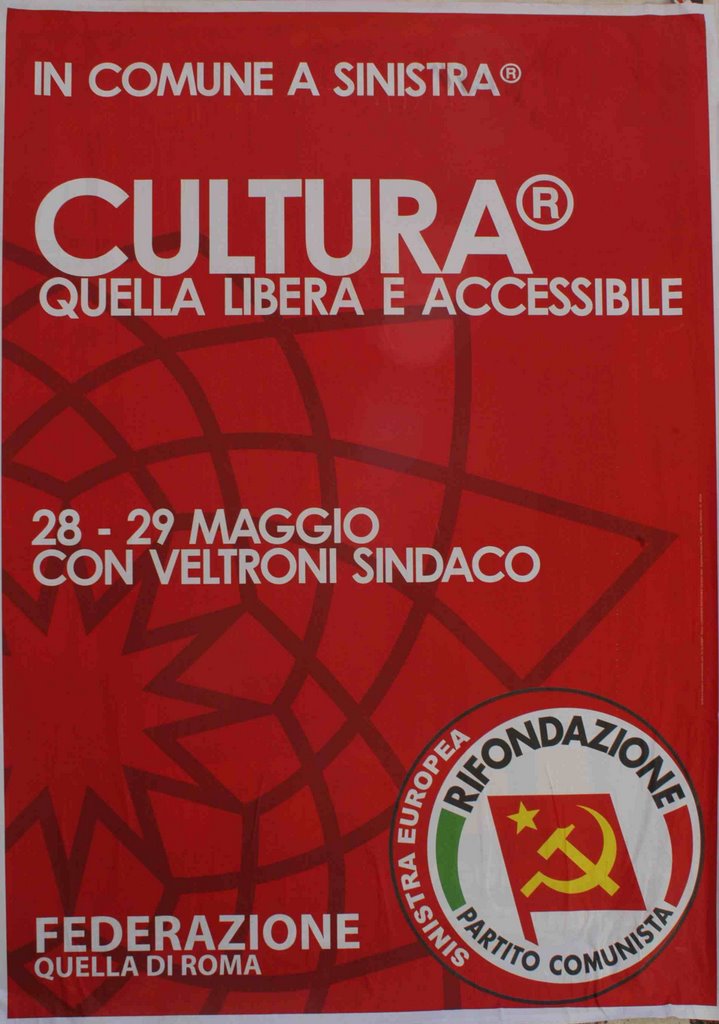
    I also went on something like a Marxist "detour" while I was there, too. The image at left is one I took in Rome; it's of a political poster for the Italian Communist Party. That in itself wasn't interesting to me. What was interesting, though, was what it seemed to be espousing--within the limits of my admittedly spotty Italian, free culture and broad intellectual property rights. Though I think the idea of free culture does have its problems (I'm particularly leery of its libertarian dimensions), it was so refreshing to see a political party campaigning, in part, on a policy of open access to ideas, words, and things.

    This next image is a photo of me at the gravesite of Antonio Gramsci, the brilliant thinker and activist who contributed so much to cultural studies' (and other field's) understanding of hegemony. His ashes are interred at what's called the cemetery for non-Catholics. (Sometimes it's referred to as the Protestant cemetery, though there are Jews and members of various Eastern Orthodox faiths buried there, too.) It's a lovely place--for a cemetery--and it also plays "home" to poets Keats and Shelley. What was intriguing about the cemetery, beyond the "celebrities" buried there, was the fact that Gramsci, apparently, was one of its main attractions.

    Next time I'm in Italy, I suppose I'll have to track down Toni Negri or something....

    Monday, May 29, 2006

    Open access

    CALL FOR CONTRIBUTIONS

    CULTURE MACHINE
    http://www.culturemachine.net

    Recent figures suggest that research published as "open access" is between two and four times more likely to be read and cited than if it is published in print-on-paper form only.

    With this in mind, Culture Machine is seeking contributions to an open access archive for cultural studies and related fields (communication and media studies, visual culture, literary, critical and cultural theory, post-colonial theory, women's studies, new media ...). The archive, called CSeARCH, which stands for Cultural Studies e-Archive, is
    completely free to both download from and upload into.

    You can find CSeARCH at: http://www.culturemachine.net/csearch

    This will let you browse the archive as well as read and download its contents for free. It already contains over 500 books, book chapters, journal issues, articles, interviews and lectures by everyone from Adorno, Agamben, Badiou, Baudrillard, Deleuze and Foucault, through Hebdige, Laclau, Latour, McRobbie and Mouffe, to Nancy, Negri, Poster, Stiegler, Virilio, Virno, Williams and Zizek, to mention just some of the most well known names.

    To upload work into the archive go to the "Submit" page. Fill in the brief details and you'll then be sent a login name and password via e-mail together with a direct link. Click on the link and you'll be there--no need to login at that point the first time. (The password just ensures no one but you can edit your entries.) It's really quick and easy.

    We realise it's going to take a little time to grow. But one of the ideas behind open access archives of this kind is that if everyone deposits a digital copy of their published material in the archive, then it means all the (in this case) cultural studies research is going to be available for students, teachers, lecturers and researchers to use anywhere in the world, for free, for ever (as opposed to being restricted solely to those individuals and institutions which can afford to pay for access to it in the form of journal subscriptions, book cover prices, interlibrary loans, photocopying charges etc.).

    Obviously anything that is already in digital form, be it Word, pdf and so on, can be uploaded easily. If anyone does have early texts in cultural studies and related fields, including out of print books, book chapters, journal editions or articles they can scan in or otherwise make available, that would be great, too.

    However, the idea of the archive is not just to preserve documents from the past but to make widely available recent and even current work: both that which is already published and that which is awaiting publication.

    More information about CSeARCH, including how to include books, book chapters and journal articles which have already been published elsewhere, or which are due to be so in the future, without infringing copyright, is available in: "The Cultural Studies e-Archive Project (Original Pirate Copy)," Culture Machine 5, 2003.

    If you have any questions or problems, just send me an email: gary.hall@connectfree.co.uk

    Thanks, Gary Hall

    Wednesday, May 24, 2006

    Sadness

    I'm saddened to report that James W. Carey, one of the most important contemporary figures in communication, media, and cultural studies, has died. He passed away on Monday, May 22nd in Rhode Island as a result of complications from emphysema. He was 71. You can read his complete obituary online at The Rhode Island News. Columbia University, where Carey was CBS Professor of International Journalism, also has set up a website and discussion forum for those wishing to share their thoughts about Professor Carey's life. You can access it by clicking here.

    Carey taught for many years at the University of Illinois before moving on to Columbia. Titles and appointments, though, don't capture the depth of Carey's intellect, creativity, and passionate commitment to democracy. His writings on space, time, and communication have had an inestimable impact on my own work in media studies and communication theory, as I'm sure they have on the work of countless other people in these and related fields. He balanced history and theory as gracefully as could be, and never once let dogmatic commitments or intellectual trends cloud his vision of how this strange, modern world of ours worked communicatively. Always, the empirical led his writing and research, even as he was one of the most vociferous opponents of an unreconstructed empiricism. Carey's scholarship and mindful disposition are models for us to follow.

    I had the good fortune of meeting Professor Carey twice--once when he gave a lecture at the University of North Carolina, and later on a panel I organized for the National Communication Association's annual convention a few years back. (There was a third time, when I stood behind him on a hotel registration line, though I didn't know him at the time and, to my regret, ended up not talking to him.) He was gracious, patient, and engaged, and if the testimonials of his many students are any indication, these and other qualities were precisely what made him such an extraordinary mentor.

    He will be sorely missed, even by those who barely knew him.


    Addendum: Here is a link to the Poynter Institute website, which has more to say about Carey's life, work, and passing.

    Wednesday, May 03, 2006

    Cracking the code

    A confession: I'm obsessed with Dan Brown's The Da Vinci Code. I haven't read it, to tell you the truth, or at least much of it (I bought the book for my sister and browsed the first few pages), but my work on book history and intellectual property has led me to develop what's fast becoming a compulsive interest in it. Mostly, I'm riveted by the recent court case in Britain, in which the authors of The Holy Blood and the Holy Grail accused Brown of stealing key ideas and the "architecture" of their book. I won't burden you with the details, but a few weeks ago Justice Peter Smith found in Brown's favor.

    Inasmuch as I'm excited by intellectual property law and jurisprudence, on their own they're usually not enough to get me this worked up. What's got me excited is the text of the judge's ruling, which evidently contains its own hidden code--"The Smithy Code." You can read about it by clicking this link to an article that ran recently in The New York Times.

    You'll have to read The Da Vinci Code and The Holy Blood and the Holy Grail to crack The Smithy Code, and since I'm already behind in that department, I'm going to leave it to others to do so. For now, kudos to Justice Smith not only for handing down an intriguing decision, but more importantly, for embodying some of the principles and affects at stake in the case in the text of his ruling. I would, to be honest, like to see more scholarship--and jurisprudence, for that matter--adopt that kind of creative disposition. I've been trying to do this recently in my own work, specifically in my chapter-in-progress on Harry Potter counterfeits and knockoffs, for I find that letting the form of one's writing reflect that of its content can provide for a more engaging kind of academic discourse.

    P.S. Read boldly.

    Wednesday, April 26, 2006

    Leggo my Lego

    I grew up playing with Legos, and now I'm a professor of media and cultural studies. What better way to join my two interests than with Lego Theorists, the latest "release" from theory.org.uk? The sets feature such luminaries as Judith Butler, Anthony Giddens, Stuart Hall (at left), and Angela McRobbie, among others, and each comes equipped with a Lego scene appropriate to her or his work.

    Before you get too excited (or put off) by the prospect of Lego Theorists, I gather that the sets don't really exist--though I suppose, if you're innovative enough with some off-the-shelf Legos, that you could build one yourself. Nevertheless, there is a growing body of academic/celebrity/activist paraphernalia out there, such as the Karl Marx and Michel Foucault finger puppets I have in my campus office. (I bought them at a local novelty store here in Bloomington, Indiana.) Part of me has always been bothered with my having purchased them, since, at some level, they represent making a commodity of individuals who had grave misgivings about a commodity-driven life. Yet, there is a certain, well, novelty about them, and if nothing else there's an odd kind of thrill in knowing that scholarly work can produce some kind of public recognition and impact. In part that's why I do what I do, although I'd be hard-pressed to imagine what I'd look like as a finger puppet, much less as a Lego character.

    Saturday, April 22, 2006

    Deleuze conference

    Deleuze: Texts and Images

    The 9th Annual University of South Carolina Comparative Literature Conference

    5th - 8th April, 2007

    Over the past two decades, readers of the works of Gilles Deleuze have had several opportunities to participate in international conferences held at Trent University and organized by Constantin V. Boundas. In that tradition, we announce the organization of a conference to take place on the campus of the University of South Carolina (Columbia, SC, USA), between April 5 and 8, 2007, sponsored by the Program in Comparative Literature, the English Department, and the College of Arts and Sciences.

    The conference theme, "Gilles Deleuze: texts and images," is meant to be understood inclusively rather than exclusively. That is, while recognizing theconference's focus on the work of Gilles Deleuze, the organizers encourage broad and comparative interpretations and commentaries from Deleuzian perspectives on subjects such as literature, philosophy, painting and film, as well as exegeses of Deleuze's body of work that engage with ontological and epistemological concepts and problems. Presentations by the invited plenary speakers--Eric Alliez, Ronald Bogue, Constantin V. Boundas, and Elizabeth Grosz--will be supplemented by speakers in parallel sessions.

    The conference will be held on the historic campus of the University of South Carolina (http://president.sc.edu/history.html). The weather in April will be mild, and the campus will be in bloom. Columbia is mid-sized city with a major airport and is easily accessible. It is the capital of South Carolina and has many fine restaurants. Conference participants will be lodged on campus at the new Inn at USC (http://www.innatusc.com/); rooms have been reserved at a special conference rate of $116.00 for those making their reservations by February 20, 2007. There are also other hotels nearby.

    Those interested in speaking at the conference should send a title, a 750-word abstract, and a 250-word bibliographical biography to delcon2k7@yahoo.com as a Word or RTF attachment no later than October 1, 2006. Additional details will be available at http://www.cas.sc.edu/DLLC/CPLT/activities/9thannucon.html.

    Organizing Committee:

    Eugene W. Holland, Ohio State University
    Paul Allen Miller, University of South Carolina
    Daniel W. Smith, Purdue University
    Charles J. Stivale, Wayne State University