In conjunction with the students in my graduate seminar, and in conversation with my fellow NCA panelists (see my post on Nov. 21, 2005, below), I've been wondering lately what it would mean to take up the writings of Deleuze & Guattari. As far as I can tell, there are or have been five principal modes of engaging their work:
(1) What I like to call, "rhizome spotting." Here, the analyst tries to find evidence of Deleuzoguattarian concepts at work in the world.
(2) Applications. In this case, the analyst takes up one or more Deleuzoguattarian concepts and "applies" them to an empirical object.
(3) Operationalizing/extending Deleuze & Guattari's work. A lot of interesting work operates at this level. Here, the analyst engages the work of Deleuze and Guattari and makes their work resonate with one or more empirical objects. Often this results in some kind of extension or elaboration of Deleuzoguattarian thought.
(4) Reading what Deleuze and Guattari have read and extending their work therefrom. My sense is that Brian Massumi and Greg Seigworth tend to engage in this kind of practice, as in, for example, where Seigworth reads Freud's early texts for evidence of the ways in which he sublimated affect.
(5) Implicit dialogue. I'm most tentative about this category, but I've long felt that people like Giorgio Agamben and Jean-Luc Nancy take up Deleuzoguattarian ideas without mentioning D+G's work explicitly. For example, both Agamben's "The Coming Community" and Nancy's "The Inoperative Community" seem to be responses of sorts to the Deleuzoguattarian insight, "the people are missing."
Obviously these aren't neat and tidy categories, and some very well may disagree with my categorizations or the way in which I've identified the work of specific authors relative to that of D+G. It also should be clear that there's something of a hierarchy here, and that I do not believe that the first few modes of engagement are particularly Deleuzoguattarian--at least in any interesting way. I'd be curious to hear how others feel about this schema.
Sunday, November 27, 2005


Thursday, November 24, 2005
Happy (US) Thanksgiving
Though I'm not a vegetarian, I thought, given the US Thanksgiving Holiday, that linking to the Meatrix might be appropriate. Check it out.
Tuesday, November 22, 2005
Coming soon
 I just updated my website with this information, but I figured it would be worthwhile to post the information to D&R as well. Kembrew McLeod, a colleague at the University of Iowa, and I are editing a special issue of the journal "Cultural Studies" on the politics of intellectual properties. It should be coming out either in February or April, 2006, assuming all goes well on the production-end of things. In the meantime, here's the table of contents. It's a fantastic issue.
(1) Ted Striphas & Kembrew McLeod, “Introduction—Strategic Improprieties: Cultural Studies, the Everyday, and Intellectual Property Law"
(2) Adrian Johns, "Intellectual Property and the Nature of Science"
(3) McKenzie Wark, "Information Wants to be Free (But is Everywhere in Chains)"
(4) Andrew Herman, Rosemary J. Coombe, & Lewis Kaye, "Your Second Life? Goodwill and the Performativity of Intellectual Properties in On-Line Games"
(5) Steve Jones, "Reality© and Virtual Reality©: When Virtual and Real Worlds Collide"
(6) Jane Gaines, "Early Cinema, Heyday of Copying: The Too Many Copies of L'’arroseur arose"
(7) Gilbert B. Rodman & Cheyanne Vanderdonckt, "Music for Nothing or, I Want My MP3: The Regulation and Recirculation of Affect"
(8) David Sanjek, "Ridiculing the 'White Bread Original': The Politics of Parody and Preservation of Greatness in Luther Campbell a.k.a. Luke Skyywalker et al. v. Acuff-Rose Music, Inc."
(9) Eva Hemmungs Wirten, “Out of Sight and Out of Mind: On the Cultural Hegemony of Intellectual Property (Critique)"
(10) Siva Vaidhyanathan, “Afterword—Critical Information Studies: A Bibliographic Manifesto”
Monday, November 21, 2005
"Media effects without cause & effect"
I just returned from the National Communication Association's (US) annual convention in Boston, Massachusetts. It consisted, as usual, of a wide range of work; most of it was uninteresting, though a few papers and sessions stood out. One panel to which I contributed was called, "Communication in a Deleuze-Guattarian Framework: Image-Event, Deterritorialization, Difference, Assemblage." My piece, "Difference & Repetition in Harry Potter," was on the popular book series' relationship to philosophy and intellectual property law, and is a much-distilled fragment of a chapter I'm working on for my book on book culture, "Equipment for Living." I was joined by co-panelists Gordon Coonfield (Villanova U), session organizer (thank you!) Mehdi Semati (Eastern Illinois U), Greg Wise (Arizona State U-West), and respondent Greg Seigworth (Millersville U).
I have a couple of things to say: first, our session was programmed opposite of Ernesto Laclau talking about Lacan, which meant that a lot of our potential audience (understandably) got siphoned off. On top of that, though, our session was located literally in the hinterlands of one of the conference hotels: at the very end of a long, dark, circuitous hallway near an emergency exit. Perhaps that tells us something about the discipline of communication's relationship to Deleuzoguattarian thought. Sigh.
I enjoyed my co-panelists' presentations immensely, and I'm especially taken with Greg Wise's suggestion that media researchers begin writing about media effects absent the language of cause and effect. I'm not sure what that means, exactly, but it's a provocative idea that I look forward to trying on. Perhaps others of you have thought through this idea a bit and would care to chime in as well.
I have a couple of things to say: first, our session was programmed opposite of Ernesto Laclau talking about Lacan, which meant that a lot of our potential audience (understandably) got siphoned off. On top of that, though, our session was located literally in the hinterlands of one of the conference hotels: at the very end of a long, dark, circuitous hallway near an emergency exit. Perhaps that tells us something about the discipline of communication's relationship to Deleuzoguattarian thought. Sigh.
I enjoyed my co-panelists' presentations immensely, and I'm especially taken with Greg Wise's suggestion that media researchers begin writing about media effects absent the language of cause and effect. I'm not sure what that means, exactly, but it's a provocative idea that I look forward to trying on. Perhaps others of you have thought through this idea a bit and would care to chime in as well.
Monday, November 14, 2005
REQUIRED reading
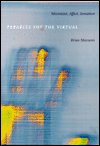 You may be wondering why I keep mentioning books by Deleuze, Guattari, and by those who've been inspired by their work. Partly this has to do with the ambit of "Differences & Repetitions." I'm also teaching a class this term called "The Problem of the Media in Deleuze & Guattari" (see my webpage under "teaching" for a more complete description), so these texts are very much on my mind. I can't help but think--and think publicly--about them.
I have to say, other than the primary works we've been reading, Brian Massumi's "Parables for the Virtual" easily is the most provocative book I've encountered in the class this term. The book's just too imaginative and broad-ranging for me to provide an adequate summary of it here. Suffice it to say that it's just one of only a handful of works that does more than "spot" Deleuzoguattarian concepts in action. In fact, what's marvelous about the book is the way in which it generates concepts all its own, building on, but moving away from, the work of D+G. This I take to be one of the primary injunctions of a deleuzoguattarian critical practice--to draw a line of flight away from their work. The other thing I'll say is how ecumenical and respectful the work is. In chapter two, for instance, Massumi really *listens* to the autobiography of Ronald Reagan, and from it he extracts concepts that would help to explain the devastating success of Reaganism. Most critics simply would dismiss the book as the meandering recollections of an aging B-grade actor.
I'm moved by a lot of what I read, but there's very little that compels me in the way that this book has. It ought to be absolutely, positively required reading for anyone at work in the humanities--or, for that matter, for anyone who wants to imagine (and enact) the possibility of more ethical ways of life.
Wednesday, November 02, 2005
Will the future unfold?
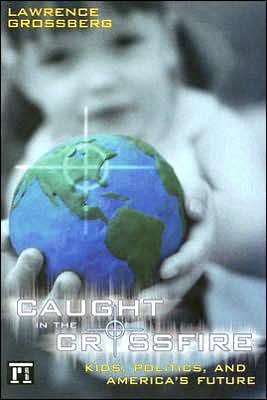 I'm bothered. I'm bothered because more people aren't talking about this book.
I'll put my cards on the table: Lawrence Grossberg was (and always will be) my teacher, my mentor. But that's not why I'm disturbed about the generally quiet reception of his important new book, "Caught in the Crossfire: Kids, Politics, and America's Future" (Paradigm Publishers, 2005). What's even more troubling is the minimal amount of attention that his argument seems to be receiving within the culture at large. The growing crackdown on kids--criminalizing, marginalizing, and otherwise mistreating them--is no more and no less than an attack on the future, Grossberg argues, an attack on "American modernity" itself. If we take seriously what Lefebvre says in the quotation atop this blog, then we should be fearful of the implications of America's war on kids. What would it mean to foreclose on the very possibility of the future, to fold it up so tightly that we no longer can find it amid all the twists, turns, pleats, knots, and layers?
Read this book, promote it, review it (not just in academic journals), and do what you can to engage its empirical and theoretical findings. It would be a cliche (is that so wrong?) to say, "do it for the children." If cliches don't get you going, then why not do it for the future?
P.S. Hey, Paradigm Publishers! Why not activate Amazon.com's "search inside" features for "Caught in the Crossfire," so that people can browse the text online?
Subscribe to:
Posts (Atom)