Thursday, March 23, 2006
...and still more chatter
Since my previous post--heck, it was just a few hours ago--more people have chimed in on the piece Siva Vaidhyanathan's penned for Kembrew McLeod and my special issue of Cultural Studies. Here are some links to the discussion, courtesy of Kembrew:
Liberal Education Today
Virtualpolitik
Funferal
ACR Log
Simong


People are talking...
I just caught wind of the fact that people already are talking about the special issue of the journal Cultural Studies Kembrew McLeod and I co-edited on the politics of intellectual properties. The buzz thus far mostly has concerned Siva Vaidhyanathan's Afterword to the issue, in which he talks about an emergent field he calls "Critical Information Studies." You can check out what's been said on Siva's Blog. It contains some links to Boing Boing and other sites where the conversation has been happening. I should mention that the rest of the issue is fantastic, too, and definitely worth checking out.
The funny thing is, I don't think the issue's actually out. I haven't received my copy of the journal yet, nor have I gotten a hold of any offprints. (I haven't even received the preceding issue, for that matter, but that's another story....) Needless to say, I'm eagerly anticipating seeing the issue, especially now that it's starting to create something of a stir.
The funny thing is, I don't think the issue's actually out. I haven't received my copy of the journal yet, nor have I gotten a hold of any offprints. (I haven't even received the preceding issue, for that matter, but that's another story....) Needless to say, I'm eagerly anticipating seeing the issue, especially now that it's starting to create something of a stir.
Thursday, March 16, 2006
Help
 Last November, I posted a short piece called "Will the future unfold?" It concerned Lawrence Grossberg's latest book, Caught in the Crossfire: Kids, Politics, and American's Future (Paradigm Publishers, 2005). If you haven't read it, please make sure to. It's a fantastic piece of scholarship.
I'm writing now to ask for your help. I've been charged with composing a letter nominating Caught in the Crossfire for one of the National Communication Association's annual book awards. (NCA, for those of you who don't know, is the major professional organization for communication research and scholarship in the United States.) I'm thrilled to do this, obviously, because I'm convinced everyone ought to be reading the book. The trouble is, I'm not able to speak very well to its reception. It was published just this past May, and to the best of my knowledge it hasn't yet been reviewed or widely commented on. That's where you come in. If you've read and enjoyed Caught in the Crossfire, would you mind leaving a comment, below, along with your name and where you're writing from? If you do, please know that I might include your response, or an excerpt thereof, in my letter to NCA. I'd like it to reflect a wide, international readership, so comments from people both inside and outside the U.S. are welcome.
Please post your comments by no later than March 21st. Thanks in advance for your help!
Wednesday, March 15, 2006
Culture Machine
CULTURE MACHINE 8 (2006)
http://www.culturemachine.net
COMMUNITY
Edited by Dorota Glowacka
In recent years, the notion of community has emerged as an important but also contested field of enquiry. The ‘new’ discourse of community has challenged the understanding of community as related to the nation-state, and as an ‘imagined’ cultural and political artifact that provides a collectivity with the sense of unity, continuity, and closure. Jacques Derrida has insisted that such circumscribed articulations of community conceal but also perpetrate foundational violence that underlies the collective myth. Philosophical investigations of this myth by Jean-Luc Nancy, Maurice Blanchot and Giorgio Agamben have opened up the concept of community onto a broader politico-ethical and cultural context. Here, Nancy’s call for the disbanding of the immanent community has been especially influential. According to him, community as the dominant Western political formation, founded upon a totalizing, exclusionary myth of national, racial or religious unity, must be tirelessly ‘unworked’ in order to accommodate more inclusive and fluid forms of Being-in-common, of dwelling together
in the world.
The contributors to this issue of Culture Machine navigate multiple tangents of community as a socio-historical, politico-ethical, and cultural construct. The authors comment on the nascent virtual or networked communities as the forum for cultural avant-garde and politically progressive forces but also as, potentially, the mainstay of political conservatism. They ask about the function of community in rapidly shifting geo-political contexts, of which the European community
is a fecund if also volatile contemporary example, as is the plethora of post-colonial, post-Western articulations.
The ‘Community’ issue features:
* Editorial, 'Community: Comme-un?'
* Kuisma Korhonen, 'Textual Communities: Nancy, Blanchot, Derrida'
* Ignass Devisch, 'The Sense of Being(-)with Jean-Luc Nancy'
* Marie-Eve Morin, 'Putting Community under Erasure: Derrida and Nancy
on the Plurality of Singularities'
* Dorota Glowacka, 'Community and the Work of Death: Thanato-ontology in
Hannah Arendt and Jean-Luc Nancy'
* Timothy J. Deines, 'Bartleby the Scrivener, Immanence and the
Resistance of Community'
* Angela Mitropoulos and Brett Neilson, 'Cutting Democracy's Knot'
* Paulina Tambakaki, 'Global Community, Global Citizenship?'
* Daniel H. Ortega, '"En Cada Barrio": Timocracy, Panopticism and the
Landscape of a Normalized Community'
* John Paul Ricco, 'The Surreality of Community: Frederic Brenner's
Diaspora: Homelands in Exile'
* Jake Kennedy, 'Gins, Arakawa and the Undying Community'
* Petra Kuppers, 'Community Arts Practices: Improvising Being-Together'
* Natalie Cherot, 'Transnational Adoptees: Global Biopolitical Orphans
or an Activist Community?'
-------------------------
CONTRIBUTING TO CULTURE MACHINE
Culture Machine publishes new work from both established figures and up-and-coming writers. It is fully refereed, and has an International Advisory Board which includes Robert Bernasconi, Lawrence Grossberg, Peggy Kamuf, Alphonso Lingis, Meaghan Morris, Paul Patton, Avital Ronell and Nicholas Royle. Among the distinguished contributors to the first seven editions of Culture Machine are Mark Amerika, Alain Badiou, Geoffrey Bennington, Bifo, Simon Critchley, Jacques Derrida, Diane Elam, Johan Fornäs, Henry A. Giroux, Lawrence Grossberg, Stevan Harnad, N. Katherine Hayles, Peggy Kamuf, David Kolb, Ernesto Laclau, J. Hillis Miller, Anna Munster, Michael Naas, Mark Poster, Melinda Rackham, Tadeusz Slawek, Bernard Stiegler, Kenneth Surin, Gregory L. Ulmer, Hal Varian, Cathryn Vasseleu and Samuel Weber.
Culture Machine welcomes original, unpublished submissions on any aspect of culture and theory. All contributions to Culture Machine are refereed anonymously. Anyone with material they wish to submit for publication is invited to contact:
Culture Machine c/o Dave Boothroyd and Gary Hall
e-mail: g.hall@mdx.ac.uk and d.boothroyd@kent.ac.uk
All contributions will be peer-reviewed; all correspondence will be
responded to.
For more information, visit the Culture Machine site at:
http://www.culturemachine.net
http://www.culturemachine.net
COMMUNITY
Edited by Dorota Glowacka
In recent years, the notion of community has emerged as an important but also contested field of enquiry. The ‘new’ discourse of community has challenged the understanding of community as related to the nation-state, and as an ‘imagined’ cultural and political artifact that provides a collectivity with the sense of unity, continuity, and closure. Jacques Derrida has insisted that such circumscribed articulations of community conceal but also perpetrate foundational violence that underlies the collective myth. Philosophical investigations of this myth by Jean-Luc Nancy, Maurice Blanchot and Giorgio Agamben have opened up the concept of community onto a broader politico-ethical and cultural context. Here, Nancy’s call for the disbanding of the immanent community has been especially influential. According to him, community as the dominant Western political formation, founded upon a totalizing, exclusionary myth of national, racial or religious unity, must be tirelessly ‘unworked’ in order to accommodate more inclusive and fluid forms of Being-in-common, of dwelling together
in the world.
The contributors to this issue of Culture Machine navigate multiple tangents of community as a socio-historical, politico-ethical, and cultural construct. The authors comment on the nascent virtual or networked communities as the forum for cultural avant-garde and politically progressive forces but also as, potentially, the mainstay of political conservatism. They ask about the function of community in rapidly shifting geo-political contexts, of which the European community
is a fecund if also volatile contemporary example, as is the plethora of post-colonial, post-Western articulations.
The ‘Community’ issue features:
* Editorial, 'Community: Comme-un?'
* Kuisma Korhonen, 'Textual Communities: Nancy, Blanchot, Derrida'
* Ignass Devisch, 'The Sense of Being(-)with Jean-Luc Nancy'
* Marie-Eve Morin, 'Putting Community under Erasure: Derrida and Nancy
on the Plurality of Singularities'
* Dorota Glowacka, 'Community and the Work of Death: Thanato-ontology in
Hannah Arendt and Jean-Luc Nancy'
* Timothy J. Deines, 'Bartleby the Scrivener, Immanence and the
Resistance of Community'
* Angela Mitropoulos and Brett Neilson, 'Cutting Democracy's Knot'
* Paulina Tambakaki, 'Global Community, Global Citizenship?'
* Daniel H. Ortega, '"En Cada Barrio": Timocracy, Panopticism and the
Landscape of a Normalized Community'
* John Paul Ricco, 'The Surreality of Community: Frederic Brenner's
Diaspora: Homelands in Exile'
* Jake Kennedy, 'Gins, Arakawa and the Undying Community'
* Petra Kuppers, 'Community Arts Practices: Improvising Being-Together'
* Natalie Cherot, 'Transnational Adoptees: Global Biopolitical Orphans
or an Activist Community?'
-------------------------
CONTRIBUTING TO CULTURE MACHINE
Culture Machine publishes new work from both established figures and up-and-coming writers. It is fully refereed, and has an International Advisory Board which includes Robert Bernasconi, Lawrence Grossberg, Peggy Kamuf, Alphonso Lingis, Meaghan Morris, Paul Patton, Avital Ronell and Nicholas Royle. Among the distinguished contributors to the first seven editions of Culture Machine are Mark Amerika, Alain Badiou, Geoffrey Bennington, Bifo, Simon Critchley, Jacques Derrida, Diane Elam, Johan Fornäs, Henry A. Giroux, Lawrence Grossberg, Stevan Harnad, N. Katherine Hayles, Peggy Kamuf, David Kolb, Ernesto Laclau, J. Hillis Miller, Anna Munster, Michael Naas, Mark Poster, Melinda Rackham, Tadeusz Slawek, Bernard Stiegler, Kenneth Surin, Gregory L. Ulmer, Hal Varian, Cathryn Vasseleu and Samuel Weber.
Culture Machine welcomes original, unpublished submissions on any aspect of culture and theory. All contributions to Culture Machine are refereed anonymously. Anyone with material they wish to submit for publication is invited to contact:
Culture Machine c/o Dave Boothroyd and Gary Hall
e-mail: g.hall@mdx.ac.uk and d.boothroyd@kent.ac.uk
All contributions will be peer-reviewed; all correspondence will be
responded to.
For more information, visit the Culture Machine site at:
http://www.culturemachine.net
Monday, March 06, 2006
Pathetic
Did you watch the Oscars? I'll say that, on the whole, I was pleased with the winners. I was most excited to see Ang Lee win a long-overdue best director award, and inasmuch as I was sad that Brokeback Mountain didn't take home the best picture honor, at least another socially-conscious movie, Crash, did. Still, I was bothered....
I'll admit that the stage set was quite nice, decked out as it was in the look of a resplendent art-deco movie palace. The scrolling movie posters were a nice touch, as was the dynamic overhead marquee that displayed the winners' names. By mid-broadcast, though, it was clear that the set design was more than just elaborate window-dressing. It was part of a rather heavy-handed--and frankly pretty sad--effort on the part of the Academy of Motion Picture Arts & Sciences to convince viewers of the enduring virtues of theatrical movie-going.
Jake Gyllenhaal led the charge during what can only be described as a painfully awkward monologue in which he impugned portable DVD players--doubtless at the Academy's request. It was clear from his body language and the way he stumbled through his lines--I think he nearly laughed once--that he didn't believe what he was saying. Gyllenhaal was followed by Academy President Sid Ganis, who dragged out the tired old saw about how nothing's better than seeing a movie on the big screen, with the sound coming at you from all sides, and how the DVD home theater experience simply doesn't compare.
I have to admit to being baffled by these anti-DVD philippics. Sure, box-office receipts were down this year. But you'd think the movie industry would embrace the fact that DVD sales have become its cash cow, given how they've now more lucrative than theatrical movie-going. (See Charles Acland's brilliant Screen Traffic: Movies, Multiplexes, and Global Culture, if you haven't already.) So why dis the DVD? Why not simply own up to the fact that Hollywood needs to figure out how to make DVDs and theatrical movie-going lead an even more complementary and compatible existence? Is this just nostalgia for silver screens and celluloid, or is there something more at stake here?
I'll admit that the stage set was quite nice, decked out as it was in the look of a resplendent art-deco movie palace. The scrolling movie posters were a nice touch, as was the dynamic overhead marquee that displayed the winners' names. By mid-broadcast, though, it was clear that the set design was more than just elaborate window-dressing. It was part of a rather heavy-handed--and frankly pretty sad--effort on the part of the Academy of Motion Picture Arts & Sciences to convince viewers of the enduring virtues of theatrical movie-going.
Jake Gyllenhaal led the charge during what can only be described as a painfully awkward monologue in which he impugned portable DVD players--doubtless at the Academy's request. It was clear from his body language and the way he stumbled through his lines--I think he nearly laughed once--that he didn't believe what he was saying. Gyllenhaal was followed by Academy President Sid Ganis, who dragged out the tired old saw about how nothing's better than seeing a movie on the big screen, with the sound coming at you from all sides, and how the DVD home theater experience simply doesn't compare.
I have to admit to being baffled by these anti-DVD philippics. Sure, box-office receipts were down this year. But you'd think the movie industry would embrace the fact that DVD sales have become its cash cow, given how they've now more lucrative than theatrical movie-going. (See Charles Acland's brilliant Screen Traffic: Movies, Multiplexes, and Global Culture, if you haven't already.) So why dis the DVD? Why not simply own up to the fact that Hollywood needs to figure out how to make DVDs and theatrical movie-going lead an even more complementary and compatible existence? Is this just nostalgia for silver screens and celluloid, or is there something more at stake here?
Wednesday, March 01, 2006
The greediest guys in the room
 Last night, I had the good fortune of seeing the documentary Enron: The Smartest Guys in the Room. I'll say right off the bat that I would like to have heard more from the workers whose pensions and retirement plans got scuttled along with the company. Beyond that, though, the documentary provides a pithy look into the world of unmitigated corporate greed.
First, I'm just fascinated by Enron's use of "mark-to-market" accounting, which essentially allowed it to claim earnings on investments that hadn't yet generated any revenue--and in many cases never generated any revenue at all. As it happens, a few days ago I happened to be reading over one of Amazon.com's annual shareholder reports. (No...I'm not a shareholder. I was referring to it for book-related research.) There I discovered--and the company doesn't try to hide this fact--that it's remained afloat in part through infusions of venture capital, but also, and more importantly, by maintaining positive cash flow. It's done so by keeping a "negative operating cycle," which, I gather, means that the company collects on payments from customers weeks before it ever has to make payments on its loans. Essentially, Amazon gets a free, short-term cash "loan" every time someone makes a purchase.
So where's all this going? I'm beginning to believe that those of us interested in cultural studies need to become more mindful of these kinds of accounting tactics. They seem to me part and parcel of the new capitalism, and any political-economic analysis that doesn't "get" modern accounting is likely to come up short in the end. It's not, for example, all about bio-power and affective labor, as important as those "public" activities might be. I'm not saying that we need to become accountants, but we do need to understand the extent to which accounting constitutes knowledge work integral to capitalism's continued wellbeing. We need, in effect, a better understanding of what goes on in capitalism's back office.
The other thing that struck me about the documentary was what it had to say about "free market" economics. Evidently, there's no such thing. Enron and others pushed hard for California to de-regulate its energy market, claiming that government only stultified possibilities for keeping prices down and letting profits soar. Yet, the documentary clearly showed how Enron intervened in the California energy market to manipulate electricity supply and demand, with the intention then of inflating prices. Those who champion the "free" market, it seems, really want to pull the market's strings themselves.
Friday, February 24, 2006
Copyright Criminals remix contest
Kembrew McLeod asked me to post this announcement to D&R. He and the copyright activism organization, Creative Commons, are holding a contest in conjunction with a documentary Kembrew's co-directing and producing. Here's the information.
-------------------------------------------------------------------------------
COPYRIGHT CRIMINALS CONTEST EXTENDED UNTIL MARCH 14
New Samples from Chuck D and George Clinton Available for Use
Creative Commons, along with filmmakers Kembrew McLeod and Ben Franzen, today announced that due to overwhelmingly positive response, the Copyright Criminals Remix Contest has been extended by two weeks, ending on March 14. Additionally, new vocal samples from influential rapper Chuck D (of Public Enemy) and pioneering funk musician George Clinton (of Parliament-Funkadelic) have been made available for use in the competition.
Winners will be chosen according to the same criteria as originally announced; no other contest details are changed.
The Copyright Criminals Remix Contest encourages producers, DJs, and remixers from around the world to use audio snippets from the upcoming documentary film Copyright Criminals in new, original songs. One winner will have his/her music featured prominently in the final edit of Copyright Criminals. The winning track, along with 11 runners-up, will be included on the film's companion CD. The contest is going on now at http://ccmixter.org/.
Drawing from more than fifty interviews with prominent musicians, artists, scholars, lawyers, and music industry representatives, Copyright Criminals looks at the development of sound collage (also known as sampling). The film explores the complicated impact that copyright law has had on the creative practice of sampling and studies the conflicting opinions artists and others have about appropriation.
Samples of dialogue by artists like De La Soul, DJ Qbert, Matmos, Coldcut, and members of Negativland – all taken from interviews conducted for Copyright Criminals – are available online at the popular remix community ccMixter.org for use as source material to be included in entrants' songs. Entries will be judged by McLeod, Franzen, and author/producer Jeff Chang. Contest rules and details are available at http://ccmixter.org.
About the judges
Kembrew McLeod is a professor at the University of Iowa and an award-winning independent documentary filmmaker. McLeod has written music criticism for Rolling Stone, the Village Voice, and MOJO; and has authored two books, most recently Freedom of Expression®: Overzealous Copyright Bozos and Other Enemies of Creativity (Doubleday).
Ben Franzen is an Atlanta-based artist who owns an independent production company called Changing Images LLC, which specializes in video, photography, and multimedia. Franzen edits the animated TV program Squidbillies, which appears as part of the Cartoon Network’s Adult Swim line-up.
Jeff Chang is the author of the American Book Award-winning Can't Stop Won't Stop: A History of the Hip-Hop Generation. In 1993, he co-founded and ran the influential indie hip-hop label, SoleSides (now called Quannum Projects), helping launch the careers of DJ Shadow, Blackalicious, Lyrics Born, and Lateef the Truth Speaker. He has helped produce over a dozen records.
About Creative Commons
Creative Commons is a nonprofit organization that promotes the creative re-use of intellectual and artistic works by empowering authors and audiences. It is sustained by the generous support of the Center for the Public Domain, the John D. and Catherine T. MacArthur Foundation, the Omidyar Network, and the Hewlett Foundation. For more information, visit CC's Web site.
Contact:
Eric Steuer
Creative Director, Creative Commons
eric@creativecommons.org
Kembrew McLeod
Co-director, Copyright Criminals
kembrew@kembrew.com
-------------------------------------------------------------------------------
COPYRIGHT CRIMINALS CONTEST EXTENDED UNTIL MARCH 14
New Samples from Chuck D and George Clinton Available for Use
Creative Commons, along with filmmakers Kembrew McLeod and Ben Franzen, today announced that due to overwhelmingly positive response, the Copyright Criminals Remix Contest has been extended by two weeks, ending on March 14. Additionally, new vocal samples from influential rapper Chuck D (of Public Enemy) and pioneering funk musician George Clinton (of Parliament-Funkadelic) have been made available for use in the competition.
Winners will be chosen according to the same criteria as originally announced; no other contest details are changed.
The Copyright Criminals Remix Contest encourages producers, DJs, and remixers from around the world to use audio snippets from the upcoming documentary film Copyright Criminals in new, original songs. One winner will have his/her music featured prominently in the final edit of Copyright Criminals. The winning track, along with 11 runners-up, will be included on the film's companion CD. The contest is going on now at http://ccmixter.org/.
Drawing from more than fifty interviews with prominent musicians, artists, scholars, lawyers, and music industry representatives, Copyright Criminals looks at the development of sound collage (also known as sampling). The film explores the complicated impact that copyright law has had on the creative practice of sampling and studies the conflicting opinions artists and others have about appropriation.
Samples of dialogue by artists like De La Soul, DJ Qbert, Matmos, Coldcut, and members of Negativland – all taken from interviews conducted for Copyright Criminals – are available online at the popular remix community ccMixter.org for use as source material to be included in entrants' songs. Entries will be judged by McLeod, Franzen, and author/producer Jeff Chang. Contest rules and details are available at http://ccmixter.org.
About the judges
Kembrew McLeod is a professor at the University of Iowa and an award-winning independent documentary filmmaker. McLeod has written music criticism for Rolling Stone, the Village Voice, and MOJO; and has authored two books, most recently Freedom of Expression®: Overzealous Copyright Bozos and Other Enemies of Creativity (Doubleday).
Ben Franzen is an Atlanta-based artist who owns an independent production company called Changing Images LLC, which specializes in video, photography, and multimedia. Franzen edits the animated TV program Squidbillies, which appears as part of the Cartoon Network’s Adult Swim line-up.
Jeff Chang is the author of the American Book Award-winning Can't Stop Won't Stop: A History of the Hip-Hop Generation. In 1993, he co-founded and ran the influential indie hip-hop label, SoleSides (now called Quannum Projects), helping launch the careers of DJ Shadow, Blackalicious, Lyrics Born, and Lateef the Truth Speaker. He has helped produce over a dozen records.
About Creative Commons
Creative Commons is a nonprofit organization that promotes the creative re-use of intellectual and artistic works by empowering authors and audiences. It is sustained by the generous support of the Center for the Public Domain, the John D. and Catherine T. MacArthur Foundation, the Omidyar Network, and the Hewlett Foundation. For more information, visit CC's Web site.
Contact:
Eric Steuer
Creative Director, Creative Commons
eric@creativecommons.org
Kembrew McLeod
Co-director, Copyright Criminals
kembrew@kembrew.com
Monday, February 20, 2006
Deleuze: The new Lacan?
Last week, the review section of The Chronicle of Higher Education contained an intriguing piece by Krin Gabbard entitled, "Cinema and Media Studies: Snapshot of an 'Emerging' Discipline." He just came off a stint as program chair of the Society for Cinema and Media Studies (SCMS), which is the major professional organization representing scholars in those fields. The piece makes a pitch for the Council of Learned Societies' formally recognizing media studies as a discipline. Even more intriguing to me, however, was his discussion of trends he saw in programming for the upcoming SCMS convention. He had this to say:
I was at once thrilled and saddened to read these words. When I taught my graduate seminar, "The Problem of the Media in Deleuze and Guattari," last term, I felt like my class and I really were on the cutting-edge of work in media studies. I still think we were. On the other hand, I'm somewhat bothered by the prospect of such cutting-edge work going mainstream. What put me off more than anything in Gabbard's Chronicle piece was his subsequent explanation of Deleuze's work, which (a) reduced it merely to the concept of the rhizome, and (b) forgot that Guattari was an integral party involved in advancing that concept.
I worry that, like Lacan before him, Deleuze might be spawning something of an industry. And here I'm reminded of Ken Wark's prophetic words in his Hacker Manifesto:
Is a Deleuze industry something to be welcomed or something from which to recoil in horror?
The work of [Laura] Mulvey and those who extended her theories on the gender politics of representation is hardly forgotten, but it is no longer front and center. Indeed, Mulvey's name is nowhere to be seen in the stack of proposals for the 2006 conference. And I found only one mention of Jacques Lacan, the French psychoanalyst who was a major influence on Mulvey. . . . Lacan is no longer a central figure. Even Slavoj Zizek, the flamboyant theorist who revived Lacan in the 1990s, is absent from the proposals. The one theorist who pops up repeatedly in the proposals is Gilles Deleuze, another Frenchman, but one with little patience for the old therapeutically based models of psychoanalysis and cultural politics.
I was at once thrilled and saddened to read these words. When I taught my graduate seminar, "The Problem of the Media in Deleuze and Guattari," last term, I felt like my class and I really were on the cutting-edge of work in media studies. I still think we were. On the other hand, I'm somewhat bothered by the prospect of such cutting-edge work going mainstream. What put me off more than anything in Gabbard's Chronicle piece was his subsequent explanation of Deleuze's work, which (a) reduced it merely to the concept of the rhizome, and (b) forgot that Guattari was an integral party involved in advancing that concept.
I worry that, like Lacan before him, Deleuze might be spawning something of an industry. And here I'm reminded of Ken Wark's prophetic words in his Hacker Manifesto:
D+G [Deleuze and Guattari] describe in somewhat formal, general terms the space of possibility of hacker thought. But their version of escape from history can easily take on an aristocratic form, a celebration of singular works of high modernist art and artifice. These in turn are all too easily captured by the academic and cultural marketplace, as the designer goods of the over-educated. D+G all too easily become the intellectual's Dolce and Gabbana. (n. 91)
Is a Deleuze industry something to be welcomed or something from which to recoil in horror?
Sunday, February 19, 2006
MJ on IP
The centerfold of Mother Jones magazine always is worth checking out, the one included in the March/April 2006 issue especially. It's devoted entirely to the politics of intellectual properties and contains some intriguing bits of information. A few highlights:
Someone evidently owns the rights to "The Internationale," the anthem of global communism.
The recording industry has sued about 16,000 people thus far in its campaign to stop file sharing.
The latest-greatest in IP are "sensory trademarks"--you know, like the Pillsbury Doughboy's creepy giggle.
Companies like rentamark.com now go prospecting for common words and phrases to copyright and trademark. Once they claim the rights, others will have to pay them for royalties.
Okay...so maybe those aren't highlights; they're lowlights. You get the picture. Now go buy the magazine.
Okay...so maybe those aren't highlights; they're lowlights. You get the picture. Now go buy the magazine.
Thursday, February 16, 2006
Give that man an Emmy
 Last night, intellectual property scholar and darn good guy Siva Vaidhyanathan appeared on Comedy Central's The Daily Show With John Stewart. Correspondent Demetri Martin interviewed him, for a "Trendspotting" segment on social networking technologies like Facebook. The segment has been posted on TDS's website.
I have to say, Siva impressed. He held his own very well, despite being called "an old guy" (I can't imagine) and getting teased for using the word "paradox." Critics everywhere are describing his performance as "a triumph," "a must see," and "one of the year's 10 best." I hear he might even be nominated for an Emmy.
Monday, February 13, 2006
Dangerous minds
Last December I posted some information about an undergraduate student who was harassed by the FBI, ironically for having researched totalitarianism at his college library. Well, today I learned about conservative "activist" David Horowitz's new book, The Professors: The 101 Most Dangerous Academics in America. In the spirit of continuing a public dialogue about academic freedoms, I feel compelled to talk about the book--much as I'm loath to publicize Horowitz or his cause.
First things first: usually I include pictures of the books I discuss and links to places to buy them. Not this time. In fact, I haven't read the book. I find the concept so objectionable, and its premise so inclined to fear-mongering, that I cannot stomach even cracking it. I do know a few of the figures he talks about, though, and I suspect his characterizations of them--who they are, what they do, and the content of what they teach--are nothing short of unfair.
Rather than singling out "dangerous" people working in traditional and so-called "pseudo-disciplines" like queer studies, whiteness studies, race studies, and so forth, wouldn't it be more compelling to identify academics who are in fact dangerous: people who, for example, accept millions of dollars in grant money from chemical companies to justify toxic pollution? or those who work closely with the U.S. War Department on weaponry? I could go on. The point is, the professors whom Horowitz seems to be singling out in most cases probably aren't all that dangerous. Or, more to the point, he's offering up a very skewed perception of what constitutes a "danger" in academe.
The final thing I'll say is that, last week, North Dakota's House of Representatives passed an "intellectual diversity" bill, which is an offshoot of Horowitz's higher education "reform" campaign. I'm terrified about it, on the one hand, since it would demand that state University employees teach a "balanced" curriculum--something like one page of Adam Smith for every page of Karl Marx. On the other hand, I have this vision of, say, physics departments having to implement curriculum reform in which the cosmology of Indigenous peoples would need to be taught alongside the big bang theory. Of course, that's never going to happen, since "balance" only applies to those crazy humanities professors.
Enough. I've ranted for too long. These are trying--and depressing--times. These are precisely the times that call for better, more effective cultural studies. Does that make me a danger?
P.S. I'm surprised that Lawrence Grossberg didn't make the list. After all, he's a Marxist cultural studies professor who likes kids....
First things first: usually I include pictures of the books I discuss and links to places to buy them. Not this time. In fact, I haven't read the book. I find the concept so objectionable, and its premise so inclined to fear-mongering, that I cannot stomach even cracking it. I do know a few of the figures he talks about, though, and I suspect his characterizations of them--who they are, what they do, and the content of what they teach--are nothing short of unfair.
Rather than singling out "dangerous" people working in traditional and so-called "pseudo-disciplines" like queer studies, whiteness studies, race studies, and so forth, wouldn't it be more compelling to identify academics who are in fact dangerous: people who, for example, accept millions of dollars in grant money from chemical companies to justify toxic pollution? or those who work closely with the U.S. War Department on weaponry? I could go on. The point is, the professors whom Horowitz seems to be singling out in most cases probably aren't all that dangerous. Or, more to the point, he's offering up a very skewed perception of what constitutes a "danger" in academe.
The final thing I'll say is that, last week, North Dakota's House of Representatives passed an "intellectual diversity" bill, which is an offshoot of Horowitz's higher education "reform" campaign. I'm terrified about it, on the one hand, since it would demand that state University employees teach a "balanced" curriculum--something like one page of Adam Smith for every page of Karl Marx. On the other hand, I have this vision of, say, physics departments having to implement curriculum reform in which the cosmology of Indigenous peoples would need to be taught alongside the big bang theory. Of course, that's never going to happen, since "balance" only applies to those crazy humanities professors.
Enough. I've ranted for too long. These are trying--and depressing--times. These are precisely the times that call for better, more effective cultural studies. Does that make me a danger?
P.S. I'm surprised that Lawrence Grossberg didn't make the list. After all, he's a Marxist cultural studies professor who likes kids....
Sunday, February 05, 2006
Deleuze and high culture
As D&R readers might know, last term I taught a graduate seminar called, "The Problem of the Media in Deleuze and Guattari." Their philosophy was, needless to say, very much on my mind at the time, and my seminar provoked a lot of issues that I tried to work through here.
I'm on a teaching leave this term to write my book, and although it engages tangentially with Deleuze and Guattari's individual and collaborative writings, it's hardly a Deleuzo-guattarian project in any obvious sense. Perhaps that, in conjunction with my not teaching this term, explains why D&R has taken a turn away of late from D+G. All that's just a longwinded way of saying that it's time again for me to revisit their work.
I've been re-reading Deleuze's Logic of Sense for fun (sick, I know), and in the course of reading something occurred to me. Deleuze's engagement with the writings of Lewis Carroll is one of the few examples I can think of in which he engages with might be called "popular" artifacts. (I also vaguely recall D+G making a passing reference to actor Robert De Niro's "becoming crab" somewhere in A Thousand Plateaus.) Now, I realize that in many places Deleuze discusses fiction--the writings of Proust, Melville, Kafka, Woolf, and others. Those, however, arguably are canonized works of Literature--not "popular culture" in any obvious sense. What's also striking to me is the utter contempt Deleuze seemed to hold for television, as evidenced most of all in Cinema 2.
Now, I'm pretty sure someone else writing about D+G already has addressed the issue of Deleuze's tendency to extrude his philosophy from "high" cultural artifacts. If D&R readers could remind me of who that is, I'd be appreciative. Even so, I want to raise the matter again, for two reasons. First, I want to affirm how radical Deleuze's philosophical method is, despite his propensity to turn to "high" culture. His project of seeking the philosophical in the "non-philosophical" is quite compelling, and indeed it adds a nice dose of humility to a discipline that once put forth the idea of the philosopher-king. Second, I want to pose a question: what might a Deleuzian-inspired philosophy look like, were it more oriented to popular artifacts? I see the work of people like Charlie Stivale and Brian Massumi responding to this question, at least in part, though I do think it could be explored further. Are there philosophical concepts waiting to be extruded from, say, a mainstream TV program like Cold Case? Or a popular artifact like the TV itself?
I'm on a teaching leave this term to write my book, and although it engages tangentially with Deleuze and Guattari's individual and collaborative writings, it's hardly a Deleuzo-guattarian project in any obvious sense. Perhaps that, in conjunction with my not teaching this term, explains why D&R has taken a turn away of late from D+G. All that's just a longwinded way of saying that it's time again for me to revisit their work.
I've been re-reading Deleuze's Logic of Sense for fun (sick, I know), and in the course of reading something occurred to me. Deleuze's engagement with the writings of Lewis Carroll is one of the few examples I can think of in which he engages with might be called "popular" artifacts. (I also vaguely recall D+G making a passing reference to actor Robert De Niro's "becoming crab" somewhere in A Thousand Plateaus.) Now, I realize that in many places Deleuze discusses fiction--the writings of Proust, Melville, Kafka, Woolf, and others. Those, however, arguably are canonized works of Literature--not "popular culture" in any obvious sense. What's also striking to me is the utter contempt Deleuze seemed to hold for television, as evidenced most of all in Cinema 2.
Now, I'm pretty sure someone else writing about D+G already has addressed the issue of Deleuze's tendency to extrude his philosophy from "high" cultural artifacts. If D&R readers could remind me of who that is, I'd be appreciative. Even so, I want to raise the matter again, for two reasons. First, I want to affirm how radical Deleuze's philosophical method is, despite his propensity to turn to "high" culture. His project of seeking the philosophical in the "non-philosophical" is quite compelling, and indeed it adds a nice dose of humility to a discipline that once put forth the idea of the philosopher-king. Second, I want to pose a question: what might a Deleuzian-inspired philosophy look like, were it more oriented to popular artifacts? I see the work of people like Charlie Stivale and Brian Massumi responding to this question, at least in part, though I do think it could be explored further. Are there philosophical concepts waiting to be extruded from, say, a mainstream TV program like Cold Case? Or a popular artifact like the TV itself?
Monday, January 30, 2006
Lawrence Grossberg live
Early last November, I wrote about Lawrence Grossberg's book Caught in the Crossfire: Kids, Politics, and America's Future, and made a plea for people to read it. I hope people have been reading it, since it's a significant piece of scholarship. As a follow up to that post, I thought D&R readers might be interested in the latest issue of Bad Subjects, in which Jonathan Sterne interviews Grossberg about the book. It's an excellent interview (kudos, Jonathan), because it revisits Caught in the Crossfire's key themes and insights, extends them, and provides useful context on the book's genesis. Check it out.
Friday, January 27, 2006
When?
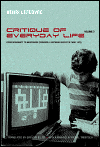 Am I the only one who's getting tired of waiting for the third installment of Lefebvre's Critique of Everyday Life to be released? By chance I happened to check my account on Amazon.com, and found that I had pre-ordered COELvIII almost two-and-a-half years ago! Last I heard, the publisher, Verso, was aiming for a January 2006 release date--which obviously has been pushed back several times already. Given that it's the 27th today, I'm not very optimistic about their chances of getting it out before the month ends. Does anyone have any information on what's delayed the book for so long, or on when it might actually come out? Sigh....
Saturday, January 21, 2006
Say my name
Nobody--understandably--knows how to pronounce my surname, "Striphas." The name's of Greek origin, but it's been Anglicized like nobody's business. The worst pronunciation I ever heard occurred when I was a small boy, at my pediatrician's office. I remember the nurse calling out, "Ted 'Strip-ass?'" It was, needless to say, embarrassing.
So, drawing some inspiration from Siva Vaidhyanathan's blog, I decided to add a link (at right) to an mp3 file of me saying my name. I'm sure people still will get it wrong, and that's okay, since maybe a few more people will get it right.
All together now....
So, drawing some inspiration from Siva Vaidhyanathan's blog, I decided to add a link (at right) to an mp3 file of me saying my name. I'm sure people still will get it wrong, and that's okay, since maybe a few more people will get it right.
All together now....
Thursday, January 19, 2006
Pieces of Shatner
Here I am, writing about the problem with "presence" and "traces," only to hear the latest story about actor William Shatner (of Star Trek, and more recently of Boston Legal, fame). Apparently he auctioned off a kidney stone (yes, thankfully, it had been passed) for US$10,000. He donated the proceeds of the sale to Habitat for Humanity, a charitable organization that builds homes for the needy.
Let's just hope he never needs to have a whole kidney removed.
Let's just hope he never needs to have a whole kidney removed.
Sunday, January 15, 2006
The first rule of cultural studies
I realize it's been awhile since I last posted. As I mentioned in an earlier post, I'm in the process of writing my book about changes in the US and global book industries. I "reward" myself for a good writing week with blogging. I know, I know--it sounds incredibly masochistic to reward intensive writing with more writing, but I guess that's what having a passion for writing means. Anyway, I'm here because I've made progress.
The January 6, 2006 issue of The Chronicle of Higher Education contained a cartoon on p. B6 of the review section. I wish I could reproduce it here, but because of copyright considerations I'm sure I'd get my butt whupped (though it arguably could fall under the "criticism" proviso of the US fair use exception, but that's another story...). Anyway, it depicts two Sex & the City-ish women in what appears to be an upscale bistro, sipping martinis. Both look rather wealthy and aloof. The caption? "What happens in Cultural Studies stays in Cultural Studies."
I'm not sure what to do with this. On the one hand, I couldn't help but laugh, mainly because I cannot understand why people make such a big deal about why cultural studies (I don't use capital letters) has a specialized language. Doesn't anthropology? Mathematics? Physics? Literary studies? So why single out cultural studies--yet again--to suggest it's some kind of insular and exclusive (fight?) club? Given its pervasiveness in the humanities, why are these kinds of criticisms still circulating?
Maybe I'm just being too sensitive. At least the cartoon foregrounds two women, and as we all know women too often are under-represented at all levels of academe, in cultural studies or otherwise. On the other hand, there's a clear sense in which the cartoon seems to be suggesting that cultural studies is, at the end of the day, a martini-sipping, petit bourgeois discipline.
What do you think about this?
The January 6, 2006 issue of The Chronicle of Higher Education contained a cartoon on p. B6 of the review section. I wish I could reproduce it here, but because of copyright considerations I'm sure I'd get my butt whupped (though it arguably could fall under the "criticism" proviso of the US fair use exception, but that's another story...). Anyway, it depicts two Sex & the City-ish women in what appears to be an upscale bistro, sipping martinis. Both look rather wealthy and aloof. The caption? "What happens in Cultural Studies stays in Cultural Studies."
I'm not sure what to do with this. On the one hand, I couldn't help but laugh, mainly because I cannot understand why people make such a big deal about why cultural studies (I don't use capital letters) has a specialized language. Doesn't anthropology? Mathematics? Physics? Literary studies? So why single out cultural studies--yet again--to suggest it's some kind of insular and exclusive (fight?) club? Given its pervasiveness in the humanities, why are these kinds of criticisms still circulating?
Maybe I'm just being too sensitive. At least the cartoon foregrounds two women, and as we all know women too often are under-represented at all levels of academe, in cultural studies or otherwise. On the other hand, there's a clear sense in which the cartoon seems to be suggesting that cultural studies is, at the end of the day, a martini-sipping, petit bourgeois discipline.
What do you think about this?
Saturday, January 07, 2006
How to do things with words
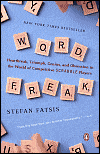 I have two confessions to make. First, I'm addicted to Scrabble(TM). Second, I'm not particularly good at it. I think I've scored over 400 points only a couple of times, and cracking 300 still constitutes a good game for me.
Nevertheless, because I'm fascinated with the game and with words more generally, I was given a copy of Stefan Fatsis's book Word Freak: Heartbreak, Triumph, Genius, and Obsession in the World of Competitive Scrabble Players (Penguin, 2002). The book offers a thoughtful, observant look into the history of the popular board game and into the lives of key figures who make up the world of competitive Scrabble play. It also contains some interesting bits about how players and Hasbro (Scrabble's current owner) have struggled for control of the game. Players, if nothing else, have been instrumental in developing dictionaries, strategy sheets, and more, in effect adding value to a game whose trademark is coveted by, and produces significant profit for, its corporate parent.
Though the book only mentions this in passing, I'm intrigued by the fact that some of the best English-language Scrabble players in the world are individuals who barely know English. I read more about this phenomenon in an article published recently in The Chronicle of Higher Education, which profiled a Thai Scrabble player scheduled to compete in--and favored to win--the 2005 World Championship. Though he did not ultimately win the tournament, his success at the game raises interesting questions about the semiotic dimensions of language. In the world of Scrabble, meaning apparently is a hindrance, as Fatsis's book shows even of native English-language speakers. Those who know what words mean, or who try to play interesting, cheeky words to demonstrate their intelligence or command of language, often are among the worst competitive Scrabble players. (Yes--that's me.)
Those who succeed at Scrabble know how to do things with words, to recall J. L. Austin's memorable phrase, rather than getting bogged down in the depths of meaning and symbolicity. Scrabble is a game about words, power, space, and, yes, chance, this despite its being passed off by the uninitiated (and Hasbro) simply as a "word game." As competitive Scrabble players will tell you, theirs is a game they think ought to be on par with chess, Parcheesi, go, and other games valorized for their intellectual and philosophical dimensions. I'm beginning to agree.
Friday, January 06, 2006
Sly & the family Stallone
From the annals of strange intellectual property disputes...
I just read a short blurb in Newsweek magazine about action star Sylvester Stallone's most recent venture, a health and fitness magazine for 50-something men called Sly (always a creative force to be reckoned with, that Mr. Stallone). The funny thing is, Sly--both the actor and the mag--were sued by an internet publication for shoe fetishists bearing the same name. The judge ruled in the actor's favor, saying that the potential for confusion between the two mags was minimal.
Sly indeed.
I just read a short blurb in Newsweek magazine about action star Sylvester Stallone's most recent venture, a health and fitness magazine for 50-something men called Sly (always a creative force to be reckoned with, that Mr. Stallone). The funny thing is, Sly--both the actor and the mag--were sued by an internet publication for shoe fetishists bearing the same name. The judge ruled in the actor's favor, saying that the potential for confusion between the two mags was minimal.
Sly indeed.
Fishing expedition
Yikes--it's been a few weeks since my last post. (Now doesn't that sound confessional?) Sorry for not keeping things fresher. The holidays got the better of me, and I'm only now getting caught up. Ironic, isn't it, how much work goes into--and comes out of--trying to take a little break? Sigh.
Anyway, I have a teaching leave this semester. With it I'm gearing up to complete my book manuscript about how the book industry changed (and remained the same) in the 20th and 21st centuries, Equipment for Living: Everyday Book Culture in the Late Age of Print. You can read more about the book by clicking on this link to my website: http://www.indiana.edu/~bookworm/research.html.
I'm writing today because I'm bogged down in historical minutiae--important historical minutiae. More specifically, I'm in the process of researching two figures who, I imagine, most of you have never heard of but who nonetheless were key shapers of the book industry we now know: Charles Montgomery (C.M.) Barnes, one of the progenitors of the Barnes & Noble bookselling chain; and Orion Howard (O.H.) Cheney, who conducted the first systematic economic survey of the book industry's structure and functioning.
I know it's a long, long, longshot, but if any of you reading this have any information on these fellows, or know of good sources that might turn up some leads, I'd appreciate hearing from you. You will, of course, get an acknowledgment in my book!
Happy New Year to all of you reading D & R. More to come. . . .
Anyway, I have a teaching leave this semester. With it I'm gearing up to complete my book manuscript about how the book industry changed (and remained the same) in the 20th and 21st centuries, Equipment for Living: Everyday Book Culture in the Late Age of Print. You can read more about the book by clicking on this link to my website: http://www.indiana.edu/~bookworm/research.html.
I'm writing today because I'm bogged down in historical minutiae--important historical minutiae. More specifically, I'm in the process of researching two figures who, I imagine, most of you have never heard of but who nonetheless were key shapers of the book industry we now know: Charles Montgomery (C.M.) Barnes, one of the progenitors of the Barnes & Noble bookselling chain; and Orion Howard (O.H.) Cheney, who conducted the first systematic economic survey of the book industry's structure and functioning.
I know it's a long, long, longshot, but if any of you reading this have any information on these fellows, or know of good sources that might turn up some leads, I'd appreciate hearing from you. You will, of course, get an acknowledgment in my book!
Happy New Year to all of you reading D & R. More to come. . . .
Subscribe to:
Posts (Atom)