Monday, January 30, 2006
Lawrence Grossberg live
Early last November, I wrote about Lawrence Grossberg's book Caught in the Crossfire: Kids, Politics, and America's Future, and made a plea for people to read it. I hope people have been reading it, since it's a significant piece of scholarship. As a follow up to that post, I thought D&R readers might be interested in the latest issue of Bad Subjects, in which Jonathan Sterne interviews Grossberg about the book. It's an excellent interview (kudos, Jonathan), because it revisits Caught in the Crossfire's key themes and insights, extends them, and provides useful context on the book's genesis. Check it out.


Friday, January 27, 2006
When?
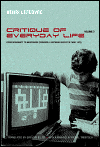 Am I the only one who's getting tired of waiting for the third installment of Lefebvre's Critique of Everyday Life to be released? By chance I happened to check my account on Amazon.com, and found that I had pre-ordered COELvIII almost two-and-a-half years ago! Last I heard, the publisher, Verso, was aiming for a January 2006 release date--which obviously has been pushed back several times already. Given that it's the 27th today, I'm not very optimistic about their chances of getting it out before the month ends. Does anyone have any information on what's delayed the book for so long, or on when it might actually come out? Sigh....
Saturday, January 21, 2006
Say my name
Nobody--understandably--knows how to pronounce my surname, "Striphas." The name's of Greek origin, but it's been Anglicized like nobody's business. The worst pronunciation I ever heard occurred when I was a small boy, at my pediatrician's office. I remember the nurse calling out, "Ted 'Strip-ass?'" It was, needless to say, embarrassing.
So, drawing some inspiration from Siva Vaidhyanathan's blog, I decided to add a link (at right) to an mp3 file of me saying my name. I'm sure people still will get it wrong, and that's okay, since maybe a few more people will get it right.
All together now....
So, drawing some inspiration from Siva Vaidhyanathan's blog, I decided to add a link (at right) to an mp3 file of me saying my name. I'm sure people still will get it wrong, and that's okay, since maybe a few more people will get it right.
All together now....
Thursday, January 19, 2006
Pieces of Shatner
Here I am, writing about the problem with "presence" and "traces," only to hear the latest story about actor William Shatner (of Star Trek, and more recently of Boston Legal, fame). Apparently he auctioned off a kidney stone (yes, thankfully, it had been passed) for US$10,000. He donated the proceeds of the sale to Habitat for Humanity, a charitable organization that builds homes for the needy.
Let's just hope he never needs to have a whole kidney removed.
Let's just hope he never needs to have a whole kidney removed.
Sunday, January 15, 2006
The first rule of cultural studies
I realize it's been awhile since I last posted. As I mentioned in an earlier post, I'm in the process of writing my book about changes in the US and global book industries. I "reward" myself for a good writing week with blogging. I know, I know--it sounds incredibly masochistic to reward intensive writing with more writing, but I guess that's what having a passion for writing means. Anyway, I'm here because I've made progress.
The January 6, 2006 issue of The Chronicle of Higher Education contained a cartoon on p. B6 of the review section. I wish I could reproduce it here, but because of copyright considerations I'm sure I'd get my butt whupped (though it arguably could fall under the "criticism" proviso of the US fair use exception, but that's another story...). Anyway, it depicts two Sex & the City-ish women in what appears to be an upscale bistro, sipping martinis. Both look rather wealthy and aloof. The caption? "What happens in Cultural Studies stays in Cultural Studies."
I'm not sure what to do with this. On the one hand, I couldn't help but laugh, mainly because I cannot understand why people make such a big deal about why cultural studies (I don't use capital letters) has a specialized language. Doesn't anthropology? Mathematics? Physics? Literary studies? So why single out cultural studies--yet again--to suggest it's some kind of insular and exclusive (fight?) club? Given its pervasiveness in the humanities, why are these kinds of criticisms still circulating?
Maybe I'm just being too sensitive. At least the cartoon foregrounds two women, and as we all know women too often are under-represented at all levels of academe, in cultural studies or otherwise. On the other hand, there's a clear sense in which the cartoon seems to be suggesting that cultural studies is, at the end of the day, a martini-sipping, petit bourgeois discipline.
What do you think about this?
The January 6, 2006 issue of The Chronicle of Higher Education contained a cartoon on p. B6 of the review section. I wish I could reproduce it here, but because of copyright considerations I'm sure I'd get my butt whupped (though it arguably could fall under the "criticism" proviso of the US fair use exception, but that's another story...). Anyway, it depicts two Sex & the City-ish women in what appears to be an upscale bistro, sipping martinis. Both look rather wealthy and aloof. The caption? "What happens in Cultural Studies stays in Cultural Studies."
I'm not sure what to do with this. On the one hand, I couldn't help but laugh, mainly because I cannot understand why people make such a big deal about why cultural studies (I don't use capital letters) has a specialized language. Doesn't anthropology? Mathematics? Physics? Literary studies? So why single out cultural studies--yet again--to suggest it's some kind of insular and exclusive (fight?) club? Given its pervasiveness in the humanities, why are these kinds of criticisms still circulating?
Maybe I'm just being too sensitive. At least the cartoon foregrounds two women, and as we all know women too often are under-represented at all levels of academe, in cultural studies or otherwise. On the other hand, there's a clear sense in which the cartoon seems to be suggesting that cultural studies is, at the end of the day, a martini-sipping, petit bourgeois discipline.
What do you think about this?
Saturday, January 07, 2006
How to do things with words
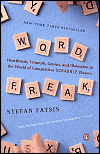 I have two confessions to make. First, I'm addicted to Scrabble(TM). Second, I'm not particularly good at it. I think I've scored over 400 points only a couple of times, and cracking 300 still constitutes a good game for me.
Nevertheless, because I'm fascinated with the game and with words more generally, I was given a copy of Stefan Fatsis's book Word Freak: Heartbreak, Triumph, Genius, and Obsession in the World of Competitive Scrabble Players (Penguin, 2002). The book offers a thoughtful, observant look into the history of the popular board game and into the lives of key figures who make up the world of competitive Scrabble play. It also contains some interesting bits about how players and Hasbro (Scrabble's current owner) have struggled for control of the game. Players, if nothing else, have been instrumental in developing dictionaries, strategy sheets, and more, in effect adding value to a game whose trademark is coveted by, and produces significant profit for, its corporate parent.
Though the book only mentions this in passing, I'm intrigued by the fact that some of the best English-language Scrabble players in the world are individuals who barely know English. I read more about this phenomenon in an article published recently in The Chronicle of Higher Education, which profiled a Thai Scrabble player scheduled to compete in--and favored to win--the 2005 World Championship. Though he did not ultimately win the tournament, his success at the game raises interesting questions about the semiotic dimensions of language. In the world of Scrabble, meaning apparently is a hindrance, as Fatsis's book shows even of native English-language speakers. Those who know what words mean, or who try to play interesting, cheeky words to demonstrate their intelligence or command of language, often are among the worst competitive Scrabble players. (Yes--that's me.)
Those who succeed at Scrabble know how to do things with words, to recall J. L. Austin's memorable phrase, rather than getting bogged down in the depths of meaning and symbolicity. Scrabble is a game about words, power, space, and, yes, chance, this despite its being passed off by the uninitiated (and Hasbro) simply as a "word game." As competitive Scrabble players will tell you, theirs is a game they think ought to be on par with chess, Parcheesi, go, and other games valorized for their intellectual and philosophical dimensions. I'm beginning to agree.
Friday, January 06, 2006
Sly & the family Stallone
From the annals of strange intellectual property disputes...
I just read a short blurb in Newsweek magazine about action star Sylvester Stallone's most recent venture, a health and fitness magazine for 50-something men called Sly (always a creative force to be reckoned with, that Mr. Stallone). The funny thing is, Sly--both the actor and the mag--were sued by an internet publication for shoe fetishists bearing the same name. The judge ruled in the actor's favor, saying that the potential for confusion between the two mags was minimal.
Sly indeed.
I just read a short blurb in Newsweek magazine about action star Sylvester Stallone's most recent venture, a health and fitness magazine for 50-something men called Sly (always a creative force to be reckoned with, that Mr. Stallone). The funny thing is, Sly--both the actor and the mag--were sued by an internet publication for shoe fetishists bearing the same name. The judge ruled in the actor's favor, saying that the potential for confusion between the two mags was minimal.
Sly indeed.
Fishing expedition
Yikes--it's been a few weeks since my last post. (Now doesn't that sound confessional?) Sorry for not keeping things fresher. The holidays got the better of me, and I'm only now getting caught up. Ironic, isn't it, how much work goes into--and comes out of--trying to take a little break? Sigh.
Anyway, I have a teaching leave this semester. With it I'm gearing up to complete my book manuscript about how the book industry changed (and remained the same) in the 20th and 21st centuries, Equipment for Living: Everyday Book Culture in the Late Age of Print. You can read more about the book by clicking on this link to my website: http://www.indiana.edu/~bookworm/research.html.
I'm writing today because I'm bogged down in historical minutiae--important historical minutiae. More specifically, I'm in the process of researching two figures who, I imagine, most of you have never heard of but who nonetheless were key shapers of the book industry we now know: Charles Montgomery (C.M.) Barnes, one of the progenitors of the Barnes & Noble bookselling chain; and Orion Howard (O.H.) Cheney, who conducted the first systematic economic survey of the book industry's structure and functioning.
I know it's a long, long, longshot, but if any of you reading this have any information on these fellows, or know of good sources that might turn up some leads, I'd appreciate hearing from you. You will, of course, get an acknowledgment in my book!
Happy New Year to all of you reading D & R. More to come. . . .
Anyway, I have a teaching leave this semester. With it I'm gearing up to complete my book manuscript about how the book industry changed (and remained the same) in the 20th and 21st centuries, Equipment for Living: Everyday Book Culture in the Late Age of Print. You can read more about the book by clicking on this link to my website: http://www.indiana.edu/~bookworm/research.html.
I'm writing today because I'm bogged down in historical minutiae--important historical minutiae. More specifically, I'm in the process of researching two figures who, I imagine, most of you have never heard of but who nonetheless were key shapers of the book industry we now know: Charles Montgomery (C.M.) Barnes, one of the progenitors of the Barnes & Noble bookselling chain; and Orion Howard (O.H.) Cheney, who conducted the first systematic economic survey of the book industry's structure and functioning.
I know it's a long, long, longshot, but if any of you reading this have any information on these fellows, or know of good sources that might turn up some leads, I'd appreciate hearing from you. You will, of course, get an acknowledgment in my book!
Happy New Year to all of you reading D & R. More to come. . . .
Monday, December 19, 2005
Open society (warning: "subversive" content follows!)
I was just forwarded this article about an undergraduate student at the University of Massachusetts-Dartmouth. Apparently, agents from the US Department of Homeland Security paid him a visit, after he had checked out a copy of Mao's "Little Red Book" through the library's inter-library loan service. Ironically, the student had requested the book so that he could write a paper about the dangers of totalitarianism.
Though I've been aware of US librarians' efforts to safeguard patrons' borrowing information, I hadn't caught wind of the fact that some, clearly, aren't doing so. I'm chilled further by the fact that this occurred through a university library's borrowing program. I happen to work at a university, and I suspect many of you reading D&R do, too.
I read the aforementioned article with a sense that things have changed here in the US--particularly since the coming online of the USA Patriot Act (a painfully laughable name for such a pernicious piece of legislation). It's clear that there's a growing climate of fear here among intellectuals, and no doubt others, too. Yet, I am forced to remind myself how intellectuals have been persecuted for decades, even centuries, around the world for just these kinds of activities, often by more than just a "visit" by local security agents. I also am compelled to reflect on the fact that I came of age at a relatively safe, and thus privileged, time in the US academy, when nobody seemed to care if you checked out a copy of Mao's "Little Red Book," Marx and Engels' "Communist Manifesto," or some other politically charged ("unpatriotic") piece of writing.
I suppose, ultimately, the article I've linked to is very clarifying. It underscores the stakes of doing meaningful, engaged intellectual work at a time when it's unpopular (from the government's standpoint) to dissent. Visits by homeland security for checking out Mao's "Little Red Book?" Those clearly must stop--and the climate of fear and intimidation that goes along with them.
P.S. If you decide to comment, watch what you say. "They" may be reading, too. . . .
Though I've been aware of US librarians' efforts to safeguard patrons' borrowing information, I hadn't caught wind of the fact that some, clearly, aren't doing so. I'm chilled further by the fact that this occurred through a university library's borrowing program. I happen to work at a university, and I suspect many of you reading D&R do, too.
I read the aforementioned article with a sense that things have changed here in the US--particularly since the coming online of the USA Patriot Act (a painfully laughable name for such a pernicious piece of legislation). It's clear that there's a growing climate of fear here among intellectuals, and no doubt others, too. Yet, I am forced to remind myself how intellectuals have been persecuted for decades, even centuries, around the world for just these kinds of activities, often by more than just a "visit" by local security agents. I also am compelled to reflect on the fact that I came of age at a relatively safe, and thus privileged, time in the US academy, when nobody seemed to care if you checked out a copy of Mao's "Little Red Book," Marx and Engels' "Communist Manifesto," or some other politically charged ("unpatriotic") piece of writing.
I suppose, ultimately, the article I've linked to is very clarifying. It underscores the stakes of doing meaningful, engaged intellectual work at a time when it's unpopular (from the government's standpoint) to dissent. Visits by homeland security for checking out Mao's "Little Red Book?" Those clearly must stop--and the climate of fear and intimidation that goes along with them.
P.S. If you decide to comment, watch what you say. "They" may be reading, too. . . .
Tuesday, December 13, 2005
On beyond Deleuze & Guattari, redux
My November 27th entry, "On beyond Deleuze & Guattari," concerned the dynamic duo and various practices by which to engage their philosophical work. It turns out that Jonathan Sterne picked this piece up on his Blog, "Super Bon!" and extended the discussion into a broader--and very smart--engagement with theory. Check it out.
Jonathan makes several good points, but at least two are worth mentioning within the context of my foregoing discussion. First, he adds a category to my framework, which he calls "commentary." A lot of what passes for "theory," he notes, amounts to little more than one's flatly discussing the theoretical work of others. Second, he notes that what I (ahem, dismissively) refer to as "rhizome spotting" indeed can be an important step in building and extending one's own theoretical work, as in the case of Paul Gilroy's parlaying the notion of a rhizome into a compelling formulation of countermodernity and the Black Atlantic. I couldn't agree more--and thanks, Jonathan, for helping me to fine tune what was, admittedly, a cursory set of musings on philosophy and the politics of doing theory.
On an unrelated note, it's finals time here and the you-know-what's hitting the fan. My posts, as a result, may be fewer and farther between for awhile.
Jonathan makes several good points, but at least two are worth mentioning within the context of my foregoing discussion. First, he adds a category to my framework, which he calls "commentary." A lot of what passes for "theory," he notes, amounts to little more than one's flatly discussing the theoretical work of others. Second, he notes that what I (ahem, dismissively) refer to as "rhizome spotting" indeed can be an important step in building and extending one's own theoretical work, as in the case of Paul Gilroy's parlaying the notion of a rhizome into a compelling formulation of countermodernity and the Black Atlantic. I couldn't agree more--and thanks, Jonathan, for helping me to fine tune what was, admittedly, a cursory set of musings on philosophy and the politics of doing theory.
On an unrelated note, it's finals time here and the you-know-what's hitting the fan. My posts, as a result, may be fewer and farther between for awhile.
Thursday, December 08, 2005
I don't know why-pod
Okay, I'll admit that (a) I'm privileged enough to own an Apple iPod and (b) that I enjoy using it a great deal. I'll also say that I have one of the earlier-generation models--not one of the newer, fancier ones with colors, video screens, and gargantuan hard drives, but a more modest one with room enough for a modest music collection.
I'm intrigued--and disturbed--by Apple's recent decision to start selling television programs for use on iPods for US$1.99. I suppose the price is cheap enough if you have a video-capable iPod, and, besides, it's nice to have an opportunity to view a favorite show on demand. But in my more Orwellian moments, I have this vision of already expensive pay-for television getting even more expensive. I currently pay about US$50/month for basic cable television services. Now imagine a world in which typical television services (off-air, cable, and satellite) have been replaced by subscriptions to iPod/iTunes-distributed TV. Figuring that a typical TV program in the U.S. runs about 22 episodes per season, that would mean an annual subscription to any given program would set you back about US$44 (assuming no subscriber discounts, which would result in commercials getting spliced back into the programs). That's almost the cost of my monthly cable bill, and that's just for the right to download a single season of a single program.
Apple's decision to distribute TV programming through its iPod/iTunes service is genius--in that devilish, capitalist kind of way. Assuming the service catches on, the potential economic windfall for both the TV producers and for Apple could be astonishing. Of course, their astonishing revenue stream very well could mean emptier pockets for those of us on the receiving end of things.
I'm intrigued--and disturbed--by Apple's recent decision to start selling television programs for use on iPods for US$1.99. I suppose the price is cheap enough if you have a video-capable iPod, and, besides, it's nice to have an opportunity to view a favorite show on demand. But in my more Orwellian moments, I have this vision of already expensive pay-for television getting even more expensive. I currently pay about US$50/month for basic cable television services. Now imagine a world in which typical television services (off-air, cable, and satellite) have been replaced by subscriptions to iPod/iTunes-distributed TV. Figuring that a typical TV program in the U.S. runs about 22 episodes per season, that would mean an annual subscription to any given program would set you back about US$44 (assuming no subscriber discounts, which would result in commercials getting spliced back into the programs). That's almost the cost of my monthly cable bill, and that's just for the right to download a single season of a single program.
Apple's decision to distribute TV programming through its iPod/iTunes service is genius--in that devilish, capitalist kind of way. Assuming the service catches on, the potential economic windfall for both the TV producers and for Apple could be astonishing. Of course, their astonishing revenue stream very well could mean emptier pockets for those of us on the receiving end of things.
Saturday, December 03, 2005
Cap codes...?
A student in my graduate seminar wants to write a paper on cap codes. What's a cap code, you ask? Well, that's the problem. Very few people seem to be talking about them, at least publicly. Here's a link to a short entry on cap codes on Wikipedia.
Apparently cap codes are small, unique, visible sets of symbols that the Hollywood movie studios now encode onto film prints. They're sort of like the flashes that used to indicate upcoming reel changes to projectionists. In this case, however, the codes identify which cinema a specific print has been sent to. The point of cap coding is to forestall movie piracy--or, at the very least, to help the studios identify which exhibition hall is responsible for letting an illicit duplicate leave the theather and thus to track down alleged "pirates."
My student tells me that the phenomenon of cap coding is fairly widespread, but most everyone involved--the theaters, the trade magazines, the studios, etc.--are pretty hush-hush about the practice. Anyone out there know anything about this or have any leads? Conspiracy theorists are, of course, welcome to chime in, too.
Apparently cap codes are small, unique, visible sets of symbols that the Hollywood movie studios now encode onto film prints. They're sort of like the flashes that used to indicate upcoming reel changes to projectionists. In this case, however, the codes identify which cinema a specific print has been sent to. The point of cap coding is to forestall movie piracy--or, at the very least, to help the studios identify which exhibition hall is responsible for letting an illicit duplicate leave the theather and thus to track down alleged "pirates."
My student tells me that the phenomenon of cap coding is fairly widespread, but most everyone involved--the theaters, the trade magazines, the studios, etc.--are pretty hush-hush about the practice. Anyone out there know anything about this or have any leads? Conspiracy theorists are, of course, welcome to chime in, too.
Thursday, December 01, 2005
Naturalism in Lefebvre
If it's not abundantly clear by now, I'm a big admirer of Henri Lefebvre, particularly his writings on everyday life. Obviously, I'm also taken by his understanding of the relationship of everyday life and repetition, or better yet the relationship of everyday life and two forms of repetition: a deadened repetition of the Same and a more open, vital form of repetition in which the act of repeating holds forth possibilities for creation, improvisation, and change.
I'm struggling, though, with the scant examples he gives of the latter form of repetition. My favorite, which I quoted in my entry, "Why do I write?" concerns the sense of promise and wonderment one might receive from watching the sun rise. This example speaks, I think, to a persistent naturalism in Lefebvre, as though the kind of repetition to which we ought to be striving is a cosmic one that's intimately connected with the heavens and the earth. I wonder if that kind of "return," for lack of a better word, is tenable in (post-)industrial societies? Is there, perhaps, a less naturalistic form of repetition that also might open pathways for change?
I'm struggling, though, with the scant examples he gives of the latter form of repetition. My favorite, which I quoted in my entry, "Why do I write?" concerns the sense of promise and wonderment one might receive from watching the sun rise. This example speaks, I think, to a persistent naturalism in Lefebvre, as though the kind of repetition to which we ought to be striving is a cosmic one that's intimately connected with the heavens and the earth. I wonder if that kind of "return," for lack of a better word, is tenable in (post-)industrial societies? Is there, perhaps, a less naturalistic form of repetition that also might open pathways for change?
Sunday, November 27, 2005
On beyond Deleuze & Guattari
In conjunction with the students in my graduate seminar, and in conversation with my fellow NCA panelists (see my post on Nov. 21, 2005, below), I've been wondering lately what it would mean to take up the writings of Deleuze & Guattari. As far as I can tell, there are or have been five principal modes of engaging their work:
(1) What I like to call, "rhizome spotting." Here, the analyst tries to find evidence of Deleuzoguattarian concepts at work in the world.
(2) Applications. In this case, the analyst takes up one or more Deleuzoguattarian concepts and "applies" them to an empirical object.
(3) Operationalizing/extending Deleuze & Guattari's work. A lot of interesting work operates at this level. Here, the analyst engages the work of Deleuze and Guattari and makes their work resonate with one or more empirical objects. Often this results in some kind of extension or elaboration of Deleuzoguattarian thought.
(4) Reading what Deleuze and Guattari have read and extending their work therefrom. My sense is that Brian Massumi and Greg Seigworth tend to engage in this kind of practice, as in, for example, where Seigworth reads Freud's early texts for evidence of the ways in which he sublimated affect.
(5) Implicit dialogue. I'm most tentative about this category, but I've long felt that people like Giorgio Agamben and Jean-Luc Nancy take up Deleuzoguattarian ideas without mentioning D+G's work explicitly. For example, both Agamben's "The Coming Community" and Nancy's "The Inoperative Community" seem to be responses of sorts to the Deleuzoguattarian insight, "the people are missing."
Obviously these aren't neat and tidy categories, and some very well may disagree with my categorizations or the way in which I've identified the work of specific authors relative to that of D+G. It also should be clear that there's something of a hierarchy here, and that I do not believe that the first few modes of engagement are particularly Deleuzoguattarian--at least in any interesting way. I'd be curious to hear how others feel about this schema.
(1) What I like to call, "rhizome spotting." Here, the analyst tries to find evidence of Deleuzoguattarian concepts at work in the world.
(2) Applications. In this case, the analyst takes up one or more Deleuzoguattarian concepts and "applies" them to an empirical object.
(3) Operationalizing/extending Deleuze & Guattari's work. A lot of interesting work operates at this level. Here, the analyst engages the work of Deleuze and Guattari and makes their work resonate with one or more empirical objects. Often this results in some kind of extension or elaboration of Deleuzoguattarian thought.
(4) Reading what Deleuze and Guattari have read and extending their work therefrom. My sense is that Brian Massumi and Greg Seigworth tend to engage in this kind of practice, as in, for example, where Seigworth reads Freud's early texts for evidence of the ways in which he sublimated affect.
(5) Implicit dialogue. I'm most tentative about this category, but I've long felt that people like Giorgio Agamben and Jean-Luc Nancy take up Deleuzoguattarian ideas without mentioning D+G's work explicitly. For example, both Agamben's "The Coming Community" and Nancy's "The Inoperative Community" seem to be responses of sorts to the Deleuzoguattarian insight, "the people are missing."
Obviously these aren't neat and tidy categories, and some very well may disagree with my categorizations or the way in which I've identified the work of specific authors relative to that of D+G. It also should be clear that there's something of a hierarchy here, and that I do not believe that the first few modes of engagement are particularly Deleuzoguattarian--at least in any interesting way. I'd be curious to hear how others feel about this schema.
Thursday, November 24, 2005
Happy (US) Thanksgiving
Though I'm not a vegetarian, I thought, given the US Thanksgiving Holiday, that linking to the Meatrix might be appropriate. Check it out.
Tuesday, November 22, 2005
Coming soon
 I just updated my website with this information, but I figured it would be worthwhile to post the information to D&R as well. Kembrew McLeod, a colleague at the University of Iowa, and I are editing a special issue of the journal "Cultural Studies" on the politics of intellectual properties. It should be coming out either in February or April, 2006, assuming all goes well on the production-end of things. In the meantime, here's the table of contents. It's a fantastic issue.
(1) Ted Striphas & Kembrew McLeod, “Introduction—Strategic Improprieties: Cultural Studies, the Everyday, and Intellectual Property Law"
(2) Adrian Johns, "Intellectual Property and the Nature of Science"
(3) McKenzie Wark, "Information Wants to be Free (But is Everywhere in Chains)"
(4) Andrew Herman, Rosemary J. Coombe, & Lewis Kaye, "Your Second Life? Goodwill and the Performativity of Intellectual Properties in On-Line Games"
(5) Steve Jones, "Reality© and Virtual Reality©: When Virtual and Real Worlds Collide"
(6) Jane Gaines, "Early Cinema, Heyday of Copying: The Too Many Copies of L'’arroseur arose"
(7) Gilbert B. Rodman & Cheyanne Vanderdonckt, "Music for Nothing or, I Want My MP3: The Regulation and Recirculation of Affect"
(8) David Sanjek, "Ridiculing the 'White Bread Original': The Politics of Parody and Preservation of Greatness in Luther Campbell a.k.a. Luke Skyywalker et al. v. Acuff-Rose Music, Inc."
(9) Eva Hemmungs Wirten, “Out of Sight and Out of Mind: On the Cultural Hegemony of Intellectual Property (Critique)"
(10) Siva Vaidhyanathan, “Afterword—Critical Information Studies: A Bibliographic Manifesto”
Monday, November 21, 2005
"Media effects without cause & effect"
I just returned from the National Communication Association's (US) annual convention in Boston, Massachusetts. It consisted, as usual, of a wide range of work; most of it was uninteresting, though a few papers and sessions stood out. One panel to which I contributed was called, "Communication in a Deleuze-Guattarian Framework: Image-Event, Deterritorialization, Difference, Assemblage." My piece, "Difference & Repetition in Harry Potter," was on the popular book series' relationship to philosophy and intellectual property law, and is a much-distilled fragment of a chapter I'm working on for my book on book culture, "Equipment for Living." I was joined by co-panelists Gordon Coonfield (Villanova U), session organizer (thank you!) Mehdi Semati (Eastern Illinois U), Greg Wise (Arizona State U-West), and respondent Greg Seigworth (Millersville U).
I have a couple of things to say: first, our session was programmed opposite of Ernesto Laclau talking about Lacan, which meant that a lot of our potential audience (understandably) got siphoned off. On top of that, though, our session was located literally in the hinterlands of one of the conference hotels: at the very end of a long, dark, circuitous hallway near an emergency exit. Perhaps that tells us something about the discipline of communication's relationship to Deleuzoguattarian thought. Sigh.
I enjoyed my co-panelists' presentations immensely, and I'm especially taken with Greg Wise's suggestion that media researchers begin writing about media effects absent the language of cause and effect. I'm not sure what that means, exactly, but it's a provocative idea that I look forward to trying on. Perhaps others of you have thought through this idea a bit and would care to chime in as well.
I have a couple of things to say: first, our session was programmed opposite of Ernesto Laclau talking about Lacan, which meant that a lot of our potential audience (understandably) got siphoned off. On top of that, though, our session was located literally in the hinterlands of one of the conference hotels: at the very end of a long, dark, circuitous hallway near an emergency exit. Perhaps that tells us something about the discipline of communication's relationship to Deleuzoguattarian thought. Sigh.
I enjoyed my co-panelists' presentations immensely, and I'm especially taken with Greg Wise's suggestion that media researchers begin writing about media effects absent the language of cause and effect. I'm not sure what that means, exactly, but it's a provocative idea that I look forward to trying on. Perhaps others of you have thought through this idea a bit and would care to chime in as well.
Monday, November 14, 2005
REQUIRED reading
 You may be wondering why I keep mentioning books by Deleuze, Guattari, and by those who've been inspired by their work. Partly this has to do with the ambit of "Differences & Repetitions." I'm also teaching a class this term called "The Problem of the Media in Deleuze & Guattari" (see my webpage under "teaching" for a more complete description), so these texts are very much on my mind. I can't help but think--and think publicly--about them.
I have to say, other than the primary works we've been reading, Brian Massumi's "Parables for the Virtual" easily is the most provocative book I've encountered in the class this term. The book's just too imaginative and broad-ranging for me to provide an adequate summary of it here. Suffice it to say that it's just one of only a handful of works that does more than "spot" Deleuzoguattarian concepts in action. In fact, what's marvelous about the book is the way in which it generates concepts all its own, building on, but moving away from, the work of D+G. This I take to be one of the primary injunctions of a deleuzoguattarian critical practice--to draw a line of flight away from their work. The other thing I'll say is how ecumenical and respectful the work is. In chapter two, for instance, Massumi really *listens* to the autobiography of Ronald Reagan, and from it he extracts concepts that would help to explain the devastating success of Reaganism. Most critics simply would dismiss the book as the meandering recollections of an aging B-grade actor.
I'm moved by a lot of what I read, but there's very little that compels me in the way that this book has. It ought to be absolutely, positively required reading for anyone at work in the humanities--or, for that matter, for anyone who wants to imagine (and enact) the possibility of more ethical ways of life.
Wednesday, November 02, 2005
Will the future unfold?
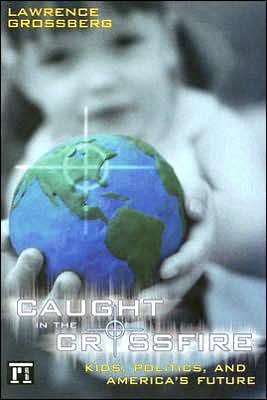 I'm bothered. I'm bothered because more people aren't talking about this book.
I'll put my cards on the table: Lawrence Grossberg was (and always will be) my teacher, my mentor. But that's not why I'm disturbed about the generally quiet reception of his important new book, "Caught in the Crossfire: Kids, Politics, and America's Future" (Paradigm Publishers, 2005). What's even more troubling is the minimal amount of attention that his argument seems to be receiving within the culture at large. The growing crackdown on kids--criminalizing, marginalizing, and otherwise mistreating them--is no more and no less than an attack on the future, Grossberg argues, an attack on "American modernity" itself. If we take seriously what Lefebvre says in the quotation atop this blog, then we should be fearful of the implications of America's war on kids. What would it mean to foreclose on the very possibility of the future, to fold it up so tightly that we no longer can find it amid all the twists, turns, pleats, knots, and layers?
Read this book, promote it, review it (not just in academic journals), and do what you can to engage its empirical and theoretical findings. It would be a cliche (is that so wrong?) to say, "do it for the children." If cliches don't get you going, then why not do it for the future?
P.S. Hey, Paradigm Publishers! Why not activate Amazon.com's "search inside" features for "Caught in the Crossfire," so that people can browse the text online?
Monday, October 31, 2005
Happy Halloween!
 It's funny--I find myself returning to "The Battle for Christmas" (see my post on 9/18, "Tisn't quite the season, but..."), even though it's Halloween. Maybe I'm just unseasonable. But what strikes me about the book's significance to this day--all Hallows Eve--is the remarkable similarity that Halloween used to share with the Christmas holiday. In the 18th and 19th centuries, working class people customarily invaded the homes of elites on or about December 25th, sometimes in costume, demanding sweets and other confections. A failure to produce the goods often resulted in interminable drunken singing, mischief, and even acts of outright vandalism. Christmas was a temporary, carnivalesque reversal of the established social order, the class dynamics of which have been transposed onto the act of children knocking at our doors demanding candy. And in that respect, though I love Halloween, it's hard not to be a little cynical about it. The cutting, critical-edge of many of our most cherished holidays has been blunted by a loss of the historicity of our ways of celebrating (or repeating) them.
Subscribe to:
Posts (Atom)